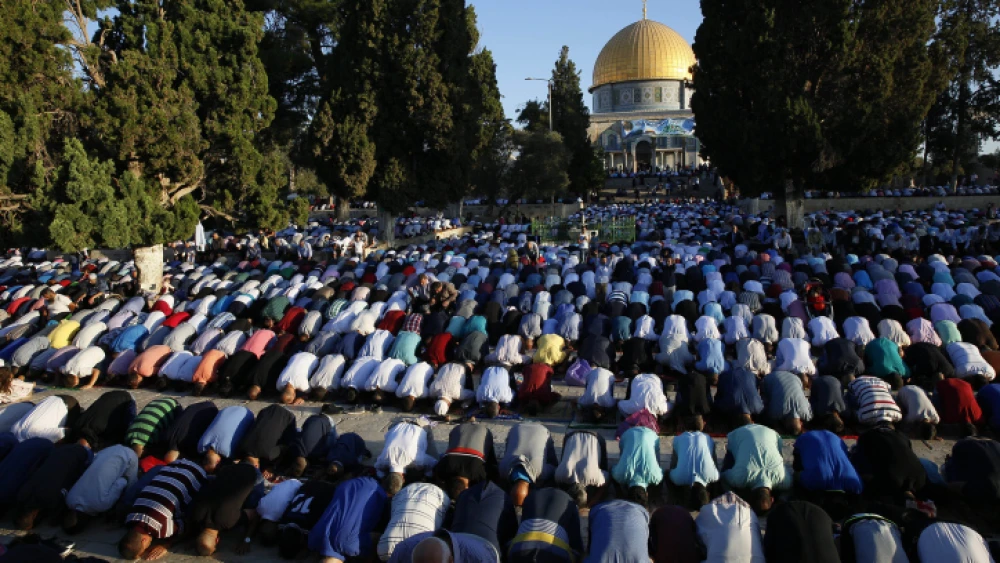
With Israel’s coronavirus numbers on the rise and the government poised to tighten restrictions on the population as a result, the worst-kept secret in the country is that the Temple Mount has turned into a COVID-19 time bomb.
Some 18,000 people crowd into the compound every Friday, many without masks. They infect each other at a dizzying rate. Then they go back to their neighborhoods in eastern Jerusalem or elsewhere, where they infect many more. In eastern Jerusalem, 14 percent of COVID tests are coming back positive. In Issawiya, it’s 17.5 percent, in Kafr Aqab, 23 percent and in the Shuafat refugee camp, a whopping 50 percent. Of the 23 neighborhoods in Jerusalem coded red under the Health Ministry’s “stoplight” plan, 12 of the, which are home to 320,000 people, are Arab.
The high rate of new cases in Jerusalem’s Arab sector is not contained there. Arabs comprise 71 percent of salaried workers in the city’s construction sector and 57 percent of public transportation workers. According to the Jerusalem Institute for Policy Research, in regular times some 35,000 of them work in Jewish neighborhoods.
The Temple Mount has become a hotbed of COVID infection, at a level that is hard to grasp. When we add the crowded housing conditions in Jerusalem’s Arab neighborhoods, where people continue to gather and law enforcement is virtually nonexistent, we get a chain of infection that kills Jews and Arabs alike.
In the face of all this, the Israeli government has decided not to enforce public health laws on the Temple Mount because of its well-known volatility in terms of both politics and security. The National Security Council is spearheading this astonishing policy, over the opinion of medical experts. The minor steps taken with Jordan and the Muslim Waqf have not yielded any significant benefits. Israel allows so many people into the Temple Mount compound that even the masks the Waqf distributes are useless.
There are plenty of other rules and regulations that go unenforced on the Mount, regarding for instance preserving antiquities, regulating construction and against incitement and sedition. Even the law that protects holy sites, which includes prison time for anyone who blocks members of other religions from accessing sites holy to their faith, or speaks offensively about those sites, is ignored.
The Temple Mount is a “hole,” as Israel’s National Coronavirus Project Coordinator Nachman Ash called it—and now it is posing a direct and immediate risk to people’s lives. Continuing to ignore this is like a contractor who builds only half a foundation and allows the other side of a building to sink, knowing that eventually, the entire structure will collapse.
The idea that “there’s nothing we can do” needs to be replaced by some creative thinking. We don’t need to shut down the Temple Mount and outrage the entire Muslim world. We could, for example, fine the Waqf officials thousands of shekels for allowing people into the compound en masse, as well as issue heavy fines to people who violate coronavirus regulations while visiting. In addition to ordering Sheikh Ikrama Sabri, who provokes and incites against Israel, to stay away from the mount, we can do the same for dozens and even hundreds of others who hold positions in the religious mechanisms that operate there. What we must stop doing, as of today, is sitting on our hands.
Nadav Shragai is a veteran Israeli journalist.
This article first appeared in Israel Hayom.