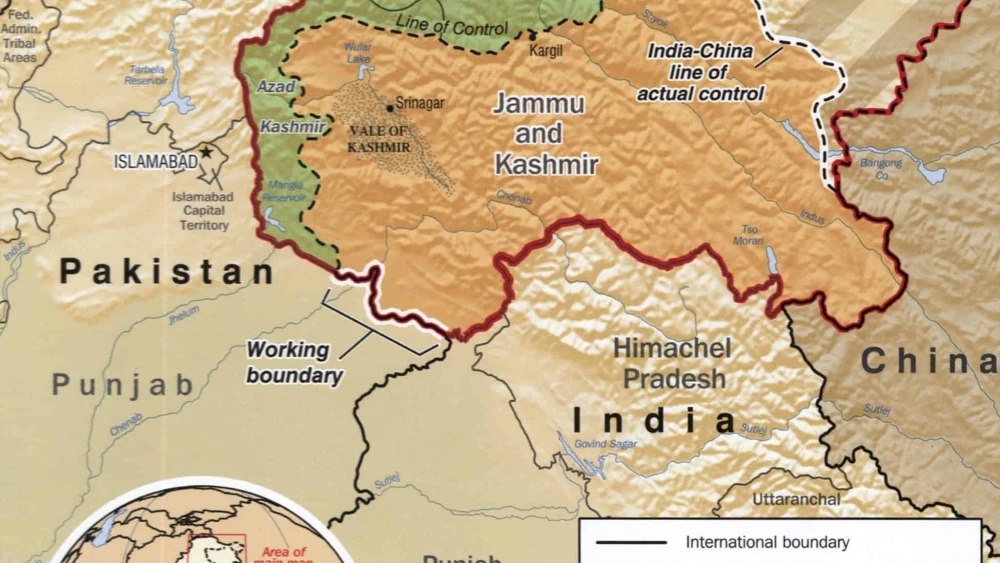

The fight over the Kashmir region has intensified this week with India’s military strikes on Pakistan following the April 22 terror attacks on vacationers in Pahalgam. It has brought the Pakistan-India fight for Kashmir to the fore of the world consciousness as Pakistani-based terror groups took a page out of the Hamas playbook and killed innocent civilians.
Ties between Hamas and Pakistan’s intelligence agencies have grown substantially since the Hamas-led terrorist attacks in southern Israel on Oct. 7, 2023, as the attacks garnered significant attention from Islamists and motivated international terror groups.
Pakistan decided to conduct similar attacks in India, especially in Jammu and Kashmir, to internationalize the Kashmir issue; Pakistan and India have been fighting over the Kashmir region for decades. More importantly, several Hamas delegations have visited Pakistan, and representatives from both groups have met at neutral venues to deepen their ties. This can have profound security implications for India and the international community.
To show their solidarity with the Pakistani military on Kashmir, a delegation of Hamas leaders, including Zaheer Naji and spokesman Khaled Qaddoumi, attended the “Kashmir solidarity day, Hamas operation Al-Aqsa flood conference,” in February. Among the groups that organized the event were the Jammu Kashmir United Movement and Jaish-e-Mohammed (JeM). The event was held in the “Pakistan-occupied Jammu and Kashmir” region.
During the conference, which Hamas participated in to express their solidarity with the “Muslims of Gaza and Kashmir,” several terror commanders delivered anti-India speeches and called on mujahideen (“jihadists”) worldwide to support the “liberation” of Kashmir, which was a direct threat to India.
Just two months later, the Resistance Front, a proxy group of the Islamic terror group Lashkar-e-Tayyiba (LeT), conducted the Pahalgam terror attack, killing 26 Hindu tourists. The modus operandi and targets chosen for the attack exhibit apparent similarities to Hamas’s terror operations against Israeli citizens.
Also, like Hamas, the terrorists recorded videos of their attack, which showed them identifying Hindu tourists, forcing them to recite Islamic verses and using some of the civilians to warn the Indian government of similar attacks against Hindus in the future.
Pakistan has been a key supporter of Hamas and its terror activities against Israel. As the terror group searched for sanctuaries to safeguard its remaining leaders, Pakistan has emerged as one of the top safe destinations for them to hide, as many Arab countries have reportedly refused to do so. Some reports suggest that Pakistan may provide state protection to some senior Hamas leaders in exchange for financial assistance and logistical support for anti-India terror outfits.
Sources indicate that in this quid pro quo arrangement, Pakistan’s military establishment has sought tactical expertise from Hamas for LeT, JeM and other terror groups to conduct religiously motivated attacks in Jammu and Kashmir. Moreover, Pakistan’s intelligence agencies arranged for Hamas leaders to visit the Pakistan-occupied Jammu and Kashmir to encourage and pressure the local population to join the so-called “Kashmir liberation” movement and garner support for the Islamic cause of “Palestine.”
Adding to the conflict, a week before the April attack, Gen. Syed Asim Munir, chief of the army staff of the Pakistani Army, delivered an inflammatory speech in which he directly criticized the Hindus and indirectly hinted at attacking them.
Munir is deliberately provoking India to initiate a regional military conflict by using terrorism in Jammu and Kashmir. This will help internationalize the Kashmir issue for Pakistanis and generate much-needed support for Munir, who faces daily attacks from the local population for his incompetence and unconstitutional involvement in the country’s politics.
However, what is most concerning here is the visible Hamas links in recent terror incidents in Kashmir, which have added an international terror dimension to a regional issue.
Facing an unprecedented economic crisis and record-low approval ratings, Pakistan’s military establishment would seize any opportunity to garner public support regarding Kashmir and the Israel-Hamas conflict and divert them from the real issues. As a longstanding policy position, Pakistan conflates these two issues at international forums to gain backing from other Muslim countries and human rights organizations.
Islamabad’s desperate efforts to generate momentum against India and Israel on these issues have so far failed miserably. Nevertheless, Pakistan’s military establishment has chosen to escalate the situation in Jammu and Kashmir by murdering Hindu tourists in Pahalgam, an attack following the clear modus operandi of Hamas. The international community must condemn Munir’s dangerous terrorism-focused strategy, which is inflaming tensions and having widespread security repercussions in the region.