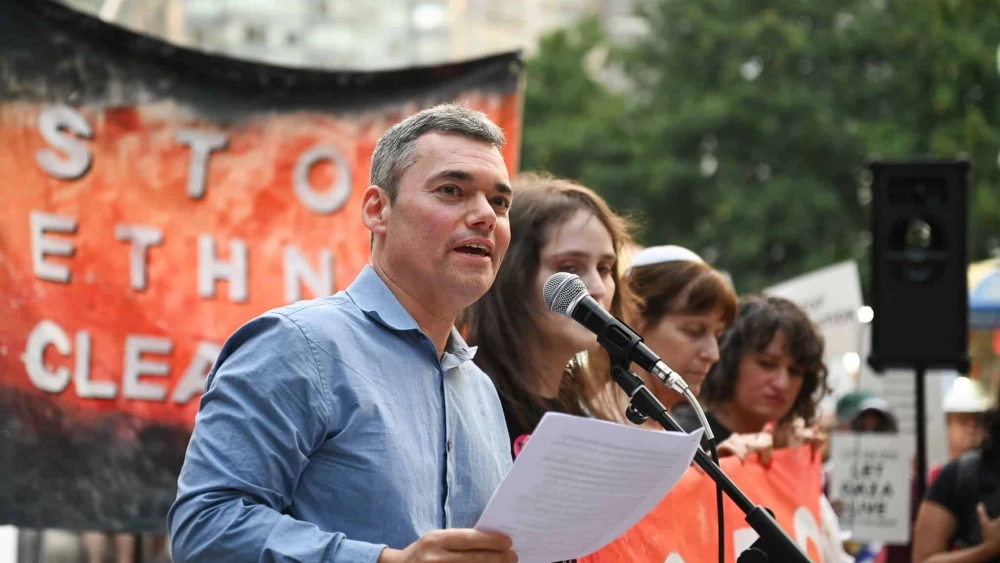

I almost felt sorry for Peter Beinart. Almost. But then I took hold of myself, reviewed his history and enjoyed a wry chuckle.
In 2012, Mark Levine, a professor at the University of California, Irvine, published a piece in Al Jazeera criticizing the journalist, which began, “Poor Peter Beinart. For the past two years, he has served selflessly on the front lines of a fight for the “soul of Zionism,” attempting to preserve—or better, revive—its supposedly liberal patrimony.”
He noted Beinart’s 2010 opinion essay in The New York Review of Books in which he argued that “by refusing to criticize the never-ending occupation and support for a more liberal strand of Zionism, the organized Jewish community was in danger of losing the support of the emerging generation of Jews.” The policies of Israel’s government were perceived to “contradict their largely liberal sensibilities.”
A dozen years later, in March 2024, Beinart, still championing liberalism, wrote in The New York Times: “The emerging rupture between American liberalism and American Zionism constitutes the greatest transformation in American Jewish politics in half a century.” By that time, he was four years into his rejection of the idea of a Jewish state, preferring, as he wrote again in the Times, that a Jewish state not be “the dominant form of Zionism.” He insisted that a Jewish state “is not the essence of Zionism. The essence of Zionism is a Jewish home in the land of Israel, a thriving Jewish society.”
In the past three years or so, Beinart has adopted more and more extreme positions. Yet as we know, once one enters that arena, the competition to stand out simply causes one to become even more extreme. On Nov. 16, under the sponsorship of Jewish Currents, where Beinart is editor-at-large at the magazine, he was in conversation with Palestinian (actually, Syrian) Columbia University graduate and pro-Hamas activist Mahmoud Khalil, the target of an attempt to deport him. Beinart is far gone.
But last week, “Within Our Lifetime/Palestine” activist Nerdeen Kiswani came upon the scene. The following excerpts from their exchanges may be a tad complex, but stay with me. But first, some background.
Let us recall her core belief: “For those that are new here, saying “Israel has a right to exist, just not as a Jewish state” isn’t anti-Zionism, it’s liberal Zionism. The question isn’t what kind of Israel, it’s how Israel came to exist, which is through genocide. Anti-Zionism necessitates decolonization.” Zionism cannot be cleansed, cannot be permitted into the family of nations, cannot be defended. Zionism must be eliminated and the Zionist state must be erased.
Kiswani tweeted, in reaction to New York state assemblyman Zohran Mamdani’s condemnation of the swastika daubings in Brooklyn, N.Y., the day after the city’s mayoral election, where Socialist Democrat came out the winner:
There’s no “scourge of antisemitism” in New York City. “Acts like these, while reprehensible, are often weaponized to justify Zionist narratives and repression of Palestine solidarity. Many past ‘antisemitic’ scares turned out to be fake.” … Norman Finkelstein has spoken about how antisemitism in the United States is largely a political tool, not a real social phenomenon. Mamdani shouldn’t be validating this framing.
Beinart, upset, responded:
“Your response to a swastika at a yeshivah is to condemn the mayor for condemning it? Because that might imply that antisemitism is a ‘real social phenomenon?’ Yes, like other bigotries, it’s a ‘real social phenomenon.’”
Unfazed and unrepentant, Kiswani tweeted back:
“Antisemitism is not a systemic structural issue in the U.S. Everyone knows this except for professional victims. There is a nazi problem in the U.S., and sadly, many of these Nazis are Jewish people. In fact, many Jewish people proudly proclaim that 95% of Jews are Nazis (zionists), which even I said was a bit much. If you want to truly fight against the nazi problem, I suggest you start with your own community.”
She then continued in a direct social-media platform assault on Beinart:
“You really have some nerve, grifting and writing books about ‘after’ the genocide of my people, as it’s still ongoing, to completely reframe what I was saying. I never condemned his condemnation of the graffiti; I explicitly called it reprehensible myself. I took issue with the implication that there’s an antisemitism problem in NYC … there’s no structural disadvantage to being Jewish like there is to being Palestinian, and you know that. You’re being purposely obtuse. You can pander to the antigenocide line, but you’re still a liberal zionist.”
The last line is the bonus: For hardcore anti-Zionist, pro-Palestinian Kiswani, “liberal Zionism” is a curse, an evil. She then added:
“For those who are new here, especially the self-proclaimed anti- or ‘non-Zionists’ (whatever that’s supposed to mean), antisemitism is not a structural issue in the United States. Jews are positioned as white in America, holding access to power, wealth, and protection under the same systems that oppress Black, Brown and Indigenous people. That doesn’t mean antisemitism doesn’t exist in individual attitudes, but it isn’t systemic … .”
Beinart then countered former government spokesperson Eylon Levy and his tweet that “the antizionist Jewish left needs to take responsibility for empowering such evil bedfellows.”
In other words, Beinart, who sought to malign mainstream Zionism by asserting that it is not truly “liberal,” finds out that he can never be liberal enough for the new generation of pro-Palestine advocates.
He condescendingly wrote to Levy: “When I face my grandchildren and my God, I’ll say that when a state committed genocide in my name, I opposed it. Good luck to you,” while also supporting the very illiberal trope of Israel committing genocide, which it hasn’t.
That “conversation” may still be going on.