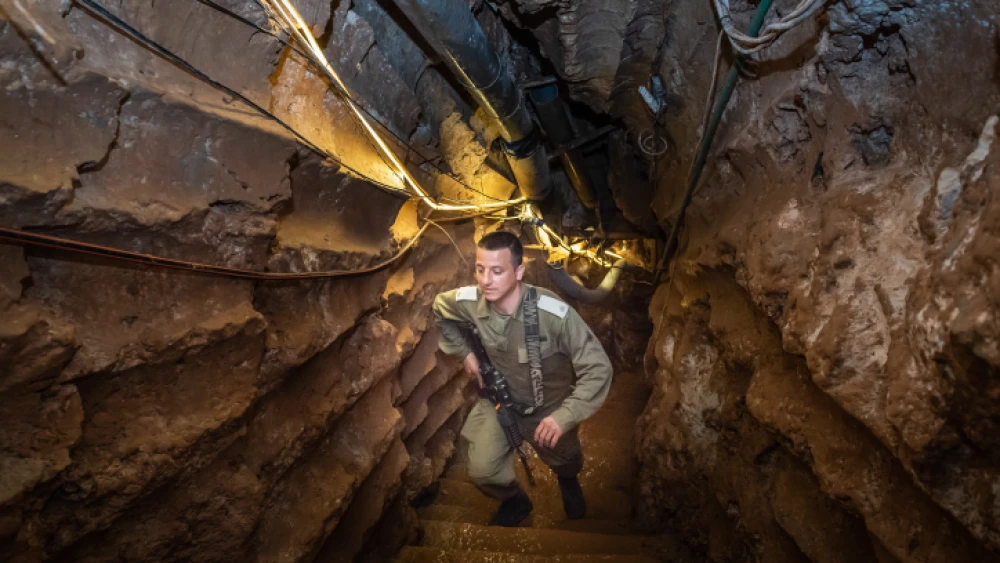
With all the astonishment at the massive Hezbollah tunnel project revealed this week by the Israel Defense Forces, the tunnels themselves were just a tool the organization intended to use to implement its larger plan to attack the Galilee.
It was a grandiose plan that entailed sending hundreds of fighters into Israeli territory, all at once, to occupy territory and commit murders and abductions, creating an unprecedented effect that would echo throughout the Middle East for years.
Fighters from Hezbollah’s elite Radwan Unit (named after Imad Mughniyeh, the Hezbollah commander killed in Damascus in 2008, reportedly by Israel) were supposed to carry out the incursion. The unit, which was established for the purpose of executing covert actions against Israel, has been fighting in the Syrian war for the past several years, gaining extensive operational experience, but suffering heavy casualties.
At the end of the Syrian war, most of the Radwan fighters returned to Lebanon, and in the past few months have been moving to the south of the country. We cannot assume this means that Hezbollah is looking for a war with Israel. The opposite: the organization is still licking its wounds, as well as suffering from the exposure and destruction of its tunnels, and is in financial trouble due to the economic situation in Iran, which led Tehran to slash funding for Hezbollah. It certainly won’t rush into another and much more difficult war.
Nevertheless, that the unit—with its special capabilities—continues to dig in southern Lebanon shows that Hezbollah has not given up its basic intentions or its intensive preparations for its next war with Israel. The exposure of its tunnels certainly requires it to change its operational plans, but the basic idea remains the same: a ground operation heading south, towards the Galilee, with the purpose of wreaking death and destruction.
Radwan is supposed to spearhead the action, which will be accompanied by a storm of rockets, mortars, anti-tank missiles, drones, and plenty of other types of attack. All of these comprise a real challenge for Israel, one that is growing as Radwan continues to move south. Though for Israel there are also certain advantages: a unit of that size needs a train of logistic and command support, which provide plenty of targets.
After the success of the IDF’s “Operation Northern Shield,” the purpose of which was to expose and neutralize Hezbollah’s cross-border attack tunnels, this will be the Northern Command’s main challenge for the foreseeable future—to expose any new plans Hezbollah comes up with and prepare a double response, one that will deter Hezbollah and root out its desire to fight, or should that fail, guarantee victory for the IDF.
Still, make no mistake—despite Israel’s victories, Hezbollah is a serious, devious enemy and the IDF’s biggest challenge right now. The recent blows to its operations will not cause it to take its eyes off its goal, which is to attack Israel. To do so, Hezbollah will stop at nothing—above or below ground.
Yoav Limor is a veteran Israeli journalist and columnist for Israel Hayom.
This column first appeared in Israel Hayom.