Newsletter
Newsletter Support JNS

Palestinian rivals agree to elections, but questions remain

In preparation for an Arab summit in Algiers next month, the heads of 14 factions, including Palestinian Authority President Mahmoud Abbas’s Fatah organization and the Islamist party Hamas, met for two days.

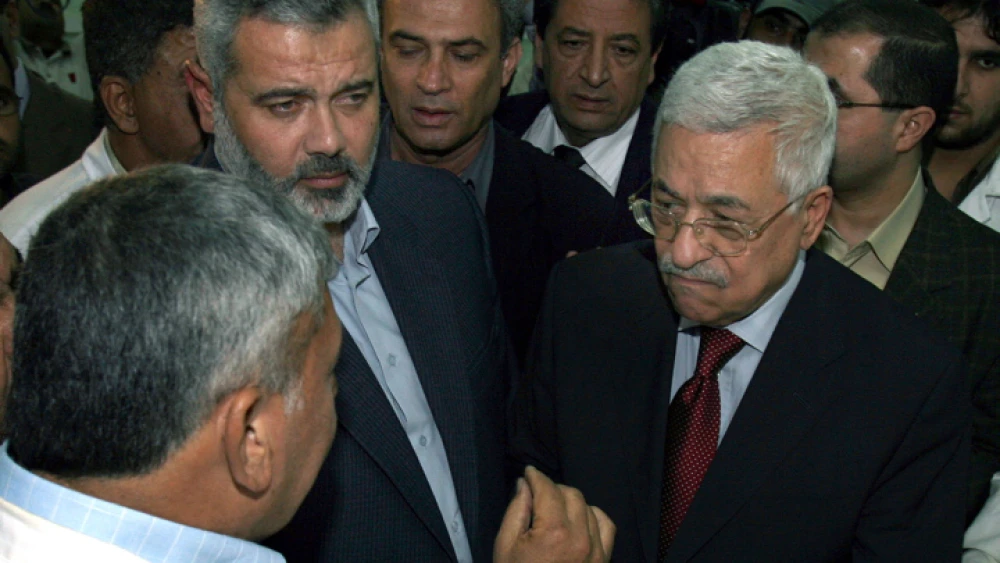
Hamas Prime Minister Ismail Haniyeh (left) and Palestinian Authority leader Mahmoud Abbas visit Odwan Hospital in the northern Gaza Strip, Nov. 8, 2006. Photo by Ahmad Khateib/Flash90.

Rival Palestinian factions convening for negotiations mediated by the Algerian government decided on Thursday to end 15 years of strife through elections that would be held within a year, Palestinian and Algerian officials told Reuters.

Back home in the West Bank, though, there remained skepticism that the Palestinian factions would bring any tangible reforms after prior electoral promises failed to materialize, according to the report.

In preparation for an Arab summit in Algiers next month, the heads of 14 factions, including President Mahmoud Abbas’s Fatah organization and the Islamist party Hamas, met for two days.

According to officials, the sides agreed in Algiers to “speed up the holding of presidential and legislative elections in all of the Palestinian territories including Jerusalem” within one year. The agreement was publicly announced later on Thursday.

The deal also acknowledged Abbas’s Palestine Liberation Organization as the sole representative of the Palestinian people, calling for elections to its national council within a year.

Officials from the two Middle Eastern countries will meet in Washington next week to resume peace talks as Israel and Hezbollah enter into a fragile ceasefire deal.
“Even if any Arab or Palestinian thinks that injustice has befallen them because of the existence of the state of Israel, moving on and forgetting about the injustice is much more in their interest than looking backwards,” Hussain Abdul-Hussain, author of The Arab Case for Israel, told JNS.
A month after his father was killed in a Queens park, Tzvi Yonie Itzkowitz told JNS that his family believes that the still-unsolved killing was motivated by Jew-hatred.
“The gravity of the situation and its widespread impact on our school community make this not the right time for a celebration,” the school stated in an email to parents.
The department said New York may be unlawfully discriminating against religious organizations by requiring long-term care facilities to accommodate residents based on gender identity without providing comparable faith-based exemptions.
“We are demonstrating that we can transform moments of division into opportunities for connection, resilience and positive action,” organizer IMPACT CEO Aaron Herman said.