Russia

Family of American-Israeli woman serving a more than seven-year sentence in Russia for drug-trafficking calls decision “immoral and inhumane” • Israeli justice minister: Extradition order was signed “after many in-depth deliberations.”

“What [Russian President Vladimir] Putin wants is a resolution to the Syria crisis on his terms,” said Anna Borshchevskaya of the Washington Institute for Near East Policy. “And he is closer to that resolution.”

Kurdish scholar Diliman Abdulkader said the Kurds “defeated [the ISIS] caliphate, protected ethnic and religious minorities, brought stability to a third of Syria ... 11,000 angels sacrificed their lives so the rest of the world can be at peace.”

“We cannot allow the Russians to continue to grow in influence by growing on the world stage,” said New Jersey Sen. Cory Booker.
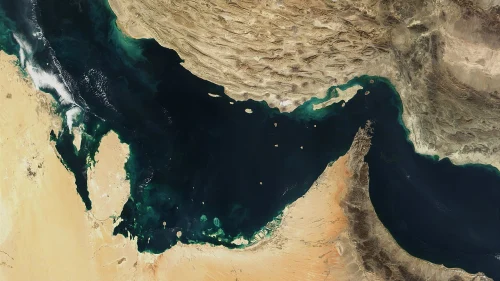
Fears of a potential military conflict with Iran may have opened the door to a Saudi-Iranian dialogue against the backdrop of a rethink of U.S. military logistics.
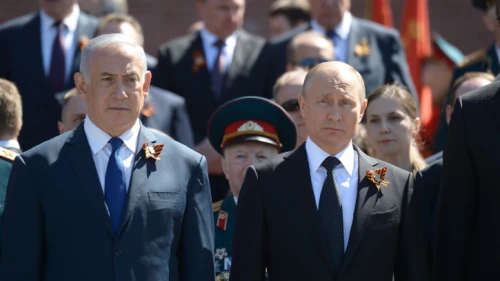
Israel’s Prime Minister’s Office confirms that Benjamin Netanyahu will formally ask Russian President Vladimir Putin to pardon Israeli-American Naama Issachar, who was sentenced to more than seven years in prison for drug-smuggling.

Israel calls sentencing of Naama Issachar, 26, “disproportionate” • Incident comes amid a campaign by Russia to prevent Israel from extraditing a Russian hacker to the United States.
“Russia wants to keep a lid on Syria and continues to play the different sides off of each other. So it can tolerate repeated low-level Israeli airstrikes, but wants to make sure that things don’t get out of hand,” said Charles Freilich, a former deputy Israeli national security adviser.

“Russians and Israelis have ties of family and friendship. Our nations are united by common and often tragic pages in history,” Russian President Vladimir Putin said at Keren Hayesod’s annual conference in Moscow.

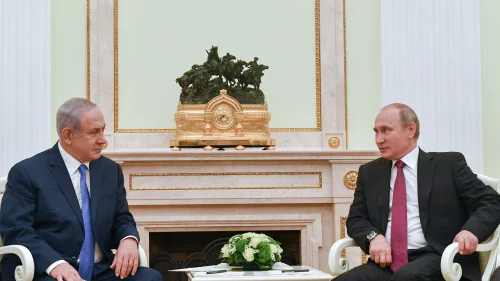
The two leaders discussed the situation in Syria, where Russia is backing Syrian President Bashar Assad and Hezbollah, an Iranian proxy.
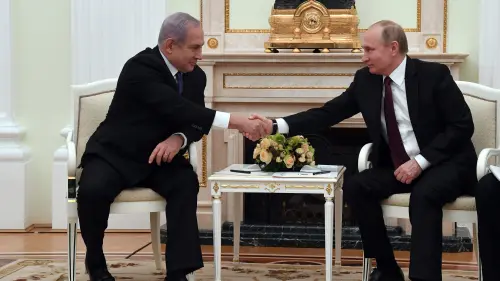
The Israeli prime minister also met with Russian President Vladimir Putin days ahead of the country’s April 9 election; it may be part of a strategy to woo voters in Israel who have Russian roots.
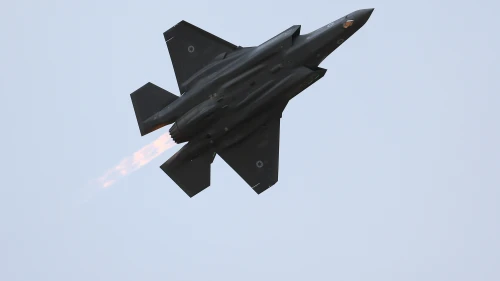
Washington reportedly gave Israel the “green light” for airstrikes as part of its plan to put maximum pressure on Iran.