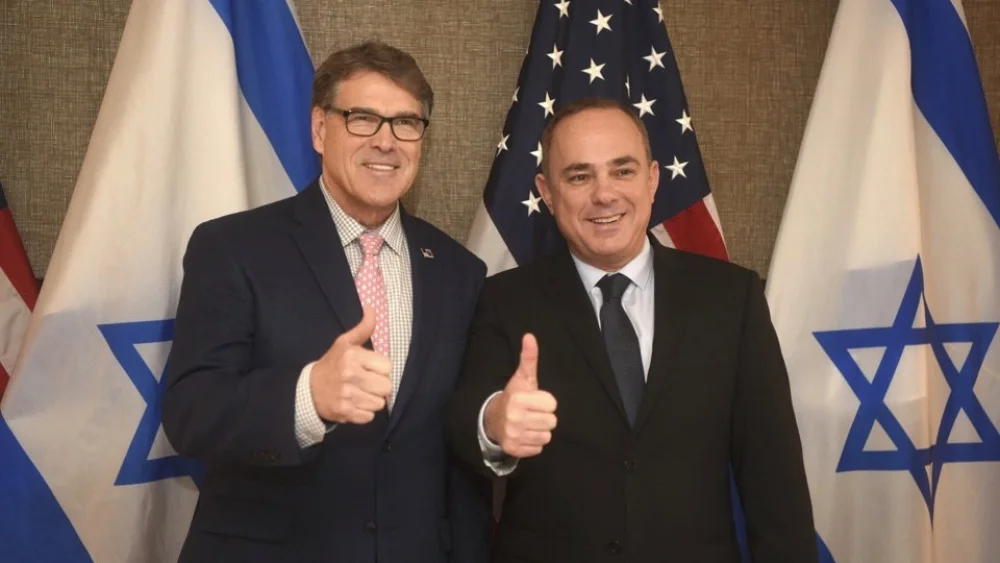
U.S. Secretary of Energy Rick Perry met with Israeli Energy Minister Yuval Steinitz on Monday to discuss cooperation between the two countries in the energy and cyber security sectors.
The two met in Houston at the annual CERAWeek conference, which focuses on challenges facing the energy industry.
“#CERAWeek bilateral meetings continue with Israel’s Minister of Energy, Dr. @steinitz_yuval, where we discussed the upcoming U.S. Israel Energy Center, cyber security cooperation, the Eastern Mediterranean Gas Forum, and commercial advocacy,” tweeted Perry.
#CERAWeek bilateral meetings continue with Israel’s Minister of Energy, Dr. @steinitz_yuval, where we discussed the upcoming U.S. Israel Energy Center, cyber security cooperation, the Eastern Mediterranean Gas Forum, and commercial advocacy. pic.twitter.com/lQI8qoWky2 — Rick Perry (@SecretaryPerry) March 11, 2019
The U.S.-Israel Center of Excellence in Energy, Engineering and Water Technology was established last year with $16 million in public and private funding. It “aims to accelerate development and more rapid deployment of critical and innovative technologies for fossil energy, energy cyber security in critical infrastructure, the energy-water nexus, energy storage, and other areas of energy that are needed to diversify energy supply and promote higher efficiency,” according to a Department of Energy statement.
The Eastern Mediterranean Gas Forum launched in January in Cairo and includes Israel, Egypt, Cyprus, Jordan, Greece, Italy and the Palestinian Authority. It seeks to respect each member’s natural resources, follow international law and enable cooperation between the members in creating a policy related to the improvement of the regional marketplace while protecting the environment.
In January, Israeli Prime Minister Benjamin Netanyahu and Israeli Energy Minister Yuval Steinitz dedicated the arrival of the foundation for the Leviathan gas platform.
“Completion of the Leviathan gas platform and the pumping of gas from this field later in the year is a critical component of the strategic, energy, economic and diplomatic strength of the State of Israel,” said Netanyahu at the time. “A gas pipeline will run from here and will link us to the gas economy of Europe. It will reach our Arab neighbors.”