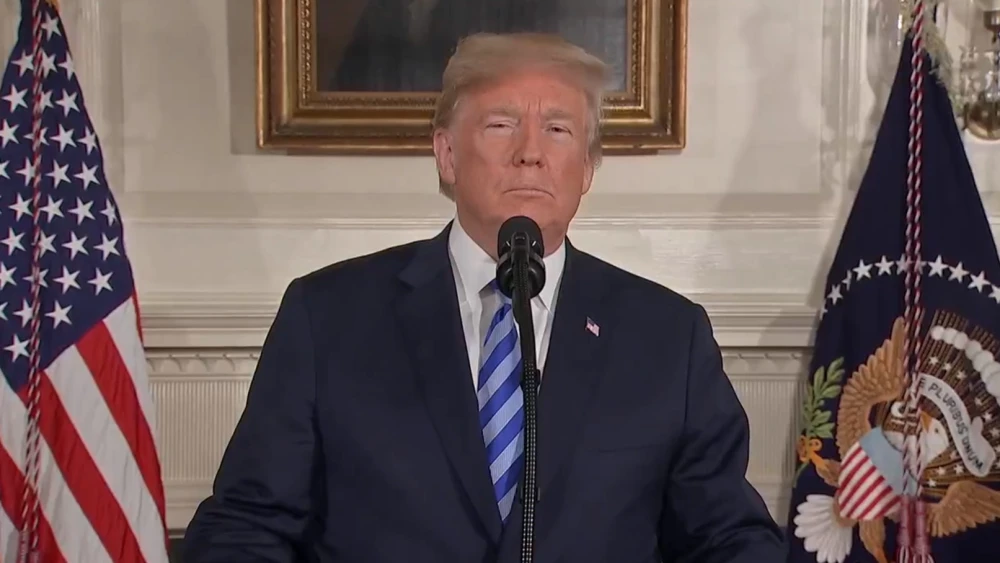
U.S. President Donald Trump signed an executive order on Monday restoring key sanctions on Iran with the hope of levying “maximum economic pressure” on Tehran over its nuclear program and other destabilizing activity in the Middle East.
“As we continue applying maximum economic pressure on the Iranian regime,” said Trump, “I remain open to reaching a more comprehensive deal that addresses the full range of the regime’s malign activities, including its ballistic-missile program and its support for terrorism.”
The new sanctions on Iran prevent any transactions with the Islamic Republic involving dollar bank notes, gold, precious metals, alumni, steel, commercial passenger aircraft and coal, as well as ending imports into the United States of Iranian carpets and food. On Nov. 5, a second round of sanctions targeting Iran’s oil industry are also set to go back into effect.
“We’re very hopeful that we can find a way to move forward, but it’s going to require enormous change on the part of the Iranian regime,” Secretary of State Mike Pompeo said on Sunday. “They’ve got to behave like a normal country. That’s the ask. It’s pretty simple.”
Israeli Prime Minister Benjamin Netanyahu congratulated Trump on his decision to reimpose sanctions.
“This is an important moment for Israel, the U.S., the region and the entire world. It represents the determination to curb Iran’s aggression in the region and its ongoing intention to arm itself with nuclear weapons. I call upon the countries of Europe, which talk about stopping Iran, to join this measure. The time has come to stop talking and to take action, and that is exactly what the U.S. has done and what Europe should do.”
The renewed sanctions come as a result of Trump’s decision to pull out of the 2015 Iranian nuclear deal last May. Trump, who called the deal “horrible” and “one-sided,” is seeking to ratchet up pressure on the Iranian regime, which the president accuses of destabilizing the Middle East.
“Since the deal was reached, Iran’s aggression has only increased. The regime has used the windfall of newly accessible funds it received under the JCPOA to build nuclear-capable missiles, fund terrorism, and fuel conflict across the Middle East and beyond,” he said.
“Reimposition of nuclear-related sanctions through today’s actions further intensifies pressure on Tehran to change its conduct,” said the president.
At the same time, the renewed sanctions come amid growing protests in Iran over the deteriorating economic situation in the country. Protesters could be seen on the streets in the last few days in several major cities, including Tehran, Isfahan and Karaj.
In addition to the newly imposed sanctions, Iranians are concerned about the rapid drop in the country’s currency, the rial, which has lost nearly 80 percent of its value from a year ago.