


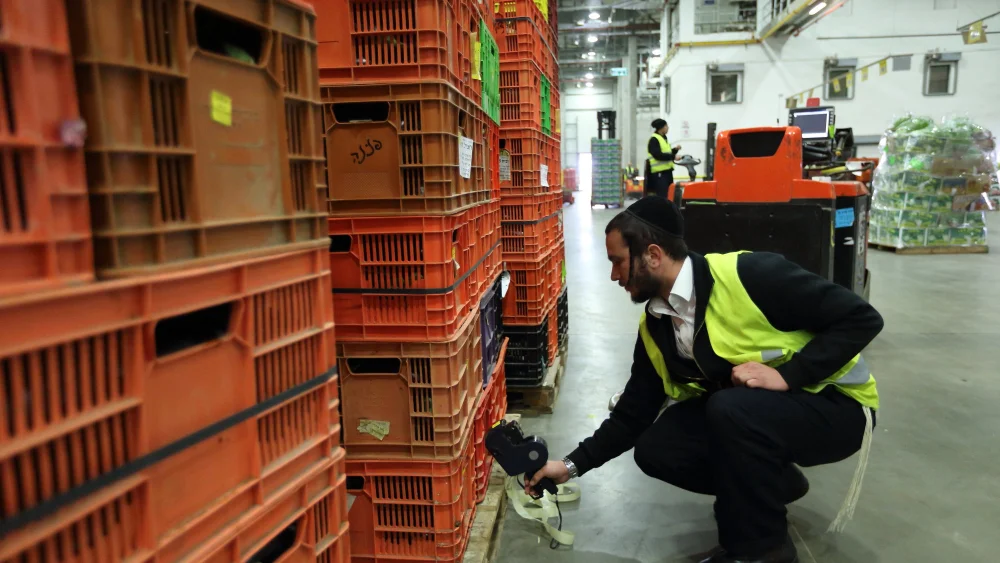
A U.S. appeals court ruled on Monday that the Orthodox Union is protected from a wage complaint lawsuit filed by a former mashgiach, or kosher food inspector, under the First Amendment’s ministerial exception.
Yaakov Markel, a former inspector employed by the Orthodox Union to oversee grape production at two wineries, quit his position in 2018. He filed a lawsuit accusing the OU and his supervisor, Rabbi Nachum Rabinowitz, of withholding a promotion and overtime wages.
The San Francisco-based 9th U.S. Circuit Court of Appeals, the country’s largest, upheld a lower court ruling, which stated that a legal doctrine known as the ministerial exception, which bars lawsuits against religious organizations by workers with religious duties, applies to Markel’s case and therefore protects the OU from his claim.
In the court’s majority opinion, judge Ryan Nelson wrote that “because only observant Orthodox Jews can serve as a mashgiach for the OU, and because they are necessary to carrying out OU’s religious mission of ensuring the wide availability of kosher food, a mashgiach is a minister for purposes of the ministerial exception.”
“Failure to apply the ministerial exception to a mashgiach would denigrate the importance of keeping kosher to Orthodox Judaism,” he added.
The Orthodox Union told JNS that it welcomes the ruling.
“There is a well-established legal principle of religious liberty in the United States, and the court’s ruling is an affirmation of that principle,” Ilana Weinberger, the OU’s director of public relations, told JNS. “We are grateful that today’s ruling thus upholds the constitutional guarantee of religious organizations and houses of worship being able to function in a manner consistent with their religious mission, without interference.”
Rabbi Chaim Dovid Zwiebel, executive vice president of Agudath Israel of America, told JNS that “this is an important victory for the OU, whose very identity as a religious organization was being challenged by a disgruntled former employee, who served as a mashgiach certifying the kosher status of certain food products.”
“To those who have any familiarity with the work of the OU, the notion that it is something other than a religious organization is preposterous—just as it is preposterous to claim that the job of mashgiach is not ministerial in nature,” he told JNS. “It is therefore extremely gratifying that the 9th Circuit Court of Appeals ruled in OU’s favor.”
Avrom Pollak, the president of Star-K, an Orthodox kosher certifier in Baltimore, told JNS that the court’s decision affirms the religious role of a mashgiach.
“The OU is a very reputable kosher certification agency, and anybody that works for them as a mashgiach should be abundantly clear from the very beginning when they take on such a position that their employment is religious in nature,” he told JNS. “We applaud this ruling and we expect our employees to understand their role in this way.”



