U.S. President Donald Trump stated on Monday that his administration is seeking $1 billion from “strongly antisemitic Harvard University” and that “this should be a criminal, not civil, event, and Harvard will have to live with the consequences of their wrongdoings.”
The president was responding to a report that he was backing off his demand that the Cambridge, Mass., Ivy League school pay $200 million as punishment for allegedly mishandling Jew-hatred on campus.
“Trump is always bargaining, so I think it’s usually best not to take his words literally but to see them as signals for negotiation,” Jay Greene, senior fellow at the Defense of Freedom Institute who focuses on Jew-hatred on campus and teacher unions, told JNS.
Greene, who holds a doctorate in government from Harvard, said that Trump is “signaling that he plans on driving a hard bargain with Harvard.”
The university is “trying to drive a hard bargain with him too, since both sides have significant resources,” Green told JNS. “This may take a little longer than people have expected to be settled, but it will be settled.”
The Trump administration froze more than $2.2 billion in funding from the university in April 2025 over what it said was the school’s inadequate response to Jew-hatred on campus. A federal judge ruled in September that the government had to restore the funding.
Trump stated that “strongly antisemitic Harvard University has been feeding a lot of ‘nonsense’ to the failing New York Times” and that the university “wanted to do a convoluted job training concept, but it was turned down in that it was wholly inadequate and would not have been, in our opinion, successful.”
“It was merely a way of Harvard getting out of a large cash settlement of more than $500 million, a number that should be much higher for the serious and heinous illegalities that they have committed,” he stated.
“We are now seeking $1 billion in damages and want nothing further to do, into the future, with Harvard University,” the president stated. (JNS sought comment from the White House, Harvard and the U.S. Education and Justice Departments.)
In subsequent posts, Trump criticized the Times for being “completely wrong” and said that its story on him removing the $200 million demand was “phony.”
Alan Dershowitz, professor emeritus at Harvard Law School, told JNS that “moderates on both sides want a deal.”
“Extremist students and faculty members on the left at Harvard would rather see the school suffer than make a deal with Donald Trump, so the radicals on the left are putting pressure on the administration not to give in, not to be perceived as giving in to the Trump ‘bad guys,’” he said.
“The same thing is happening within the Trump administration,” Dershowitz told JNS. “Some extremists on the right think that Trump benefits by being at war with Harvard and would lose by making a deal,” while the “moderates in the administration, including I think the president himself, see the benefit of a deal that achieves a lot of what they want to achieve but not all of it.”
To Dershowitz, it’s most important to “end the rampant antisemitism that permeates Harvard.”
“There are antisemites on virtually every faculty and right now, the antisemites are willing to speak out, the anti-Zionists are willing to speak out,” he said. “Almost no one who is pro-Israel is willing to speak out.”
Many pro-Israel professors at Harvard are “terrified that if they openly support Israel, they will be boycotted, they will be denied admission to various honorific events,” Dershowitz told JNS.
The legal scholar thinks that the school and the government will settle and that Harvard needs to reform. It is “not essential” that the school be forced to pay, he said.
“What’s important is that these special programs, like the Middle East studies program and these specialized regional and gender-oriented, race-oriented programs should be abolished,” he told JNS. “They have become hotbeds of anti-Zionism and often antisemitism, and they are not educationally sound.”
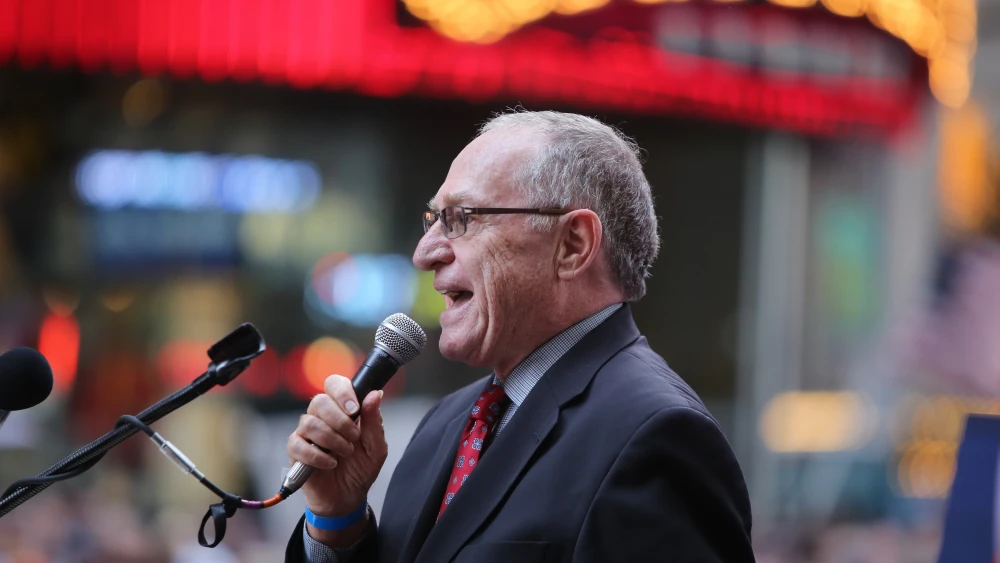
Those programs tend to be “advocacy centers rather than intellectual centers,” according to Dershowitz, who told JNS that he was against black studies, women’s studies, gay studies and Jewish studies programs from the start, and he now favors scrapping them.
“There should be courses in all of these subjects, but once you set up a department, it becomes an advocacy department,” he said. “The vast majority of them are anti-Israel, and some then morph into antisemitism.”
If Harvard settles with the Trump administration, that would reverberate across higher education nationwide, according to the scholar.
“Harvard is the leader, and what happens with Harvard has impact,” Dershowitz told JNS.
Harvard needs to explain why its Jewish enrollment has declined from about 20% to less than 10% over the past two decades, and the school “can’t be permitted to allow proportional representation,” according to Dershowitz.
“That’s what happened in Tsarist Russia. If you were 1% of the population, you had 1% of the student body and faculty,” he said. “It has to be based on meritocracy, and Harvard has to return to meritocracy. It’s not there right now. Right now, Harvard is medio-cracy.”
“It has sacrificed quality for politics,” he added.
Greene told JNS that Harvard settling with the government would make “all universities recognize that they’re not entitled to public resources, but those public resources come with conditions and obligations to the public good that they don’t unilaterally get to define.”
It would also be “a very important symbolic victory for the Trump administration,” which is why Harvard is reluctant to hand Trump that sort of victory, according to Greene.
“Substantively, Harvard has already committed itself to many of the reforms that the Trump administration demanded,” he told JNS. “So the point of an agreement, at this point, is to solidify those concessions, those reforms, with some amount of external oversight.”
Greene believes that there will be a settlement.
“Harvard has too much on the line and there’s too much the government can do to them that would interfere with their operations,” he said. “They’re not so big and powerful that they can’t ignore what the federal government can and might do to them.”
Brandy Shufutinsky, director of the education and national security program at the Foundation for Defense of Democracies, told JNS that “there’s been a lot of talk that things are quieting down on the university campuses regarding the anti-Israel protests that we’ve seen, because we haven’t seen encampments spring back up.”
That view “may be lulling some people into a little bit of a false sense of security that the problem has been tackled,” she said.
Shufutinsky thinks that might explain the recent Times report that Harvard may not have to shell out $200 million.
“The statement from the president is him reiterating his position that he is taking seriously, the administration is taking seriously, all of the civil rights violations of Jewish students, Zionist students and faculty members on these university campuses,” she told JNS.
“It’s important for any American president’s legacy to stand up for the civil rights of Americans, period,” Shufutinsky said. “Any institution that is violating those civil rights should not be allowed to continue to violate those civil rights. Those are the laws of the land, and those need to be supported and enforced.”
“This is bigger than Harvard” and “bigger than just an Ivy League university,” she said. “We’re unfortunately seeing this type of pattern on college campuses, university campuses across our country, I mean even on the K-12 campuses.”
“Discrimination, violation of civil rights, regardless of one’s own personal beliefs, is not legal,” she added. “We need leadership that will make sure that the laws of our land are enforced.”