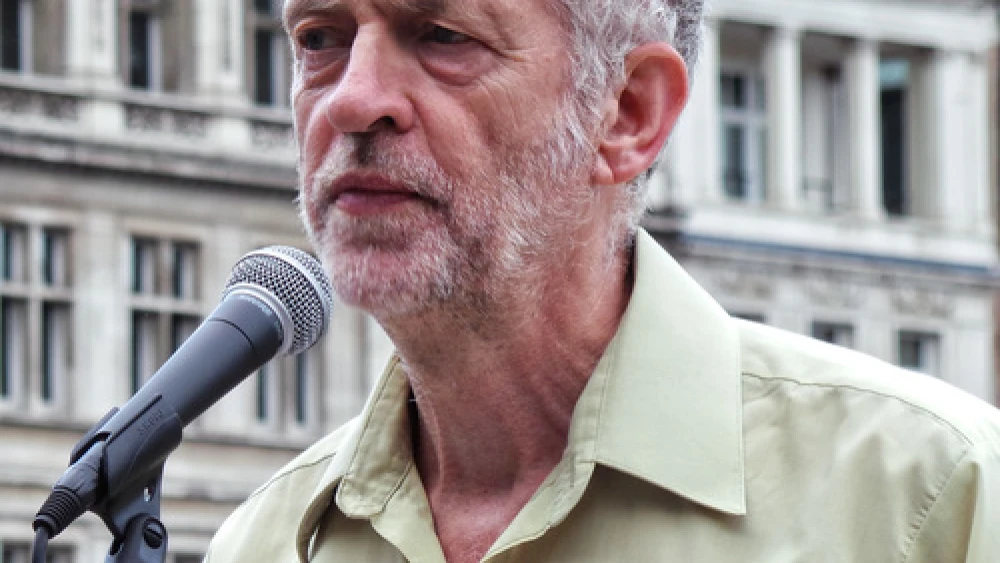
The leader of the British government’s opposition Labour Party said a government under his control would recognize a Palestinian state.
Posting to Twitter during a visit to Jordanian refugee camps on the border with Syria, Corbyn said “the next Labour government will recognize Palestine as a state as one step towards a genuine two-state solution to the Israel-Palestine conflict.”
On Saturday, Corbyn visited the Al-Baza’a Palestinian refugee camp near Amman, the country’s largest refugee camp, created in 1968 following the Six-Day War and currently home to more than 100,000 people.
Jordan has refused to give citizenship to hundreds of thousands of Palestinians, though the nationality comprises more than half of the country’s population.
Non-Jordanian Palestinians are not eligible for free education or subsidized health care, cannot be employed by the state and are ineligible to practice organized professions such as law, due to ineligibility for membership in Jordanian professional associations. Those who do hold Jordanian citizenship can have the nationality revoked.
Corbyn has been accused of being motivated by anti-Semitism, with a letter sent to him by the leaders of the British Jewish community in March, accusing him of issuing “empty statements about opposing anti-Semitism, but does nothing … because he is so ideologically fixed within a far-left worldview that is instinctively hostile to mainstream Jewish communities.”
Corbyn has criticized U.S. President Donald Trump for his official recognition of Jerusalem as the capital of Israel, calling it a “catastrophic mistake.”