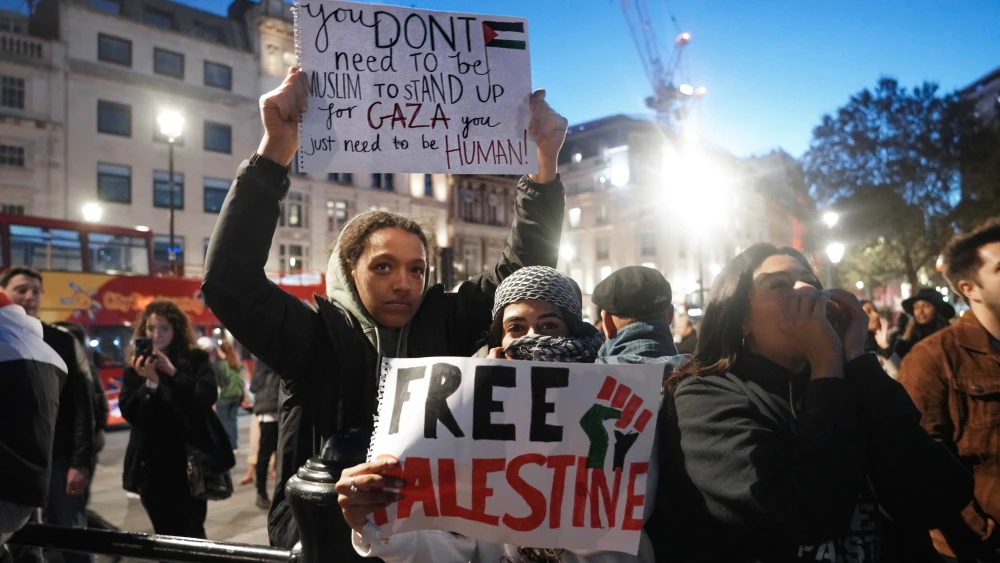
Since Hamas’s Oct. 7, 2023, attack, the United Kingdom has arguably seen the largest and most sustained anti-Israel protest movement in Europe. Hundreds of thousands poured into London’s streets at its height. It gave the impression of a grassroots uprising.
What was portrayed as a spontaneous outpouring of popular sentiment consisted, in fact, of demonstrations by a relatively small group of professionally organized, sophisticated and internationally funded groups that traffic in anti-Israel and anti-Western narratives, a new report reveals.
“The image of modern extremism as a handful of isolated radicals, confined to cells or obscure, shunned corners of society, is dangerously outdated. Today’s anti-Western influence networks are global, coordinated, top-down, well-funded,” reported NGO Monitor, the Jerusalem-based research institute that produced the study, whose findings were presented at a House of Lords event on July 8.
The report describes the network as a series of concentric circles. At the center are hostile states, terrorist groups (Hamas, Hezbollah, Al Qaeda) and extremist movements (Muslim Brotherhood). Around them are charities, protest groups and advocacy organizations that “provide legitimacy, amplify propaganda and serve as vectors of transmission for extremist agendas to society more broadly.”
The report looked at 40 major anti-Israel U.K. protests—selected based on criteria such as their scale, media visibility and political impact—and identified the organizations that sponsored them.
Although hundreds of groups took part in the U.K.’s anti-Israel mobilization post-Oct. 7, NGO Monitor boiled down the organizers to six core groups. They were involved in 32 of the 40 demonstrations, “illustrating the extent to which a relatively fixed coalition of repeat actors dominates the operational infrastructure of anti-Israel campaigning in the U.K.”
The six were: 1) Stop the War Coalition; 2) Friends of Al-Aqsa; 3) Muslim Association of Britain; 4) Palestinian Forum in Britain; 5) Palestine Solidarity Campaign; and 6) Campaign for Nuclear Disarmament.
Anne Herzberg, NGO Monitor’s legal adviser, told JNS that Stop the War Coalition (founded after 9/11 to protest against the “War on Terror”) and Campaign for Nuclear Disarmament took center stage in the organizing effort despite having no obvious connection to the Israel-Palestine issue. They did so as part of their effort to link anti-Israel activism with broader anti-Western campaigns and far-left political organizing.
In some cases, the same people ran more than one of the organizations. Former Labour Party leader Jeremy Corbyn, for example, holds key positions in three groups, serving as vice president of Campaign for Nuclear Disarmament, deputy president of Stop the War Coalition and patron of Palestine Solidarity Campaign.
The report identified 15 other groups, less central, which sponsored between one and three of the 40 protests. Some bear familiar names, including Amnesty International, Code Pink, Oxfam and Doctors Without Borders.
Extremist narratives to the mainstream
Amnesty UK runs an activist training program for youth, ages 16-24, which caught Herzberg’s eye. The training course taught hundreds of young people campaigning skills on the Palestinian issue. She said that it is a concrete example of how groups such as Amnesty serve as the transmission mechanism of extremist narratives to the mainstream.
Another feature shared by the protest groups is their complete lack of funding transparency. Of the six main groups, four are registered U.K. companies, Companies have less reporting requirements than charities. “When they register as a company, they’re clearly doing it to avoid scrutiny,” she said. One of the six wasn’t registered at all.
NGO Monitor wasn’t able to identify any of the funding sources for four of the six—Friends of Al-Aqsa, Muslim Association of Britain, Palestinian Forum in Britain, and Palestine Solidarity Campaign.
Lord Walney (John Woodcock, Baron Walney), who served as the government’s independent adviser on political violence and disruption (2020-2025), in a foreword to the report, said, “a troubling number of the organizations within [the anti-Israel network] either fall outside any meaningful regulatory framework or maintain connections to actors that no democratic state should tolerate.”
The report made several recommendations, the most important of which was to urge the government to investigate the funding sources, especially of the Islamist groups. “We have no idea who funds these organizations,” Herzberg said.
While their funding is obscure, the nature of the groups is not since they make little effort to hide their extremist connections.
To cite just a few examples: the Muslim Association of Britain was founded by a former member of the Hamas political bureau; the co-founder and outreach director of CAGE International was held for three years in U.S. custody in Afghanistan and Guantanamo Bay; the Islamic Human Rights Commission (IHRC) was identified in an independent U.K. review in 2023 as “an Islamist group ideologically aligned with the Iranian regime.”
The lack of enforcement of existing laws was a “key theme” during the report’s presentation at the House of Lords, whose attendees including several top counter-terrorism czars, Herzberg said.
The failure to act against these groups, despite their obvious terror ties, is due to the fact that many Labour Party constituents support them. Labour, fearing it will drive these people into the hands of the Green Party, does nothing. “If they actually started enforcing the laws, they would make a lot of their constituents very angry,” Herzberg said.
“Our report is aimed at officials from other parties who we think would do something when they do take control of the government,” she said.
Herzberg stressed that shadowy, foreign-aligned networks undermining society is not just a British problem. “This wave of destabilizing protests has highlighted a crisis of transparency across Western countries, where registered and unregistered groups that people know nothing about have co-opted everyday life in service of overseas actors with their own agendas,” she said.
In the U.K., U.S. and Europe, governments must step up, increase transparency and root out these disruptive anti-Western networks, she said.