Newsletter
Newsletter Support JNS

Washington wants arms embargo on Iran extended indefinitely

However, says U.S. Special Representative for Iran Brian Hook, “the door for diplomacy on our side is wide open.”

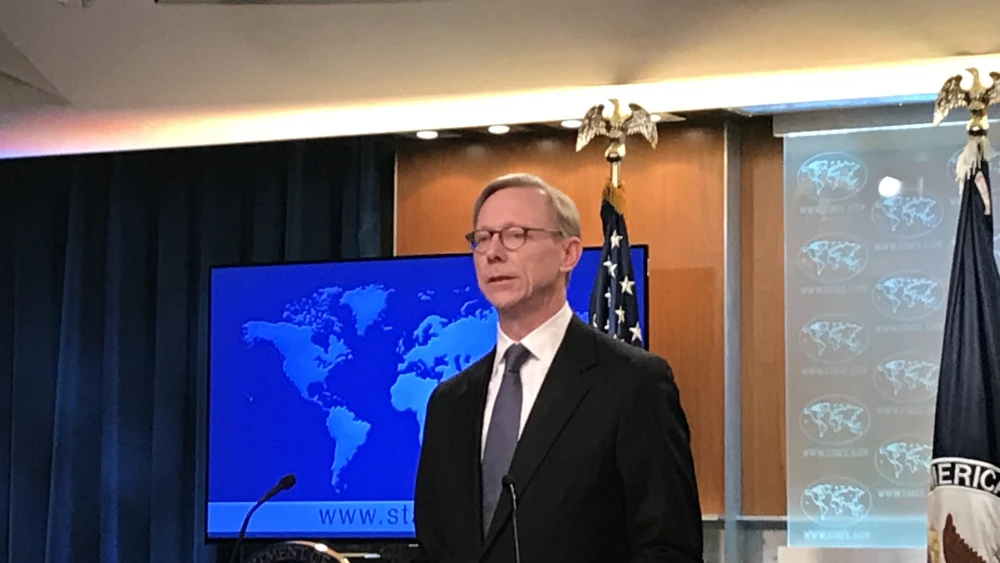
U.S. Special Representative for Iran Brian Hook announces U.S. sanctions against Iranian Brig. Gen. Hassan Shavapour on Jan. 17, 2020, at the U.S. State Department in Washington, D.C. Photo: Jackson Richman/JNS.

The administration in Washington wants the arms embargo on Tehran to be extended indefinitely, U.S. Special Representative for Iran Brian Hook said on Tuesday.

“We think the right policy is to have an arms embargo in place that doesn’t have a definite date fixed,” Hook said, during a virtual event organized by the Council on Foreign Relations, according to Reuters.

Hook, who also serves as senior policy adviser to U.S. Secretary of State Mike Pompeo, added that “we’d love to have an in-person meeting to have a consular dialogue so that we can move faster than we have.

He went on to say that “the door for diplomacy on our side is wide open, not just on these matters but on ... all the issues that have been bedeviling U.S.-Iran bilateral relations for 41 years,” and claimed that U.S. President Donald Trump “would like to get to the negotiating table.”

The arms embargo, set to expire in October, was established in the framework of the Joint Comprehensive Plan of Action, the nuclear deal reached between Iran and world powers in 2015.

The United States is “shutting down the financial infrastructure that allows the regime to continue its threats to U.S. national security and global shipping,” the U.S. treasury secretary said.
“The American people are crying out for an end to U.S. tax dollars subsidizing Israel’s military,” Rep. Greg Casar, chair of the Congressional Progressive Caucus, told colleagues.
A U.S. Department of Homeland Security spokesman told JNS that the administration “acted well within its statutory and constitutional authority” in Khalil’s case, “as it does with any alien who advocates for violence, glorifies and supports terrorists, harasses Jews and damages property.”
“The Strait of Hormuz is open to all ship traffic except for Iran,” the U.S. president wrote.
The amendment “would restrict our country’s ability to confront Hamas, Hezbollah and other terrorist organizations in the region who are sworn enemies of both the United States and Israel,” the House minority leader said.
“We are prepared for any scenario,” the prime minister assured.