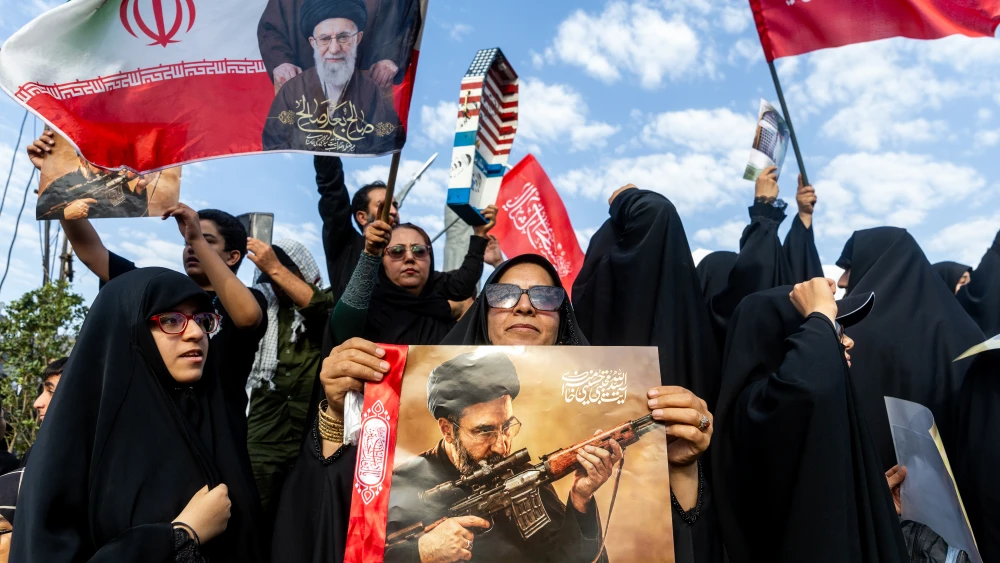

Iran’s new supreme leader, Mojtaba Khamenei, has issued an unmistakable threat. Following his father’s funeral, he declared: “We pledge to avenge your pure blood and the blood of all the martyrs … by taking revenge against the criminal, disgraceful murderers. This vengeance is what our nation is demanding, and this must definitely be done.”
Khamenei’s pledge did not come in a vacuum. It joined a growing chorus of calls in Iran for revenge, alongside intelligence warnings of plans to assassinate U.S. President Donald Trump. The extraordinary security measures surrounding Trump’s visit to Ankara for the NATO summit reflected the seriousness of the threats against him.
Trump responded to these threats with a stark warning. He stated, “I’ve been on their list for a long time. … The only thing is, I’ve left instructions, if anything happens, to just literally bomb them at levels that they’ve never seen before.”
This was not the first time Trump issued such a warning. In February 2025, as he signed a presidential directive restoring the maximum-pressure campaign against the Iranian regime, he warned that, in the event of his assassination, “I’ve left instructions: If they do it, they get obliterated. There won’t be anything left.”
The purpose of these warnings is clear: to deter the Iranian regime.
The assumption is that the regime, in deciding whether to execute such an assassination attempt, would weigh the benefits against the price Iran can expect to pay. Once decision-makers in Tehran have understood the response they can expect from the United States, the thinking goes, they will hesitate before acting.
This assumption applies not only to an assassination attempt against Trump, Israeli Prime Minister Benjamin Netanyahu or another leader, but also to other forms of Iranian aggression and destabilization in the nuclear, ballistic missile, drone, naval and terrorist arenas.
Yet this approach rests on a critical assumption: that the decision-makers in Tehran rationally weigh expected benefits against potential costs and that they fundamentally think like Western leaders.
It is far from certain that this is true in light of the Iranian regime’s radical Islamist ideology and worldview.
A document seized by the Israel Defense Forces in Gaza, apparently written by Hamas senior leader Yahya Sinwar shortly before the terror organization invaded southern Israel on Oct. 7, 2023, revealed how he assessed the cost of the monstrous massacre he was planning.
According to researchers at the Meir Amit Intelligence and Terrorism Information Center, Sinwar expected Israel to respond with overwhelming force. He even believed that Israel might use a nuclear weapon against Hamas. “The enemy will not hesitate to use all the means and weapons at its disposal,” he wrote. “It may even use a nuclear bomb.”
Yet this belief did not deter him. He viewed Hamas’s campaign against Israel as “a battle of life or death” and was determined to carry it out even if it meant the devastation of Gaza.
Could the leadership in Tehran view its mission of revenge in the same way? The answer may well be yes.
Differences exist between Hamas and Iran. But both Hamas and Tehran’s leaders are inspired by extremist Islamist ideologies that regard terror and destruction as legitimate means of achieving political and religious goals. At least some members of the Iranian leadership likely see the world in a manner similar to Sinwar and Hamas.
Against enemies of this kind, deterrence cannot be relied upon. Only prevention and the denial of capabilities can provide real security.
The same principle applies not just to assassination attempts, but to Iran’s broader military and terror infrastructure. As long as Iran remains under its present revolutionary leadership, it cannot be safely permitted to retain or rebuild strategic capabilities: nuclear weapons; ballistic missiles; advanced drones and their production facilities; naval forces capable of threatening international shipping; proxy armies; and bodies used to commit terrorism and assassinations abroad.
In the face of these threats, the objective cannot be deterrence. It must be to deny capabilities.
“They’re sick people,” Trump said of the leaders in Tehran. To put it more precisely: They do not think as we do.
Whether in Tehran, Gaza, Lebanon or Yemen, the enemy must be confronted according to the way it actually thinks, not the way others would like it to think.
We must therefore not rely primarily on deterrence, but on the aforementioned denial of capabilities. If direct and sustained denial ultimately proves impossible, the only answer may be to create the conditions under which the Iranian people can transform the regime and build a better future for their nation.