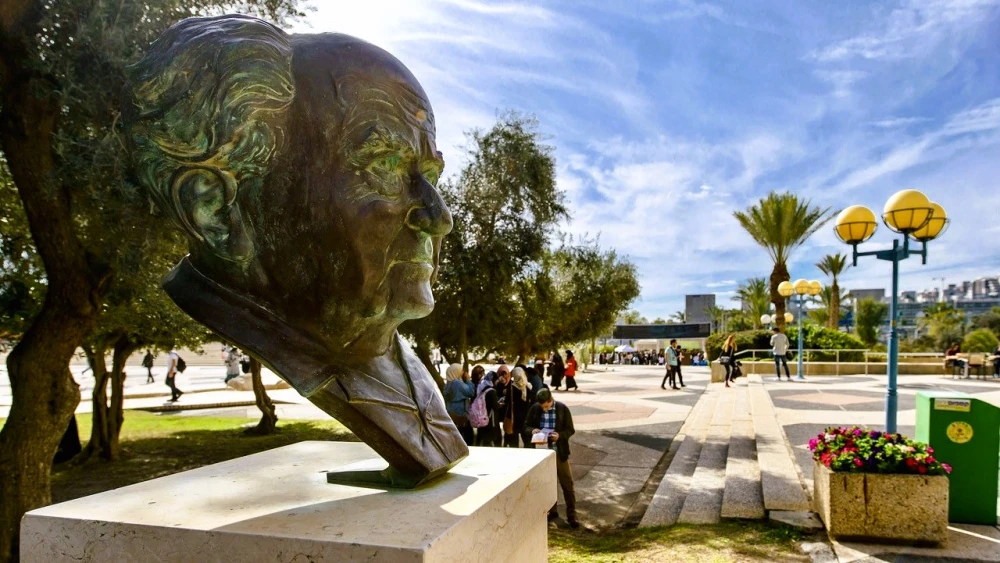
Ben-Gurion University of the Negev (BGU) announced a new partnership to pursue pioneering breakthroughs in civilian safety and protective technologies for humanitarian purposes in conjunction with Rensselaer Polytechnic Institute (RPI). Both are top-tier higher education institutions in the field of engineering and across the STEM disciplines, in Israel and the United States, respectively.
Launched with a $500,000 donation from siblings Melisa T. Gerber and David J. Gerber, which includes separate grants of $250,000 each to RPI and Americans for Ben-Gurion University (A4BGU), the collaborative program seeks to establish a long-term partnership between the institutions by leveraging their respective strengths in science and technology innovation.
The partnership will foster active collaboration between individual researchers, nurturing new technologies and research areas that can lead to tangible outcomes and potential commercialization. Possible collaborative research areas include, but are not limited to, developing resilient buildings capable of withstanding earthquakes, blasts and fire; enhanced glass and windows for shattering reduction; and smart sensors for detecting toxic and solubilized volatiles, including pesticides, persistent chemicals, air or water pollutants.
“Ben-Gurion University has long believed that the most meaningful research improves lives,” said professor Raz Jelinek, vice president and dean for research and development at BGU. “This partnership with Rensselaer Polytechnic Institute combines world-class scientific expertise with a shared commitment to translating discovery into real-world impact. Together, our researchers and students will pursue innovative technologies that strengthen civilian safety, enhance resilience and address challenges that extend well beyond our two campuses.”
“We are deeply grateful for the generosity of David and Melisa in supporting this program, and are excited to forge new collaborations with Ben-Gurion University,” said Robert Hull, Ph.D., vice president for Research at RPI. “We look forward to building substantial and long-standing collaborations with our partners at Ben-Gurion University and are excited about the new knowledge and solutions this program will generate.”
The nascent collaborative program between BGU and RPI places a strong emphasis on cultivating consistent cooperation between faculty members and graduate students at each institution, with grant awards supporting students’ tuition costs and research stipends, as well as expenses related to their projects. Meanwhile, students whose activities are funded under this program will be encouraged to engage in commercialization training and activities at their respective universities.
Research teams at the schools will hold regular virtual meetings (at least monthly) and annual retreats to strengthen their collaboration, with the expectation of their results ultimately being published in leading journals and presented at conferences.
A newly established gift fund, the H. Joseph Gerber and Sonia K. Gerber Research Fund, honors the memory of Melisa and David Gerber’s parents amid the launch of the BGU-RPI partnership.
“Rensselaer and Ben-Gurion University bring together remarkable talent and a shared conviction that science, learning, and creativity should serve humanity,” said David Gerber, an alumnus of RPI. “We hope this fund helps their researchers pursue bold, collaborative work—across disciplines and across borders—and translate it into real solutions for a safer, more livable world. Given in memory of our parents, Sonia K. and H. Joseph Gerber, an artist and an inventor, it is an investment in the ideas still to come.”
H. Joseph Gerber arrived in the U.S. as a Holocaust survivor, learned English while working full-time, and earned a scholarship to RPI, where he made his first invention as a student. He went on to become a prolific inventor, with hundreds of patents, and founded Gerber Scientific. In 1968, Gerber brought that entrepreneurial spirit to Israel, joining three engineers in Beersheva to help build Beta, one of the country’s earliest high-tech startups—and a unique undertaking at a time when little science-based industry had existed in the Negev. He received the National Medal of Technology from President Bill Clinton in 1994.
“It is not just about the ‘Startup Nation’ but also the ‘Startup Negev,’” David Gerber said of his father’s journey. BGU has come to embody the same story: using ingenuity, science and entrepreneurship to serve as a growth engine for a region far from Israel’s established centers of technology.
Sonia K. Gerber brought a complementary commitment to Israel, education, and creativity. She traveled to Israel as an Israel Bonds goodwill ambassador, taught in inner-city schools, and pursued her own work as an artist. Together, the Gerbers embodied the values of innovation and meaningful personal engagement with Israel that their children seek to extend through the new fund, and through its support for the ties between BGU and RPI.
“The best way to honor and remember our parents is through continuing their work,” said Melisa T. Gerber. “In bringing these institutions and these values together, we hope to carry forward something deeply important to both of them.”