Newsletter
Newsletter Support JNS

EU cuts its UNRWA budget by 40 percent

The new budget will provide $82 million annually, compared to the previous figure of $135 million, according to the Institute for Monitoring Peace and Cultural Tolerance in School Education (IMPACT-se).

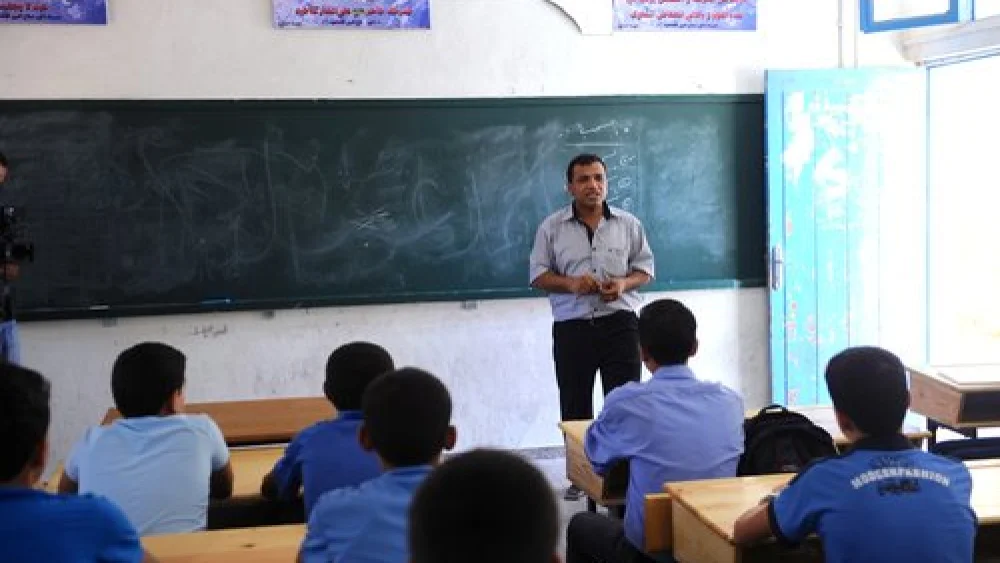
Students in a school in Gaza of the UNRWA at the beginning of the new academic year.
A teacher leads a class at an UNRWA school in the Gaza Strip, September 2011. Credit: Shareef Sarhan/U.N. Photo.

The European Union’s 2022-24 UNRWA aid budget will be 40% lower than during the previous three-year period, the E.U. announced last week.

The new budget will provide $82 million annually, compared to the previous average annual figure of $135 million, according to the Institute for Monitoring Peace and Cultural Tolerance in School Education (IMPACT-se), a Jerusalem-based nonprofit that monitors educational materials around the world for extremist content.

An additional $15 million was granted through the E.U.'s Food and Resilience Facility for 2022 to help ensure food security following the impact of the Ukraine crisis, according to the report.

In April of last year, the E.U. Parliament condemned UNRWA for teaching and producing U.N.-branded hate material uncovered by IMPACT-se, and conditioned E.U. funds on changes to the curriculum.

The E.U. commissioner, who announced the reduced funding package, said last year, after the Parliament’s condemnation, that the European Union would fight anti-Semitism and should consider conditioning aid to UNRWA on full adherence to UNESCO standards of peace and tolerance in textbooks.

He reiterated the sentiment in November 2021, when he stated during an international ministerial UNRWA donor conference that “full compliance with UNESCO standards in education material” is “non-negotiable,” and that the European Union would continue to work with UNRWA towards “increased accountability, transparency and consistency with U.N. principles.”

In a draft report delivered to the U.S. president, the commission also called for improved religious accommodations for U.S. service members.
Salah Salem Sarsour, accused of concealing Israeli military court convictions on immigration forms, argued his detention was part of a Trump admin effort to target the pro-Palestinian movement.
CENTCOM stated that the strikes targeted missile, drone and radar facilities after the Islamic Republic attacked a cargo ship in the Strait of Hormuz, calling the assault a violation of the ceasefire.
Now that the primaries are over, “we hope that everyone will come together and be united,” Christine Quinn, chair of the executive committee of the New York State Democratic Party, told JNS.
An Iranian official warned on Friday that the safety of ships passing through the Strait of Hormuz without Iran’s permission “cannot be guaranteed.”
“We have put the train back on the tracks and going in the right direction,” said Yechiel Leiter, Israeli ambassador in Washington. “Final destination? Peace between our two countries.”
Benny Gantz, JNS editor-in-chief Jonathan S. Tobin, Gilad Erdan, Mosab Hassan Yousef, Nissim Black and leading voices in security, diplomacy, media, law and Jewish communal affairs headline the summit’s third day in Jerusalem.
