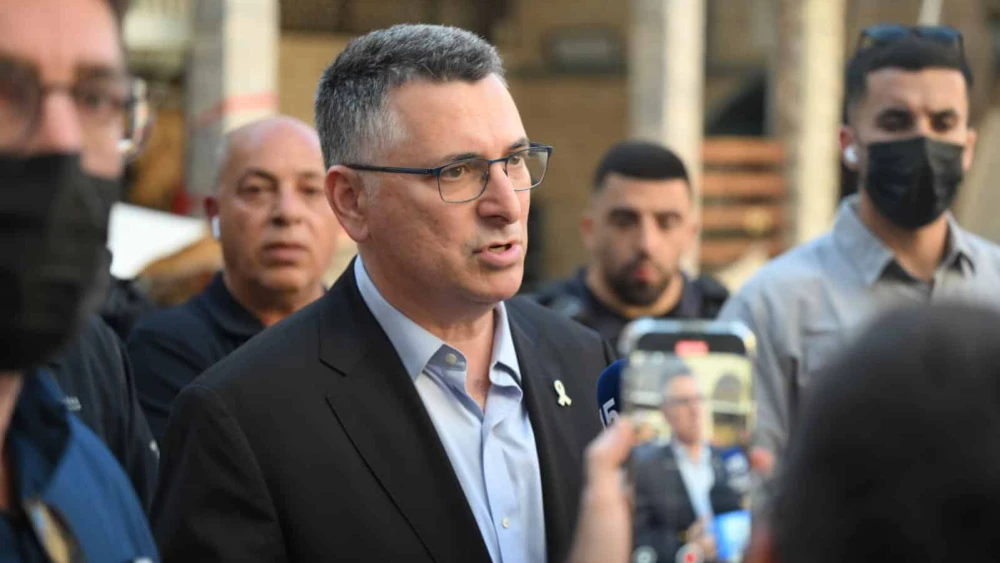
“Not any” of the ten optional measures being prepared by the European Union to censure Israel over its war against Hamas in Gaza will be adopted on Tuesday by member states, said Israeli Foreign Minister Gideon Sa’ar on Monday. “There is no justification whatsoever” for them, he added.
Speaking to the press as he arrived in Brussels to attend a ministerial meeting between the European Union and its southern neighbors from the Middle East and North Africa, Sa’ar said: “What we see is Hamas stopping people to get the aid directly because they want to be the mediators of humanitarian aid.”
Aid is a resource for the terrorist group, he said. “They threaten people, they shoot people, they kidnap people, kill Palestinians, attack Americans. But it is crucial that this aid will be given to the people and it is important to disconnect the aid from Hamas. This is part of the things that we have raised in our dialogue with the E.U., to develop methods [of aid delivery] that will reach the people and not Hamas.”
Monday’s meeting came on the eve of a E.U. Foreign Affairs Council during which the 27 E.U foreign ministers were scheduled to examine a set of 10 options for action against Israel. The move follows a review of the E.U.-Israel Association Agreement which concluded that Israel’s actions in Gaza had breached the agreement’s Article 2. The review was rejected by Israel as ”absurd.”
The proposals, which are listed with their legal basis and procedures for adoption, include suspending the “entire” E.U.-Israel Association Agreement, halting political dialogue with Israel, or barring Tel Aviv’s access to E.U. programs, all of which require unanimity among 27 member states.
However, the council takes place a few days after E.U. foreign policy chief Kaja Kallas announced on Thursday that the European Union and Israel had agreed to a “significant” improvement of humanitarian aid access into Gaza.
In a statement released on Thursday, Kallas said the steps to improve humanitarian aid include, among other things, a substantial increase in the number of daily aid trucks entering Gaza, the opening of several other crossing points in both the northern and southern areas, the reopening of the Jordanian and Egyptian aid routes, enabling the distribution of food supplies through bakeries and public kitchens throughout the Gaza strip, the resumption of fuel deliveries for use by humanitarian facilities, the protection of aid workers, the repair and facilitation of works on vital infrastructure like the resumption of the power supply to the enclave’s water desalination facility.
“These measures are or will be implemented in the coming days, with the common understanding that aid at scale must be delivered directly to the population and that measures will continue to be taken to ensure that there is no aid diversion to Hamas,’’ stated Kallas.
E.U. Foreign Ministers were to discuss this agreement on Tuesday.
Speaking after Saar’s arrival in Brussels, Kallas stressed that “it is not only the agreement but also the implementation of this agreement.’’
“We see some good signs of more trucks getting in and more supplies to the people of Gaza, but of course we know that this is not enough and we need to push for more and to improve the situation on the ground,” she added.
Asked by European Jewish Press, Sa’ar declined to say which bilateral meetings he would have on the sidelines of Monday’s meeting, but he welcomed Syria’s participation in the council. “We will be together in the same meeting. Let’s see what will happen,” he said.
Tuesday will mark the first time in 11 years that a Syrian foreign minister is participating in the E.U. Southern Partnership.
The meeting involves ministers and other representatives from all 27 E.U. countries as well as Israel and Arab countries such as Algeria, Egypt, Jordan, Lebanon, Libya, Morocco, Syria, Tunisia and the Palestinian Authority, whose foreign minister, Varsen Aghabekian Shahin, as well as Syrian Foreign Minister Asaad Hassan al-Shaibani will be at the same room as the Israeli minister.
This partnership is part of the broader European Neighbourhood Policy (ENP) which aims to foster cooperation and development in the region.
Monday’s meeting was originally scheduled to take place in June, but was postponed by the European Union because of the situation in Gaza.
“I am happy to be in Brussels for this important initiative involving E.U. countries with Mediterranean and North African countries,” said Sa’ar on Monday. “It is a very important dialogue. I hope that developments taking place in the Middle East during the last two years will help [in] defeating the radical axis in the region and enlarge the Abrahamic alliance and bring normalization and peace in the Middle East,’’ he added.
In an interview with Euronews, the Israeli minister insisted that his country “doesn’t ‘have any intention to control Gaza long term,’’ adding that Israel has “only security concerns” with regard to the enclave.
The Palestinian terrorist movement Hamas “cannot control the Gaza Strip” and “cannot be part of the future of Gaza,” he stressed. “If Hamas is ready to lay down its arms, if they are ready to demilitarize the Gaza Strip, we can do it in a political path,” he said.
He deemed “ridiculous” criticism from several Western countries that Israel’s military response in Gaza was disproportionate.
Originally published by the European Jewish Press.