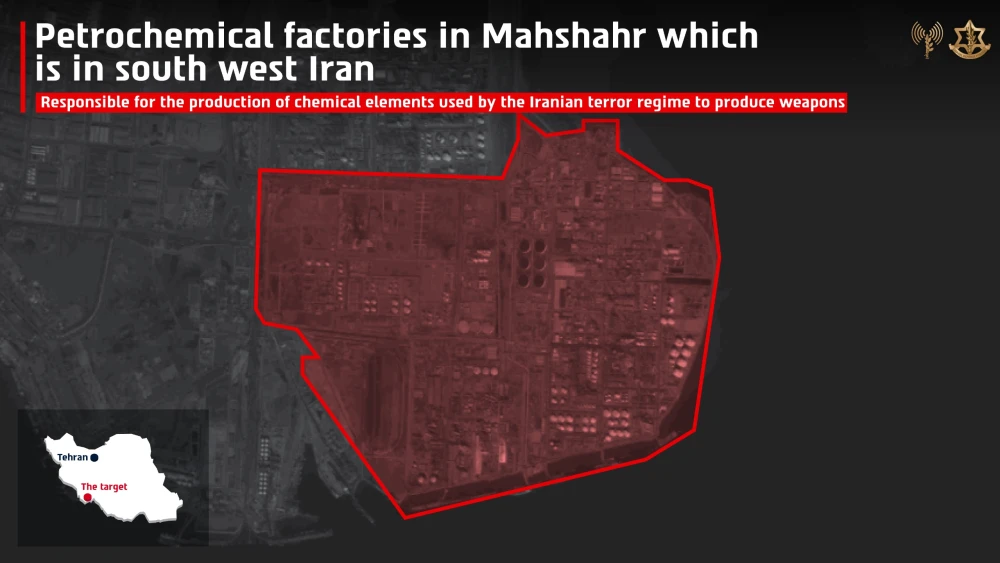

During “Operation Roaring Lion,” the Israeli Air Force conducted intensive aerial strikes targeting chemical-weapons research, development and production sites embedded deep within the Islamic Republic of Iran.
The military campaign systematically targeted and degraded the heavily intertwined military and civilian infrastructure utilized by the Iranian regime to mass-produce pharmaceutical-based agents and other lethal chemical compounds.
In public discourse, Iran’s chemical weapons program is less notorious than its nuclear or missile programs. On the ground, however, the Israel Defense Forces systematically targeted chemical-weapons-related sites such as the Islamic Revolutionary Guard Corps’ main military institution, Imam Hossein University, located in the heart of Tehran.
The university’s chemistry center, dedicated to the research and development of chemical weapons, according to the IDF, was a central technology and engineering complex.
On April 1, the Washington-based Institute for Science and International Security stated that the IDF had struck a building producing fentanyl for the Iranian Organization of Defensive Innovation and Research, adding that there is evidence Iran was working on weaponizing incapacitating and lethal pharmaceuticals.
On the same day, the Israeli Air Force confirmed that it struck a factory that transferred such chemicals to the Iranian regime. It added that fentanyl, an anesthetic, is considered highly lethal at high dosages, and was used for chemical-weapons research and development in Iran.
Oded Ailam, a former head of the Counterterrorism Division in the Mossad, and currently a researcher at the Jerusalem Center for Security and Foreign Affairs, told JNS in recent days: “Iran was intensively engaged in the development of chemical and biological weapons in several research institutes and universities, including the Shahid Meisami Group research group, some of which were destroyed in the current strikes.”
The Iranian regime operates these programs in direct violation of international law, Ailam noted.
Iran is a signatory to the Chemical Weapons Convention but violated it, said Ailam, adding that there is evidence of the use of chemical weapons in the attack on an Iranian girls’ school during the 2022 anti-regime protests, and that it even exported chemical and biological weapons, including grenades, to Libya.
The regime’s proliferation extends to regional proxy forces.
“The Syrians used Iranian chemical weapons in the civil war in the attack on Irbin. And apparently even supplied certain components to Hezbollah,” Ailam assessed.
According to the former Mossad senior official, Iranian hackers leaked documents in 2023 from the IRGC university research institute containing evidence of chemical weapons development in a project called “deteret 0.5.”
‘Agents disrupt the central nervous system’
Andrea Stricker, a research fellow and deputy director of the Nonproliferation Program at the Washington-based Foundation for Defense of Democracies, stressed the severity of the threat.
“Iran’s chemical weapons efforts receive far less attention than the nuclear program, largely due to policymakers’ focus, but this downplays a growing unconventional weapons threat,” she told JNS on Wednesday.
The regime deliberately conceals these efforts within civilian sectors, she said.
“Like the nuclear program, Tehran has managed to blend chemical weapons work at both military and civilian institutions, and in some cases exploits the Chemical Weapons Convention’s exceptions on research,” said Stricker.
“Israel has degraded key nodes of the program with the aim of preventing a rapid reconstitution. Israel and the U.S. will need to monitor and disrupt foreign supply chains to ensure the regime can’t restore its capabilities, which it will almost certainly do given the chance,” she warned.
In a recently published briefing, Stricker stated that in the past two decades, the program has increasingly focused on weaponized pharmaceutical-based agents and other substances suitable for riot control or incapacitation.
“The United States assesses that Iran is developing methods to aerosolize fentanyl and other anesthetics into pharmaceutical-based agents,” Stricker noted. “These agents, which can be deployed in combat using grenades as well as against domestic protests, severely disrupt the central nervous system, potentially incapacitating or killing victims.”
The Iranian academic sector plays a central role, she said, noting that according to U.S. State Department assessments, since 2005, Imam Hossein University and Malek Ashtar University of Technology, military-controlled facilities affiliated with the IRGC and the Ministry of Defense, researched chemical agents intended to incapacitate.
“In 2014, the chemistry department at Imam Hossein University procured large quantities of the potent sedative medetomidine from Chinese exporters and has been working to aerosolize and weaponize such pharmaceutical-based agents,” Stricker said.