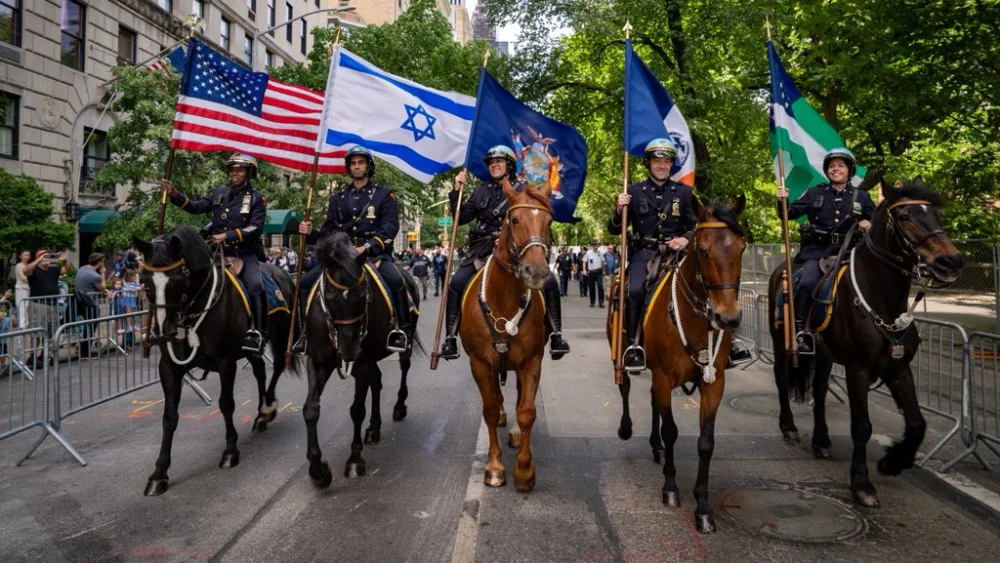

In the end, despite worries about disruptions, the possibility of official indifference to security considerations and the unprecedented absence of the mayor of New York City, Gotham’s annual Israel Day Parade went off without a hitch. More than 50,000 people marched up Fifth Avenue on May 31 to the cheers of spectators of all ages and backgrounds.
Yet the key question to be asked about the parade is not why one man absented himself from it. Rather, it is whether, as some on the Jewish left claim, that an expression of support for Israel’s ongoing and successful struggle to survive and thrive in a hostile world is no longer a cause that brings together most Jews. That is the conceit of commentary in publications like The Forward. It was also reflected in the results of a poll published by a group run by those connected to the Democratic Party.
The issue at the heart of this controversy is not about whether or not it’s acceptable for a mayor of the largest Jewish city outside of Israel to boycott the most important Jewish event of the year. It’s whether the project to normalize anti-Zionism—a belief that is indistinguishable from antisemitism, and behind efforts to target American Jews for intimidation and violence, and Israelis for genocide—is succeeding.
A celebration of Jewish life
The parade is far from the largest ethnic or religious one held every year in Manhattan. Processions celebrating St. Patrick’s Day, Puerto Rico and the Dominican Republic, let alone the Macy’s Thanksgiving Day televised marketing extravaganza, are far larger. But the fact that this annual celebration of the Jewish state requires far more extensive security than those popular events speaks volumes about the surge of antisemitism that American Jews are currently experiencing.
There was a lot of criticism of Mamdani’s decision to be the first mayor to boycott the parade since its inception in 1965—and understandably so.
The event is the single citywide affair that honors the heritage and interests of one of the area’s largest ethnic and religious groups. Slightly less than 1 million of the Big Apple’s nearly 9 million residents are Jewish. Every previous mayor and most other major elected officials on the municipal and state level have felt it obligatory to show up for it. The sight of politicians elbowing their way to the front rank of the parade is as familiar at Israel’s day in the sun as at the other ones devoted to other constituencies.
But this year, the city’s mayor was only present in the form of humorous cardboard cutouts of him and his wife, Rama Duwaji, carried by some wags in the crowd, in which they were depicted as waving Israeli flags. Some social-media accounts used AI to produce images of the pair as if they were Thanksgiving Day balloons, in which they were similarly shown as holding the blue-and-white emblem of the Jewish state.
Nevertheless, the 34-year-old chief executive of the nation’s largest city was right to stay away.
Say what you will about a demagogic politician dedicated to reviving Marxism—one of history’s bloodiest and costliest failures—as if the catastrophic events and slaughter brought on by it never happened. But on this issue, at least he wasn’t a hypocrite. Having centered his entire career as an activist and elected official primarily on his devotion to the cause of eliminating the one Jewish state on the planet, Mamdani’s presence on Fifth Avenue would have made little sense. More than that, it would have been offensive.
Those, like the mayor, who support international efforts to deprive Jews of rights they wouldn’t think of denying to any other group, have no place in a demonstration that celebrates Jewish life and the achievements of the Jewish state.
Mamdani also wisely chose not to interfere with the parade. Instead, Police Commissioner Jessica Tisch, the parade’s honorary grand marshal, ensured that the New York City Police Department did what it does best. Tisch, who at times seems to be acting as the antisemitic mayor’s ambassador to the Jewish community, allowed Mamdani to stay away without being accused of undermining the event.
While the mass turnout produced the usual feel-good vibe, it’s also true that Jewish New York, which turned out in far larger numbers in 1967 (when a reported quarter-million people attended just weeks before the Six-Day War, when many believed that a second Holocaust was in the offing), 1977 (when a reported 300,000 people marched and attended) or even in 2002 (when a reported 1 million turned out months after the 9/11 attacks), no longer exists.
The post-Oct. 7 world
The vast majority of American Jews still support Israel. But many liberal and left-wing Jews have largely internalized and/or accepted the barrage of smears aimed at it. Others even believe the blood libels about it committing “genocide” in Gaza or being an “apartheid” state—false accusations that have been mainstreamed by corporate media outlets like The New York Times.
The Jewish world of 2026 can still mobilize many members of Jewish organizations, as well as schools and synagogues, to show up for the parade. But after the events of the last 32 months since the Hamas-led Palestinian Arab terror attacks on Israel on Oct. 7, 2023, it’s not surprising that many individuals are probably afraid to turn up at a pro-Israel gathering. They know the statistics that show that antisemitic attacks have become commonplace in New York and other cities across America. And they are aware of the fact that the mayor has egged on mobs that have besieged synagogues where pro-Israel events have been held, as well as supporting those who have turned college campuses into hostile environments for Jews.
Yet what is deeply concerning is the effort to treat Mamdani’s views and their acceptance by the anti-Israel movement that has seemingly captured the base of the Democratic Party as being distinct from Jew-hatred. When pundits in left-wing publications disingenuously claim that opposition to Israel’s existence as a Jewish state isn’t antisemitism, they aren’t merely making an indefensible argument. They know that Jewish security in a Middle Eastern state where Jews couldn’t defend themselves is an invitation to the genocide that Palestinian supporters of Hamas and other terror groups dream about.
And they also recognize the purpose of efforts to demonize Israel and to distract from and/or deny the mass atrocities committed by its foes, such as The New York Times’ blood libel about Israelis training dogs to rape Palestinian foes. It is part of the drive to strip the Jewish state of support and render it vulnerable to the mass murder for which Oct. 7 was only the trailer.
Just as troubling is the question of whether a growing number of Jews support this insidious campaign.
A CNN exit poll claimed that Mamdani got 32% of the Jewish vote last November. A subsequent—and more accurate—poll claimed that the figure was only 26% and that most of those who did cast their ballots for him did so despite his anti-Zionism, not because of it. Given that many Jews are dyed-in-the-wool partisans who will always vote for the Democratic candidate and that many considered the alternatives unacceptable, particularly the disgraced former Gov. Andrew Cuomo, that explanation makes sense. But even the CNN poll acknowledged that the overwhelming majority of Jews in one of the deepest-blue enclaves in the nation voted against Mamdani.
Are younger Jews anti-Zionist?
However, a new poll produced by the Jewish Voters Resource Center, a left-wing outfit associated with the Jewish Democratic Council of America, produced some troubling results that underline worries about the acceptance of anti-Zionism. Its questions were largely worded to produce results that demonstrate opposition to President Donald Trump and the current Israeli government. And its sample was disproportionately made up of people with only tenuous claims to being members of the community, with only 76% of respondents saying they considered themselves Jewish by religion. It also bears noting that nearly half (49%) said they got their news from The New York Times.
With such a skewed sample, it probably isn’t surprising that it reported that a quarter of all of the people claiming to be Jews that it polled supported the replacement of Israel with the chimerical notion of a “binational” state in which Jews there would be left defenseless. A stunning 51% of those polled under the age of 35 supported that idea. A majority also said they opposed the war against Hamas. But the result that probably gratified the partisan funders of the survey most was the one that said that 52% of those polled claimed that Trump was antisemitic.
A poll that was worded in a less partisan manner—and in which those who had no real ties to the Jewish community and didn’t practice Judaism were not over-represented—would have produced different results. Suffice it to say that anyone—let alone anyone Jewish who has any sympathy or sense of connection with, or knowledge of, what Israelis think—would not support the destruction of Israel or stand against the war to degrade Hamas, Hezbollah and their Iranian sponsors.
It’s undoubtedly true that some Jews believe that a man with Jewish grandchildren, who is also the most pro-Israel president in history, as well as the one who has devoted the most resources and policy actions to combating Jew-hatred, is an antisemite. There are reasonable critiques to be made of the president, his administration and its policies, including those related to Israel.
Still, the accusations against him in this case aren’t rational or based on anything but a fashionable belief that “anyone I don’t like is Hitler.” This is a function of the hyper-partisan spirit of the times, when politics has replaced the role that religion used to play in most people’s lives. It also speaks to how those who only get their information about Israel or any other topic from the Times and other mainstream liberal outlets are among the least informed people in the world.
Normalizing antisemitism
Whatever we think about the poll and the biased actors promoting it, the notion that such attitudes constitute a justification for Mamdani’s anti-Zionism is risible. Suffice it to say that Democratic partisans who have consistently sought to overturn the decisions of the democratically elected government of Israel and the will of the overwhelming majority of the voters that put it into office to empower Palestinians who cheered for Oct. 7 are in no position to judge what is in Israel’s best interests. Those who rationalize or apologize for Mamdani’s bigotry cannot claim to have even a modicum of concern about the safety of Jews.
The absence of the antisemitic mayor from a parade for Israel wasn’t an insult to the Jews of New York. His presence and that of his wife, who cheered online posts about the largest mass slaughter of Jews since the Holocaust, would have been.
Instead, the outrage of those who actually care about the unprecedented surge of Jew-hatred that is confronting American Jews should be focused elsewhere. They should be concerned primarily with the way left-wing ideologues in academia, journalism and politics, as well as right-wing podcasters, are normalizing Mamdani’s belief in the destruction of Israel and the slaughter that would entail. The spillover of this campaign of hate into portions of the Jewish community that are ignorant of the truth about the war on the Jewish state and the consequences that would follow the adoption of anti-Zionist solutions is deplorable. It’s also a much greater problem than which politicians show up for a parade.
Jonathan S. Tobin is editor-in-chief of JNS (Jewish News Syndicate). Follow him: @jonathans_tobin.