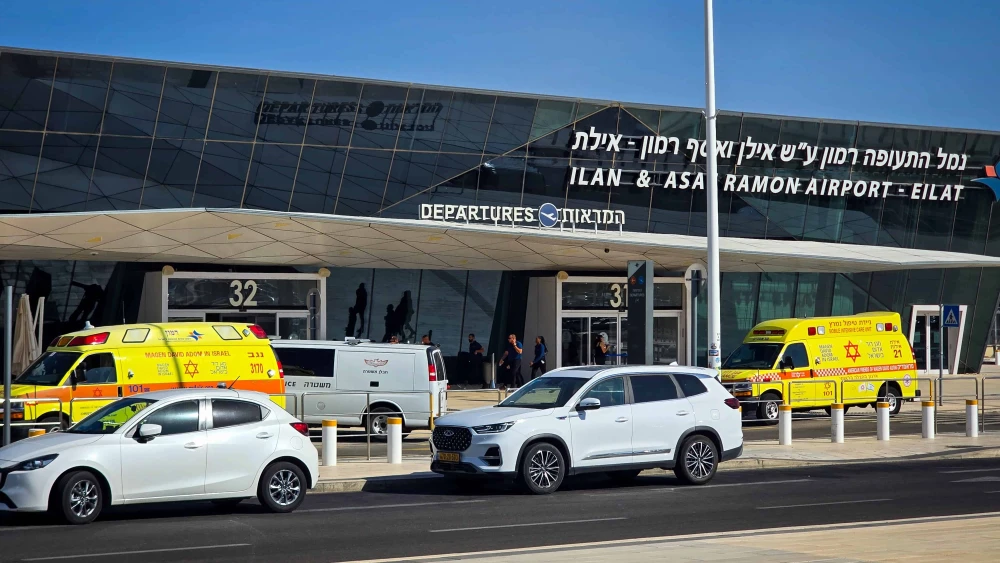

On Sunday, a Houthi drone breached Israel’s defenses and struck the arrivals hall at Ramon Airport, near Eilat, marking the first successful attack of its kind in months.
Two airport workers, a 63-year-old man and a 52-year-old woman, were wounded by shrapnel and swiftly evacuated for treatment. Flights were suspended for approximately two hours before resuming, following Israeli Air Force approval and safety inspections.
The drone, detected but not deemed hostile, escaped interception, a lapse now under investigation. The Iran-backed Houthis claimed responsibility. Houthi spokesperson Yahya Saree declared: “As long as the war in Gaza continues, Israel’s airports … will be continuously targeted.”
Houthi aggression
The strike at Ramon Airport continued a trend of escalation seen over the past several months. The summer saw a steady expansion of Houthi activity against Israel and international shipping.
On July 7–8, Houthi forces carried out an assault on the MV Eternity C, a Greek-operated, Liberian-flagged bulk carrier in the Red Sea. Using unmanned surface vessels (“sea drones”), speedboats, rocket-propelled grenades, and both cruise and ballistic missiles, they sank the ship, killing four crew members, leaving five missing and kidnapping six.
The Houthis claimed the vessel was linked to Israeli trade routes. This was the deadliest Houthi operation since the outbreak of the Swords of Iron war in October 2023. In the same period, the group also widened its targets beyond the battlefield. On Aug. 31, armed Houthis raided United Nations offices in Sanaa and Hodeidah, detaining at least 11 staff members from agencies including World Food Programme, WHO and UNICEF.
Since the end of the March ceasefire, Israeli officials report that the Houthis have fired at least 80 ballistic missiles and 31 drones toward Israel itself.
On Sept. 3, the IDF intercepted a missile launched from Yemen that triggered alarms in Tel Aviv, later confirming: “This morning … a field examination concluded that the Houthi terrorist regime used a cluster surface-to-surface missile.” The use of a cluster warhead, designed to scatter bomblets over a wide area with no control over where they fall, marked an unprecedented expansion of Houthi aggression.
Israel’s offensive strategy
Israel’s military response unfolded in a series of strikes over the summer. On June 10, the Israeli Navy hit Hodeidah Port, which the IDF described as a hub for Iranian weapons smuggling into Yemen.
On June 14, Israeli warplanes targeted the home of Houthi Chief of Staff Muhammad Abd al-Karim al-Ghamari in Sanaa. Israeli officials said he was injured, though the Houthis denied this. On July 6, Israel launched “Operation Black Flag,” a broad campaign against Houthi-controlled infrastructure and port facilities.
The most dramatic escalation came on Aug. 28, when the Israel Defense Forces carried out “Operation Lucky Drop,” striking a Cabinet meeting in the Houthi-controlled Sanaa neighborhood of Bayt Baws.
Among those killed were Prime Minister Ahmed al-Rahawi, appointed in August 2024, and no fewer than nine Cabinet ministers, including those in justice, foreign affairs, economy, agriculture, energy, culture and social affairs.
Additionally, reports suggest high-level military figures such as Defense Minister Mohamed al-Atifi and Chief of Staff al-Ghamari were likely killed or seriously wounded.
Israeli leaders hailed the operation as a turning point. Prime Minister Benjamin Netanyahu declared it was “only the beginning of the decapitation strikes in Sanaa; we will reach them all,” while Defense Minister Israel Katz said the surviving Houthi leaders were “escaping Sanaa” and warned, “We knew how to hunt them this time, and we will know how to do so in the future as well.”
Dan Diker, president of the Jerusalem Center for Security and Foreign Affairs, said the strikes demonstrated strategic reach.
“The strikes sent a clear signal that the arm of Israel is very long and can strike its enemies anywhere. It makes clear there is a price to be paid for the Houthis’ aggression,” he said.
Experts pointed out that the strike was particularly significant as it implied a crucial improvement in Israel’s intelligence capabilities on the ground in Yemen.
IDF Military Intelligence Maj. (res.) Alexander Grinberg, an expert on Iran at the Jerusalem Institute for Strategy and Security (JISS), said: “There’s definite value in hitting their leadership, mostly because it sends a clear message that there is a price to pay for attacking Israel and also because it shows that we know where they are and that we penetrated their system with good intelligence.”
Future targets
The Houthis’ surviving leadership remains in the crosshairs. At the top is Abdul Malik al-Houthi, the group’s overall leader, who rarely appears in public but continues to deliver speeches broadcast across Houthi-controlled media. Israel’s Kan public broadcaster identified him as the “key IDF target for elimination due to his symbolic and operational significance.”
Danny Ayalon, a former deputy foreign minister, former ambassador to the U.S. and chairman of Silver Road Capital financial advisory firm, told JNS: “It is important to have a price on the head of the Houthis’ leaders. If al-Houthi and a few others were taken out, it would make a major difference.”
On the political front, Mahdi al-Mashat, head of the Supreme Political Council, has assumed greater visibility since Rahawi’s death and has issued repeated threats toward Israel. His role as de facto head of state makes him one of the most prominent figures still in place and a potential target.
On the military side, Abd al-Khaliq al-Houthi, brother of Abdul Malik al-Houthi, commands elite Houthi units and is closely tied to the group’s drone and missile program. He is also deeply implicated in Houthi arms smuggling operations.
Yahya Saree, the military spokesman, has emerged as the face of the Houthi campaign, issuing claims of responsibility and operational details after strikes on Israel. Intelligence and logistics officials are also considered critical.
Abdullah Yahiya al-Hakim (aka Abu Ali al-Hakim), head of Houthi intelligence, is believed to coordinate with Iranian advisers and manage arms shipments through Hodeidah. Figures in these procurement networks are viewed as vital links keeping the Houthis supplied with advanced weaponry.
Israeli outlets note that Jerusalem’s intelligence services are closely tracking these remaining leaders. Israeli defense officials have confirmed that the August strike was intended to signal to the Houthis that no one in the chain of command is beyond reach, and that there were ongoing Israeli efforts to map the Houthis’ surviving military and logistical echelons for future operations.
Grinberg offered a note of caution. “Taking out their leaders is not enough to stop the Houthi threat,” he argued, emphasizing that the group’s structure differs significantly from Israel’s other regional adversaries.
“The Houthis are not Hezbollah. Hezbollah is a very centralized and structured organization where if you take out their leadership, such as [Hezbollah leader Hassan] Nasrallah, it has a major effect on how they can carry on their operations,” he added.
By contrast, Grinberg said, the decentralized nature of Yemen’s insurgent network means that eliminating top figures may not yield the same results. “The Houthis are a much more primitive conglomerate of tribes, so taking out the leadership has less of an effect on their capacity to carry on their attacks,” he explained.
Is an air campaign enough?
Although Israel’s Aug. 28 operation dealt a heavy blow to the Houthi Cabinet, the group’s missile and drone fire has continued. This has pushed Israel to expand its strategy on other fronts.
While Israel’s air campaign has been the centerpiece of its operations in Yemen, experts point out that disrupting smuggling networks remains a critical supplemental necessity. In a recent press briefing, Israeli defense officials explained that “Houthi stockpiles are regularly replenished through shipments arriving in Hodeidah and other Red Sea ports, carrying components for drones, missiles and radar systems.”
Analysts point out that punishing Iran directly for its role in backing Houthi aggression is another critical pressure point for resolving the Yemen front. Israel views Tehran as the central enabler of the Yemeni group’s growing capabilities.
Since 2014, the Islamic Revolutionary Guard Corps’ Quds Force, working alongside Hezbollah advisers, has provided the Houthis with training in missile, drone and UAV operations and helped establish local weapons workshops inside Yemen.
Diker explained that the link between the two fronts is unmistakable. “The Houthis are a crucial node in the Iranian terror network. The strikes coming out of Yemen are sourced, funded, and inspired by their masters in Tehran,” he said. “Israel’s high-pressure point against IRGC aggression is to remind the Iranian regime that Israel will immediately hold them accountable for every Houthi missile and drone attack.”
For now, Israel has focused on assassinations and smuggling interdictions, but the option of striking Iran directly is openly discussed. Defense Minister Israel Katz has warned that Tehran will be “held accountable” if Houthi attacks escalate further.
Grinberg elaborated on the range of options available to Israel: “Israel can strike Iranian targets without necessarily very openly targeting the central regime targets. For instance, there are many maritime and naval targets that Israel can strike either openly or covertly, which will clearly send a message to Tehran that they are being punished for their support for the Houthis.”
Yemeni officials have emphasized that defeating the Houthis outright would require significant external support. As one officer of the Yemeni National Resistance said in a recent interview, “Airstrikes alone will never be enough; only ground forces can drive the Houthis out, but our forces cannot succeed without weapons, logistics and international backing.”
For now, Israel has not openly signaled willingness to engage with on-the-ground proxies, and Washington has not committed to supporting a coastal ground-war. This leaves the prospect of ground offensives against the Houthis as a potential, but currently unrealized, option within the wider conflict.
Grinberg noted that while such operations may ultimately be necessary, they carry significant risks. “It is very possible that solving the Houthi problem will not be possible without having some kind of ground operations using proxies,” he said, warning that military planners must be clear-eyed about the challenges involved.
Diker added to this sentiment, arguing that long-term success mostly required decisive and clear deterrence that clearly linked Houthi attacks to a strong response.
“When talking about the Houthis or other jihadi assaults, it is important to differentiate between Western ‘solutions’ and the Middle Eastern notion of Victory. In the Middle East, it’s critical to speak and act ‘Middle East,” Diker said.
“Action speaks volumes and talk is cheap. Since Oct. 7, Israel has incorporated active prevention mechanisms. Massive power projection and decisive, immediate, and disproportionate response sends the message that Israel’s enemies understand,” he concluded.