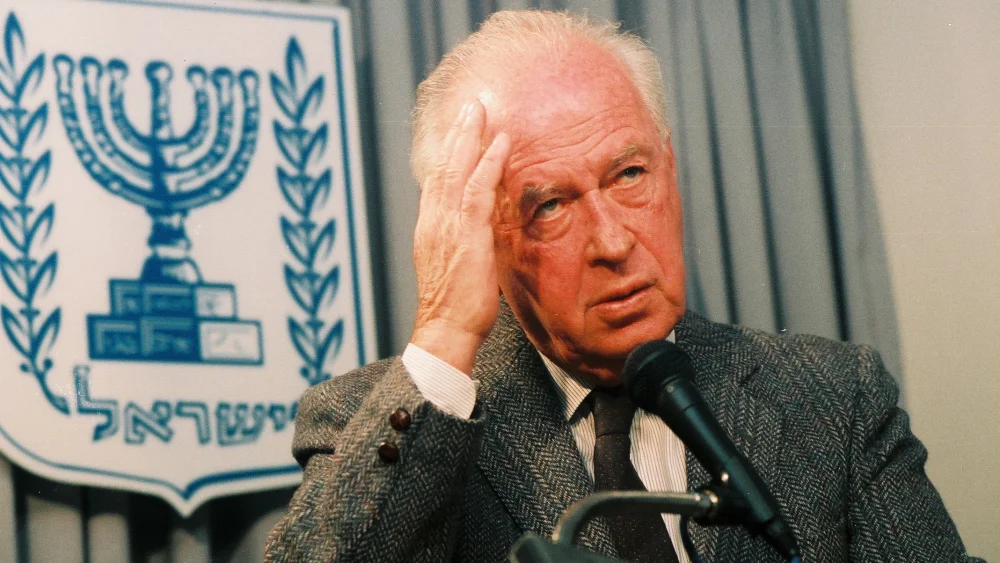

Hamas was founded in the late 1980s, and by 1992, during Yitzhak Rabin’s time as Israel’s prime minister, it had already become a major Islamic terrorist organization. It had shown a clear penchant for violence, including murder and kidnapping. Rabin initially took decisive steps to consign Hamas to the dustbin of history.
Then, tragically, he blinked. Under pressure from Peace Now, the United Nations, Europe and the White House, Rabin reversed course.
It is instructive—and deeply sobering—to recall exactly what happened.
On Dec. 13, 1992, Nissim Toledano, an Israeli border police officer, was kidnapped by Hamas in the central Israeli city of Lod—not in Gaza but in the heart of Israel. Two days later, his body was found. Hamas had sought to exchange Toledano for Sheikh Ahmed Yassin, the founder of Hamas, who at the time was serving a life sentence for ordering the murder of Palestinian collaborators.
The Israeli government responded swiftly and decisively. Rabin’s administration arrested more than 1,000 in relation to the incident, and deported more than 400 Hamas and Palestinian Islamic Jihad terrorists to Lebanon. These terrorists were sent to a Southern Lebanon no-man’s land between Israeli Defense Forces checkpoints and Lebanese army checkpoints. The expulsions should have been regarded as correct by world leaders. If Rabin’s critics inside Israel and outside of it had the foresight to see Hamas for exactly what it was, so much future carnage would not have happened. The trajectory of Israeli history would have been changed.
Instead, the backlash came quickly and forcefully.
The condemnations were immediate and widespread. The Bush administration—President George H. W. Bush’s—criticized the expulsions. White House Press Secretary Marlin Fitzwater urged nations to “avoid reactions such as deportations that risk complicating the search for peace.” The statement ignored the context: a murdered Israeli police officer and a terror network responsible for a growing list of atrocities are not morally equivalent. Hamas has never wanted true peace.
U.N. Secretary-General Boutros Boutros-Ghali called on Israel to “rescind the expulsion order.” Within days, the U.N. Security Council unanimously passed Resolution 799, which condemned Israel’s actions and demanded the immediate return of the deportees. Amnesty International chimed in, saying it was “seriously concerned” by the deportation. The European Economic Community issued a call for the Israeli government to allow the deportees to return at once.
Egypt also weighed in. Amr Moussa, then Egypt’s Minister of Foreign Affairs, insisted that “the deportees must be allowed to return, whether they belong to Hamas or Fatah or any other faction,” and incorrectly argued that Israel did not have “the right to deport them collectively.” Israel had every right.
Among those deported was none other than Ismail Haniyeh, who would later become a senior Hamas leader and the mastermind behind countless acts of terrorism. His permanent expulsion could have marked the end of his influence. Instead, it became a temporary inconvenience.
Faced with this wave of international pressure, Rabin surrendered. Within months, the deportees’ terms of expulsion were reduced from two years to just one year. The majority returned—many to Gaza, and others to Judea and Samaria. And Hamas, far from being on its way out, reconstituted itself with renewed energy.
If only Rabin had not blinked. If only he had maintained his resolve and followed through with the permanent expulsions that were very much warranted, perhaps Israel could have been spared decades of escalating conflict, suicide bombings, rocket attacks and a terrorist invasion. The failure to decapitate the leadership of Hamas when the opportunity clearly presented itself is one of modern Israel’s most devastating missed chances.
Thirty-three years ago, a prime minister—though he had initially made the right choice—ultimately succumbed to both domestic and international pressure. The result was not peace. The result was tragedy, and it set the stage for an unceasing war of terror against Israel.
Rabin’s decision gave Hamas a second life, and Israelis have been paying the price ever since.