


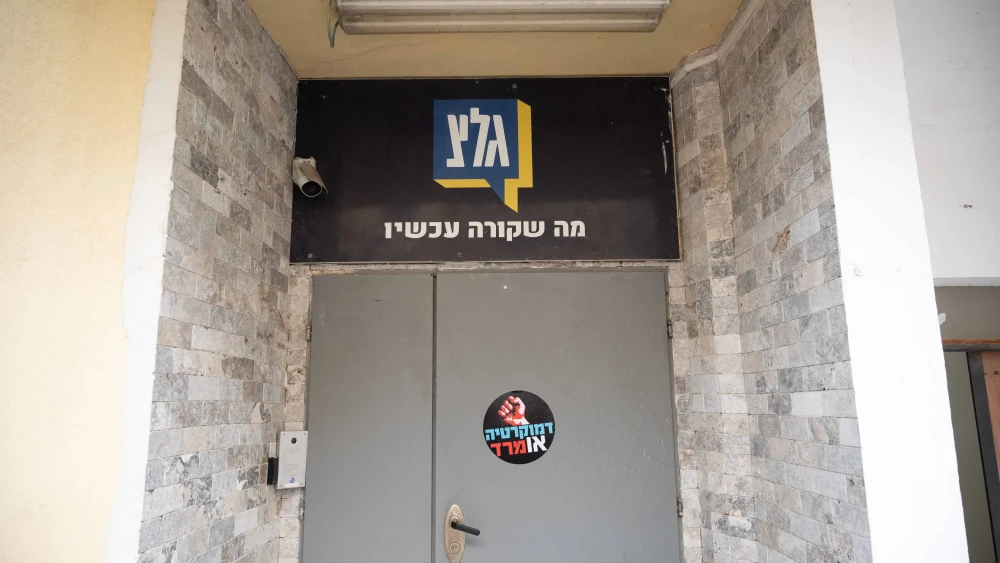

Israeli Defense Minister Israel Katz’s announcement that Galei Tzahal (Army Radio) will officially shut down on March 1, 2026, has sent the local media establishment into one of its habitual frenzies. You’d think, from the hysterics, that he was about to muzzle dissent. But all he’s done is put an end to a publicly funded relic whose purpose expired long before the smartphone era began—and whose politicization made its continued existence not only unnecessary, but counterproductive.
Let’s start with the obvious: Army Radio, once conceived as a morale-boosting communications arm for the Israel Defense Forces, long ago morphed into a garden-variety left-wing news outlet. Meanwhile, its overhead and salaries were footed by the very taxpayers whom it increasingly belittled, scolded and lectured.
Indeed, the station that was born to uplift the troops has become one more platform for pundits whose contempt for the current government—and even, in some cases, for the IDF itself—is a daily feature, including throughout the multi-front war that the military has been fighting valiantly.
This alone would have justified the defense minister’s decision. Why should conscripts, reservists and the parents who send their children to defend the country be forced to subsidize programming that frequently undermines their mission?
But that’s not the main point, which is that Army Radio is an anachronism. Like its television/radio counterpart, Kan (the Israeli Public Broadcasting Corporation)—also funded by tax shekels—it’s a leftover from a bygone era of nanny-state broadcasting.
That world no longer exists, certainly not among the young. Soldiers today have cellphones in their pockets, with access to endless content from across the spectrum and from around the world. Most Israelis who still listen to the radio do so in their cars—hardly the setting envisioned when Army Radio first crackled across the nation in 1950, just two years after Israel’s founding.
Initially established as a modest internal communications tool, its early broadcasts featured updates for troops, military announcements, music and occasionally educational programming for the general public. Over time, it grew into a full-fledged national station—staffed by a mixture of civilians and men and women in uniform—wielding disproportionate, unwelcome influence over the country’s political conversation.
By the 1970s and 80s, it had become a prestigious institution—a training ground for journalists who went on to dominate Israeli media. It also became an ideological laboratory, where the line between reporting and editorializing was blurred, if not erased.
Under the guise of “independence,” it drifted steadily woke-ward, even while sitting squarely under the umbrella of the Defense Ministry. In other words, it enjoyed all the privileges of being a state entity without any of the restraints or accountability that should accompany that status.
The professional mourners now claiming that shutting it down represents an assault on free speech are being deliberately disingenuous. No journalist is being muted, no viewpoint banned, no microphone confiscated.
They are completely free to continue pontificating to their hearts’ delight. They just won’t be able to do so with cash from the hard-working public. This is only an affront to those who believe that the right to express one’s opinion includes a government stipend.
This isn’t about left versus right—though many of the people attacking Katz for the move support the stifling of conservative commentary. It’s about public versus private.
There is no democratic justification for maintaining state-funded broadcast media in 2026. Not when the entire ecosystem of news has moved online; not when consumption habits have fundamentally changed; and not when the barriers to entry for independent journalism have never been lower.
If anything, privatization strengthens freedom of expression. It eliminates bureaucratic oversight and forces broadcasters to earn their audiences.
Older Israelis will remember the dreaded annual levy every household had to pay simply for owning a radio or television set. It was enforced by inspectors who would knock on doors to ensure compliance. The tax was widely despised, a symbol of intrusive government overreach and outdated state control of communications.
When it was finally abolished in 2015, Israelis celebrated. Not a single person complained that eliminating the tax endangered free speech. On the contrary, the cancellation of the ridiculous compulsory payments was seen as a victory for common sense and individual liberty.
Today’s media outcry over Army Radio is simply a rerun, this time with journalists playing the role of the tax inspectors banging on the public’s doors, demanding continued payment.
If Army Radio’s content is worthy of listeners, it will survive, maybe thrive, as a private station. Let it raise money, attract advertisers, build subscriber models or partner with media groups. Indeed, let it compete in the market—and marketplace of ideas.
Privatization isn’t a punishment, other than for those laurel-resters who aren’t able to hack it without a guaranteed slot. If Army Radio isn’t up to the task, the only people who will suffer are the station’s laid-off employees.
The rest of us won’t notice or care—other than the High Court of Justice, that is, which will be hearing and likely siding with bleeding-heart petitions about “preserving democracy.” Ho-hum.
But at least Katz will have been vindicated for taking a step in a sorely needed direction.


