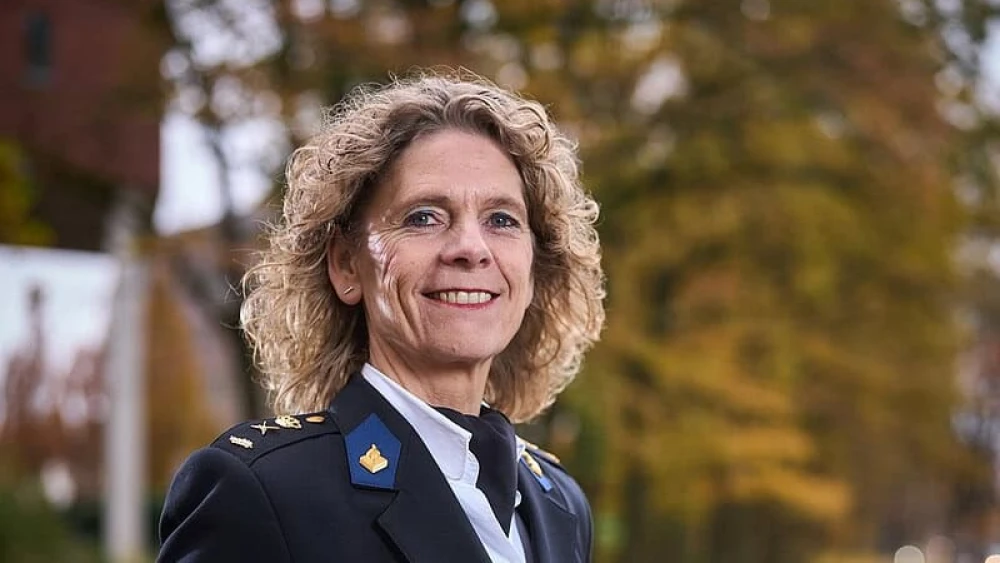
Following reports about Dutch police officers refusing to protect Jewish community events for ideological reasons, the force’s top officer last week said Dutch police will hold “an internal conversation on how to deal with such dilemmas.”
Janny Knol’s statement from Oct. 2, which contained no explicit rebuke to the officers in question, followed a controversy that began with a report on Sept. 29 in the NIW Dutch-Jewish weekly.
Michel Theeboom, a leader of the Jewish Police Network, an association of Dutch-Jewish police officers, told NIW that: “Some colleagues don’t want to protect Jewish locations or events. They cite ‘moral dilemmas’ and I’m seeing a tendency to give in [to that], which would be the beginning of the end. I’m really worried about that.”
Two Dutch lawmakers, Ulysse Ellian and Ingrid Michon of the People’s Party for Freedom and Democracy, on Oct. 1 sent a critical query to Justice and Security Minister David van Weel, who is also a member of the party, asking him what actions her office had taken to “make sure that the police are for everyone, including Dutch Jews.”
In her statement, police commissioner Knol wrote: “Police officers naturally have their own opinions and emotions. That’s fine. But if people require our help or protection, they can count on us. Always. We are for everyone. That’s the basis of police work.”
She added that on this “there can be no discussion” in the conversation she vowed to initiate.
She did not mention any intention to discipline officers who opt out or seek to opt out of protecting Jews.
The report about the opting out of police officers from protecting Jewish events and institutions was widely covered in national-circulation media and shocked many of the country’s Jews, already reeling from a near tripling of recorded antisemitic incidents in 2023 over 2022.
Many Jews in the Netherlands feel that police are too lax in enforcing laws designed to protect Jewish citizens, among others. Some Dutch Jews have bitter memories of the mass collaboration of Dutch police with the Nazis during the Holocaust, when 75% of the local Jewish population was murdered. It was the highest death rate of any country in Nazi-occupied Western Europe.