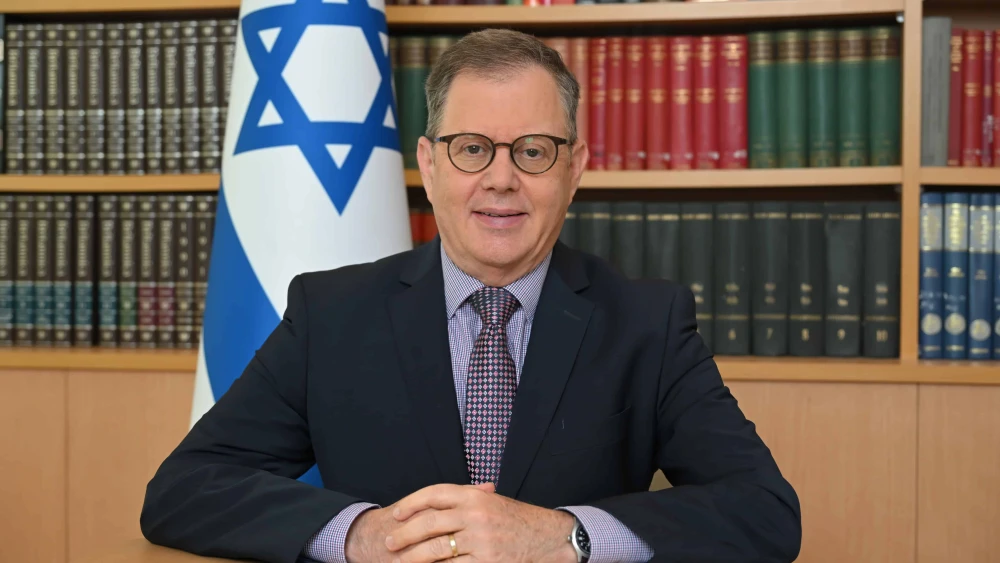
As Daniel Meron, Israeli ambassador to the United Nations in Geneva, Switzerland, readies to retire after almost 40 years working for the Israeli Foreign Affairs Ministry, he remains convinced that it is vital for the Jewish state to keep making its case on the global stage, despite the prominent anti-Israel voices and states there.
“Israel’s voice must be heard out on the international scene, and we have much to say,” he told JNS from Geneva. “If we speak loud and clear, and we speak the truth, people will listen to us. They must listen to us.”
“We cannot leave this world stage open without having a response, without having our position being heard,” he said. “That, maybe, is my most important take from my diplomatic career.”
Meron, who posted in Geneva beginning in 2022, has led the life of a diplomat since he was a cadet in Caracas, Venezuela, in 1989. He has served in the No. 2 positions at Israel’s embassies in Nicosia, Cyprus, and in Oslo, Norway, and as a counselor and, later, minister for congressional affairs in Washington. He also served as Israel’s ambassador to the Czech Republic.
He has also served at the Foreign Affairs Ministry as deputy director general for European affairs, special envoy for global health, head of the U.N. and international organizations bureau, coordinator for sustainable development, director of the department of human rights and humanitarian affairs and acting deputy director in the treaty department of the office of the legal adviser.
Meron is also a former foreign policy adviser to Israeli President Ezer Weizman.
In all of his time as a diplomat, some of his starkest memories have come amid tragedy.
On Sept. 11, 2001, he received an order to evacuate the Israeli embassy in Washington, since it wasn’t clear then whom and what terrorists were going to target next.
“I will never, never forget those scenes of going down to the main streets in D.C. and seeing hundreds fleeing from the center of town to the suburbs,” he told JNS. “The terrible feeling of despair when we didn’t know what was happening.”
He also recalled when his friend David Ben Rafael, an American-born lawyer who was then deputy chief of mission in Buenos Aires, was killed when Hezbollah terrorists blew up the embassy. Ben Rafael, 43, was one of four Israelis who were among the 29 people killed.
There have also been highlights, Meron told JNS. Those include accompanying Czech Prime Minister Andrej Babiš on a 2021 visit to Jerusalem, where the latter opened an office of the embassy in the capital city.
“That was a very exciting moment,” Meron said. “And many trade fairs and commercial events and cultural events that we organized around the world.”
“I have many more good memories to continue with me,” he told JNS.
Europe ebbs and flows
Israel’s positive relations with the Czech Republic are an example of the Jewish state’s positive interactions in Eastern Europe, as it has in its “great friends” further west, like the United Kingdom and the Netherlands, according to Meron.
Europe ebbs and flows depending on the governments in power, he said.
“Look at Slovenia, for instance. The previous government shamefully supported the policies that were promoted by the left-wing governments of Spain, of Ireland,” Meron told JNS. “Now they are among our best friends in Europe.”
“We have to maintain those relations and remind the countries of our strategic connection, of our interests that we have together,” he said. “It’s an ongoing effort to cultivate those relations. They don’t come by themselves. You have to work for them.”
Israel has been doing that in Asia and Latin America, where relations have improved as new governments operate in Bolivia, Colombia, Chile, Costa Rica, Ecuador and Peru, according to Meron.
The Israeli diplomat quoted the Biblical Hebrew from Jeremiah 51:5 to describe the Jewish state’s standing—“Israel is not a widower.”
Meron’s final posting in Geneva is in a role that isn’t widely understood or appreciated, and that doesn’t garner international headlines, as ambassadors to the United Nations do in New York, home to the Security Council and General Assembly.
But some 40 organizations, including the Human Rights Council and World Health Organization, are in Geneva, as is the lesser-known International Labor Organization.
Geneva is where the Jewish state battles annually against the Human Rights Council’s standing agenda item No. 7, the council’s only item specific to a country, which singles out Israel for extended scrutiny and debate.
It’s also where the council appoints U.N. special procedures, the special rapporteurs that it calls “independent experts” but who, critics say, focus obsessively on Israel. Francesca Albanese, whom the U.S. federal government has sanctioned, is the most high-profile Israel-hater of the special rapporteurs.
Meron said that the way that the council criticizes the Jewish state is “gross mistreatment of Israel” and “unbelievably disproportionate to anything else that is done at the U.N.”
“They can talk about Sudan for five minutes and for two hours about Israel,” he told JNS.
Meron’s final day on the job is Nov. 12. The Israeli mission in Geneva recently hosted some 60 ambassadors for a reception honoring Meron prior to his departure. He isn’t sure what he will do next, beyond some gardening and looking after grandchildren, he said.
He’d like to continue to help Israel’s image in the world via climate adaptation, where the Jewish state has been a leader in food security, including developing food alternatives like milk and meat.
“I’m thinking of putting together a body which would be the Israeli Center for Agro- Climate Resilience. Something like that,” Meron told JNS. “This is an idea I have in my head. I’ll see how that goes about.”
He said that there was wide-ranging interest in an event last month that Israel co-hosted with the United Nations Economic Commission for Europe about quantum technologies.
“Many countries sometimes are afraid to speak out publicly but afterwards, they come and they say, ‘Wow. We not only admire what we are doing, but we are envious of Israel’s leadership in these fields and we want your assistance in our countries,’” Meron told JNS.
It is fashionable in many circles to disavow Israel publicly, but “in real life, they do business with Israel and they enjoy the great Israeli achievements in technology,” the Israeli envoy said. “We are very pleased to cooperate with them.”
“We are challenged daily, and we should not give our adversaries, our enemies, the pleasure of seeing the empty seat of the state of Israel, because we have a story to tell and if we want to influence international opinion,” Meron told JNS.
“We trade with the world. We meet with the world,” he said. “We don’t want to be ousted from the international scene. We must be there to tell our story.”