
Here’s an interesting one: Does a country need to be democratic to commemorate the Shoah and apply its moral lessons?
That question was posed in the context of the plenary conference held in Buenos Aires last week by the International Holocaust Remembrance Alliance (IHRA). According to Rabbi Yehouda Kaplan, the State Department’s Special Envoy to Monitor and Combat Antisemitism, the answer is an emphatic “no.”
Launched in 2000 by the former Swedish Prime Minister Goran Persson, the IHRA is an intergovernmental organization presently composed of 35 member states. All of them would qualify as “democracies” insofar as they operate under the rule of law and guarantee the freedoms of speech, conscience, assembly and so forth that are essential for open societies. Its conditions of membership state very clearly that “IHRA will only accept countries commonly seen as democracies (i.e. not countries with authoritarian, dictatorial, or totalitarian regimes) to full membership.”
It is this clause that triggered Kaplan’s ire, because it prevented representatives of Saudi Arabia and the United Arab Emirates from attending the parley in Buenos Aires.
“Excluding states that may not be ‘commonly seen as democracies’ risks shutting IHRA out of the very places where its mission is most in demand,” he wrote in a letter to the organization’s secretary-general, Michaela Küchler.
Is Kaplan right to demand that the IHRA abandon what he called its “archaic membership requirements”? To my mind, the answer is a qualified “yes.”
Historically, there are very good reasons not to trust authoritarian states with such delicate matters as Holocaust education and awareness. For one thing, such entities are hardly averse to carrying out mass slaughter based on ethnicity—much as China, Turkey and Russia, to name but three examples, have done and continue to do.
To embrace, hypothetically speaking, China in such endeavors would make a mockery of both the Shoah and the ongoing persecution of the Uyghur minority in the northwestern Chinese province of Xinjiang.
Additionally, such states are prone to distorting and instrumentalizing the Shoah, which means they cannot be engaged with in good faith. The clearest historical example was the Soviet Union, which revised the narrative of the Shoah to exclude not just antisemitism as the foundation of the slaughter, but the Jewish identities of the victims themselves.
Until the Cold War ended, Soviet Jews murdered by the Nazis were referred to only as “Soviet citizens,” because to have highlighted their Jewishness would have undermined the vicious anti-Zionist campaign waged by the USSR on both the domestic and international fronts.
The only time Soviet Jews’ status as Jewish victims of the Nazis was recognized was when Soviet propaganda outlets used them as a stick with which to beat Israel, portraying Israeli leaders as Nazis inflicting on the Palestinians what was inflicted upon Jews during World War II.
There are two basic ways of teaching the Shoah to successive postwar generations, neither of which is satisfactory.
Those are important caveats that should always be borne in mind when dealing with non-democracies on questions of tolerance and intergroup understanding. But do they justify the exclusion of unquestionably authoritarian states like Saudi Arabia and the UAE from participation in the IHRA’s work?
In this very practical sense, Kaplan is correct: They don’t and they shouldn’t.
A blanket ban on them is counterproductive, since it overlooks the possibility of meaningful, if tentative, change from within. Should we dismiss any attempts at cultural transformation from above until these states become fully-fledged democracies? Or is it better for the IHRA to engage and encourage reform of their historical curricula while remaining clear-eyed about the inherent limitations of such an approach?
A larger problem is that the exclusion of non-democracies suggests that antisemitism is a feature only of authoritarian states. Sadly, democracies are equally vulnerable to its poisonous appeal, as Germany so neatly demonstrated when the Nazis emerged as the largest party in both elections in 1932, paving the way for Hitler’s appointment as chancellor the following year.
Moreover, the heavy presence of antisemitism in democratic countries today is arguably more alarming.
In the three years that have elapsed since the Hamas pogrom of Oct. 7, 2023, neither Saudi Arabia nor the UAE have exactly been the main threat facing Jewish communities. The same cannot be said of Spain or Ireland, where antisemitism has overwhelmed the public response to the war in Gaza, shattering any trust or regard that Jews might have had for the nationals of those countries. That is also true of France, Belgium, the United Kingdom, Canada, Sweden, Greece, Australia and even the United States.
All these states, where antisemitic incidents are a near-daily occurrence, are members of the IHRA. That fact has done nothing to stem the tide. Indeed, in Spain and Ireland especially, not only have the leaders of these countries failed to call out antisemitic sentiment; they have actively stoked it.
This sheds light on an even deeper problem. The experience of Jews across the world since Oct. 7 has graphically exposed the fleeting impact of decades of Holocaust education.
There are two basic ways of teaching the Shoah to successive postwar generations for whom it is a distant event in black and white, neither of which is satisfactory.
The first is to focus primarily on the Jewish victims. But we should be smart enough to realize that such a method will inevitably suffer from pushback by those who will insist that even talking about the Shoah is a slippery means of eliding Israel’s supposed crimes against the Palestinians.
The second is to teach the Shoah as a universalist lesson, with far less emphasis on its Jewish character. However, that would precisely mean instrumentalizing six million Jews as an example of why ethnic hatred and racism are wrong in general, playing down or outright ignoring the libels about Jews that motivated the Nazi murder machine.
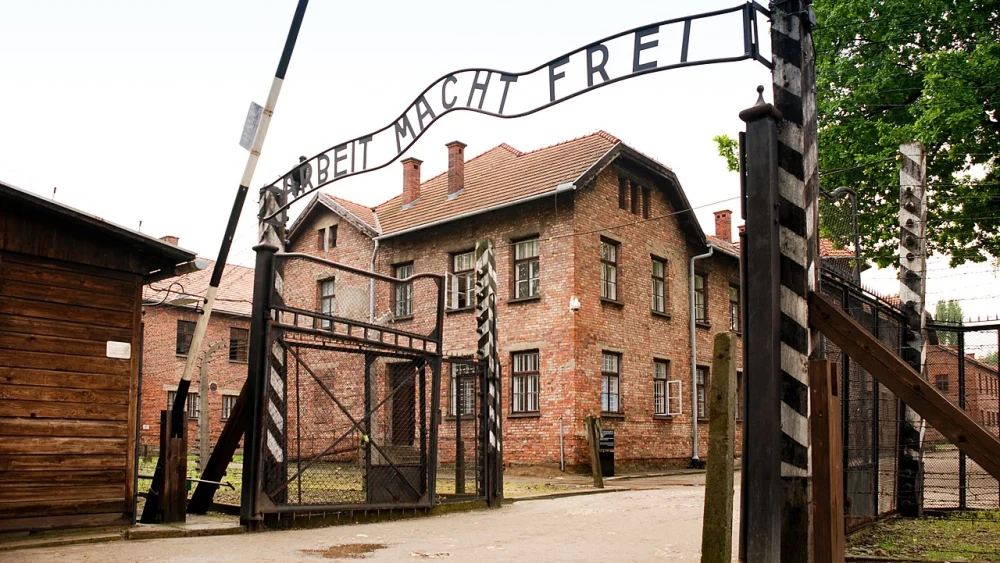
The conclusion I draw from this is that Holocaust education is important for Jews, less so for non-Jews. The horrors of Auschwitz are not by themselves sufficient to persuade increasingly hostile publics that Israel has a right to exist, and that their Jewish fellow-citizens who identify with Israel have every right to do so without fearing violence or discrimination.
That is why the focus needs to be less on the past and more on the present, in as many countries as possible, whether democratic or not. Antisemitism did not die with the Shoah, as the IHRA’s own definition of antisemitism proves. Simply put, we don’t have the luxury of worrying about a country’s democratic credentials before deciding whether to engage.