Shani Rahamim, all of 16, sings. She sings at home, she sings with her mother, she sings with her two older sisters and around her younger brother. “Music is a gift,” she said, sounding wiser than her years. “It’s a big part of being happy.”
Like most teens, it’s also a practical way to escape. Pop on the earbuds and tune out the world.
But Shani doesn’t just plow through playlists. She is a member of HaZamir Jerusalem: The International Jewish Teen Choir. And this August, she traveled with others her age from Israel to Stamford, Conn., as part of the annual Zamir Choral Festival, a five-day conference of practicing and performing, held at the city’s DoubleTree by Hilton hotel.
She was supposed to travel to the United States with her chapter in March, where they were scheduled to perform at none other than Carnegie Hall in Midtown Manhattan. But war with Iran kept them home. To make up for that, the teens got to see a bit of New York City before settling one state over to rehearse with peers under the guidance of adults.

In that short time, she observed that “it’s much more difficult to be Jewish outside Israel. It offers a new look at my Jewish identity.”
Instead of elaborating—about how the United States, or what she saw of it, seemed a bit intimidating—she pivoted back to talking shop. Now in 11th grade, she meets on Sunday evenings to train her voice. “It’s challenging to sing the songs, but it’s a good challenge. It takes time, but when you love something, you put your time into it. And the choir is right next to you; you feel part of something big.”
That may be so, but Shani has more modest dreams: “to be happy and to have a calm life. And singing will always be part of that.”
‘Everyone is dedicated, kind, talented’
Two other teens—Tehila Magal, 17, also from Jerusalem, and Meital Caldwell, 18, from Los Angeles—said the singing group fills their lives with a calling and a purpose. They met for the first time at the conference, though after just a few minutes of talking seemed to nod along to each other’s comments, both about the joys of music and the challenges of their generation.
Tehila joined HaZamir a year after war began between Israel and Hamas in Gaza, following the terrorist attacks on Oct. 7, 2023. She described it as “a breath of fresh air,” where she could “step away, sing and be happy.”

Many times, she had to meet on Zoom due to the regular rocket and missile fire launched toward Israel by multiple Iranian proxies—and twice, by projectiles from Iran itself—until the ceasefire last October. In some ways, it was business as usual; she said she saw it as a continuum of Jewish history in the Middle East. “I feel that it has always been this way. We’re used to it. It’s sad that we’re used to it.”
She acknowledged being far more skittish in her summer visit to the U.S. East Coast. Tehila said she chose to speak English, for the most part, especially in New York City. She’s seen the news feeds, the images and the video about all that’s happened abroad since Oct. 7; the irony, she noted, is that there is no antisemitism to worry about at home. Existential threats, yes, but not concerns about slander, vandals, neo-Nazi symbols and hate crimes.
She also noticed this: “In the United States, you have to decide if you want a Jewish life. In Israel, you decide how. You won’t—you can’t—forget where you come from. You know what you stand for. My country is important to me, so I have to have an opinion on it.”

The 17-year-old has one more year in a high school for the arts and then will prepare for national service in the Israel Defense Forces. She didn’t hesitate when asked what she wanted to do in the military, replying: combat.
The time away with her peers, said Tehila, “gives us, the Israeli kids, a little break. And it’s really helped me better understand the view of Americans.”
Meital gets that. In fact, she gets it so much that this graduate of a liberal arts high school is postponing college (she was accepted at Berklee College of Music in Boston) and heading for the IDF as part of the Garin Tzabar program for young adults from abroad, technically as a lone soldier. She has Israeli relatives and speaks Hebrew, so it’s less of a stretch than for others.
Like Tehila, Meital has a passion for music and found that participation in HaZamir boosted her feelings and friendships, and made her weeks more enjoyable.
“I had a hard time belonging as a Jew in artistic places, connecting with people in a genuine way. And at school, we never sang Jewish choir music,” she said. In her singing group, “everyone is dedicated, kind, talented. Everyone is so happy for each other. We want each other to succeed. I haven’t found that in other spaces.”
Los Angeles, she felt, doesn’t offer major support for Jewish identity—a place to cultivate her Judaism, Zionism and dedication to Israel. Just being a teen can feel heavy and lonely.

Then came the COVID pandemic and Oct. 7 and the hostages and the Iran war. The atmosphere got increasingly tense in LA. And increasingly, youth turned to their phones and isolation, often self-imposed, acknowledged Meital. She stated plainly that teens forgot how to talk to each other, if some of them even learned it in the first place. They felt trapped in their bubbles.
Social media is “like a gilded cage,” she said, “that keeps us from meeting in person.”
HaZamir, on the other hand, is “a place of support. It’s about music but also about bonding with others. We have productive conversations. I just feel better. It makes life feel a lot lighter.”
And because of the people she has met through the group, she now has “a whole community of friends” in Israel.

‘What a singer!’
That is music to Matthew Lazar’s ears.
The conductor and interpreter of Jewish music established the Zamir Choral Foundation, the North American Jewish Choral Festival and HaZamir. Now in his late 70s, his name is synonymous with the Jewish choral movements, and he has long inspired the adults and youth involved in them.
As he moved from meeting room to dining hall during the conference—waving the baton and teaching cadence—participants whispered in adoration when near him, sometimes sheepishly tapping his shoulder to ask a question. He regaled them all. A total of 475 people attended the conference, including some from Canada and England, with 70 from Israel.

Classes included one on Kol Nidre in advance of the High Holidays, titled “That Kol Nidre Magical Moment,” deconstructing the tune and text; and “Im Nirkod/If We Dance,” about the lyrics and musical life of Matti Caspi, one of Israel’s most popular and prolific singers and composers. He died at age 76 on Feb. 7, 2023, eight months to the day before the terror attacks and ensuing conflict that surely would have gotten his musical juices flowing, as they did during wars in 1967, 1973 and in Lebanon in the 1980s.
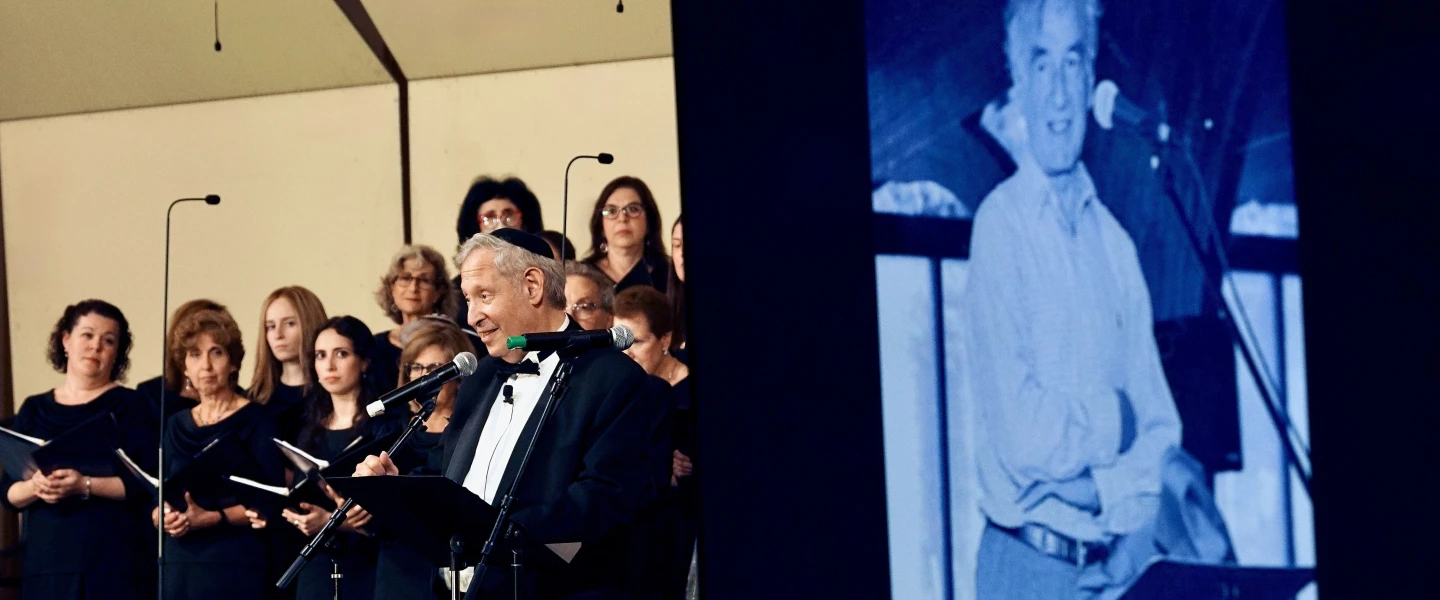
Time was also devoted to honoring the memory of Holocaust survivor and Nobel Prize laureate Elie Wiesel, who had a long relationship with Lazar and his music. Wiesel served as honorary chairman of the Zamir Choral Foundation starting in 1992, when he sang and conducted in Carnegie Hall that year to celebrate the “Hatzi Yovel,” the 25th anniversary of the reunification of Jerusalem.
He held that role until his death at the age of 87 on July 2, 2016.
Lazar dedicated an evening concert mid-week, on Aug. 5, to recognize his friend’s 10th yahrzeit.
Before he conducted, as an introduction, he said: “Those of you who followed his moral legacy know that he spent a great deal of his energy encouraging two things: stopping Iran from getting a nuclear weapon and defending the Jewish history of Jerusalem. They were very important to him. He knew a great deal about music. He was actually a choral conductor in Paris after the war, conducting a girls’ choir. He loved Beethoven’s Seventh Symphony, especially the second movement.
“But his favorite piece was Ani Ma’amin (‘I Believe’). He performed it in Carnegie Hall with the National Jewish Chorale’s 350 singers in 1992. In this tune, you can hear the height of hopeful ecstasy and the depth of despair, the golus Jewish experience of that generation.
“You know he was a great speaker, a great writer, a great moralist. And what a singer! His was not the greatest voice. But when you talk about kavanah in singing, no one had more.”
‘The people make it’
Conducting is a newer part of the program. Members of the Jewish Choral Conducting Institute attended the conference and participated in a graduation ceremony on Aug. 6.
Shani Chamovitz, a student at the Jerusalem Academy of Music and Dance, and an assistant conductor at choirs at school and for a professional ensemble in Beersheva, said it was her fifth or sixth conference experience.
She goes for the self-development and “Matti’s artistry.”

“I gain knowledge in a way I could not anywhere else,” said the 25-year-old. “You get to sing with so many people taking part in the same emotional moment of the music. And the work of the conducting institute—learning from peers, refining our skills, interpreting music—it’s a high-level group.”
She paused before adding: “There’s something you can’t explain in words when it comes to the human voice and singing together.”
Chamovitz was sitting with Yoel Rubinstein, 29, an orchestral conductor, choral conductor and pianist from Rehovot. His father is a cantor; he comes from a family tradition of chazzinut.
It was his third time in Connecticut, where he had the opportunity to work on repertoire music he said he doesn’t find in other places.
“There’s nothing like it in Israel,” he said of the program, “the way text and sound come together. And I know it sounds cliché, but it’s also about the people. The people make it.”
And fund it. For this to happen takes a belief in the philosophy behind choral music.
“Weaving text, Jewish context, Israel, prayer, meaning into music … ,” Cantor Robert Lieberman from Syracuse, N.Y., rattled off related values of this art form. He and his wife, Vicki Lieberman, launched the conducting program two years ago, and this year, the first cohort graduated, all 11 of them (Chamowitz and Rubinstein among them).
“It made sense to me immediately,” he said of the conducting aspect. He has known Lazar since 1983, and they discussed the idea over the phone—a dream of sorts made into reality. He said he was proud all around—of the conductors, the graduates, the singers, the emphasis on sound. Choral music is akin to cantorial music in that it is for the most part unaccompanied.


And still, it is inviting. Music is a part of life. Everyone hears it, listens to it—and sings. Who doesn’t belt out a tune every now and then? Not that everyone has training or pitch.
“If you don’t have instrumental underpinnings, the chorus will create harmonies that will elevate the experience of the prayer and books,” Lieberman said, spoken like a true chazzan. “It brings individuals together as one in harmony. It is a very calming connector. It advances humanity.”
He said all this during a lunch break, amid the din of relaxed conversation, punctuated by outbursts of high notes and lows as some members practiced over their soup and salads. Lieberman was comfortable in such an environment—a summer congregation of sorts.
And why not? After all, the conference echoed one of his favorite sayings: “Making good Jews better musicians, and good musicians better Jews.”
Rehearsals for the 2026-27 season begin this fall in locations across the United States and Israel, culminating in a gala performance at David Geffen Hall at Lincoln Center in New York City in April. Next summer’s Jewish Choral Festival takes place from July 11-15, 2027.