A few weeks into her combat training, a young woman from a Haredi family reached a breaking point.
Determined to serve in a combat role, she had struggled almost from the moment she enlisted. The demands of training were immense, but the greater challenge was reconciling the world she had grown up in with the one she had chosen to enter. At one stage, the Israel Defense Forces considered removing her from the program.
During a period of leave, encouraged by her father, she turned to Rabbanit Hila Naor for advice. Should she continue in combat or transfer to a less demanding role that might make it easier to maintain her religious lifestyle?
“After that conversation, something changed,” Naor recalled.
The young woman chose to stay. Over time, she found a way to bridge the gap between her home life and military service, completed her training and graduated with her parents watching proudly from the audience.
“Watching the journey she went through, from uncertainty and inner conflict to confidence and success, was truly inspiring,” Naor told JNS.
For Naor, stories like this have become increasingly familiar.
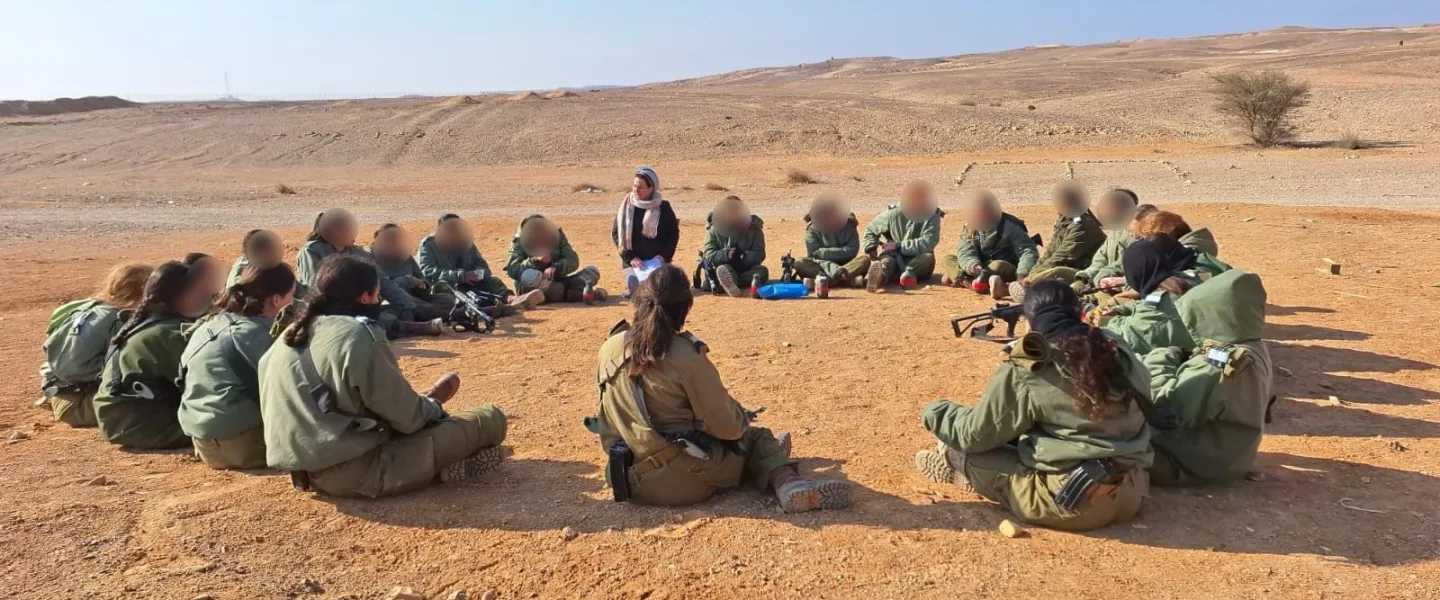
As director of Ma’aminot BeMadim (“Believers in Uniform”), an Ohr Torah Stone initiative that provides religious, halachic and practical guidance to female soldiers, Naor has spent the past two years accompanying a growing number of religious young women choosing military service, including combat roles once considered almost unthinkable in much of Israel’s Religious Zionist community.
That trend is now reaching a new milestone.
Beginning in November, the Israeli Air Force will launch its first dedicated all-female combat unit for religious women. Developed in partnership with Ma’aminot BeMadim, the framework will prepare soldiers to defend Air Force bases and strategic assets during emergencies and wartime.
Recruits will undergo advanced Rifleman 06 combat training, navigation exercises, surveillance and operational training while serving in an environment led by female commanders and supported by female spiritual mentors. Alongside their military training, participants will receive ongoing religious guidance designed to help them balance the demands of combat service with Orthodox observance.
A changing mindset
The idea that religious women would volunteer for combat service was once considered exceptional. Today, educators working with these young women say the conversation has shifted dramatically.
“The young religious women choosing combat roles speak much more about getting under the stretcher and sharing the burden,” Naor said. “They feel that now it’s their turn, that they need to be there, that this is the right thing to do.”
Even those entering noncombat positions, she added, speak differently than they did before the war.
“In the past, many young women hesitated to choose longer military tracks because of the commitment involved. Today they’re much less concerned about how long the service will be. They’re focused on the significance of what they’re doing and on helping defend the country.”
For Rabbi Ohad Teharlev, founder of Ma’aminot BeMadim and dean of Ohr Torah Stone’s Midreshet Lindenbaum, the growing interest in combat service did not begin with the war.
“Even years ago, I found myself receiving dozens of calls every month from young religious women asking for help and guidance about army service,” he said. “Their parents were also reaching out with questions. It became clear there was a real need for an institute dedicated to supporting religious women serving in the IDF.”
The organization initially focused on helping soldiers navigate military life while maintaining their religious commitments. Advisers answered practical questions, counseled families before enlistment and helped young women work through religious and personal dilemmas that arose during their service. Then came Oct. 7.
“My educational approach has always been that we cannot ignore realities on the ground,” Teharlev said. “When something becomes a lived reality for so many young people, our responsibility as educators and rabbis is to engage it seriously and help shape it in a way that is responsible and grounded in Torah.”
As the war exposed critical manpower shortages and increasing numbers of religious women sought combat roles, Ma’aminot BeMadim began working more closely with the IDF to help establish military frameworks that could accommodate both operational requirements and religious observance.
The pace of change surprised even those involved in creating the programs.
Discussions with the military originally envisioned that dedicated combat frameworks might eventually attract around 1,000 religious women. According to Teharlev, that goal is already within reach. This year, about 800 graduates of Israel’s state religious school system are expected to enter combat roles, roughly double the number from the previous year.
“The demand came first,” he said. “For years, I heard from religious young women who wanted to contribute in meaningful ways, including combat roles, but the appropriate frameworks didn’t exist. Once those frameworks were created, the response was immediate.”
Support beyond halacha
For Naor, however, the numbers tell only part of the story.
The real challenge begins after the young women enlist.
Many arrive in units where commanders and fellow soldiers have little understanding of the religious sensitivities they bring with them. While the new gender-specific combat frameworks were designed with those needs in mind, most religious female combat soldiers still serve in integrated units.
“A commander might say, ‘What’s the problem? This is the army,’” Naor said. “‘We’re doing close-combat training with a male soldier. Why is that an issue for you?’
“That reflects the mindset many of them encounter. Their commanders often don’t understand the religious sensitivities involved, and the women themselves find it very challenging. That’s why we need to provide them with a strong envelope of halachic, spiritual and moral support.”
Much of that support has little to do with answering questions of Jewish law.
“The most difficult conversations are actually very personal,” Naor said. “They revolve around their relationships with their families. How their parents react to their decision, how they’ll feel when they see them wearing military pants, whether they’ll understand what they’re doing in the army.
“Most of the practical halachic issues can be addressed. Halacha finds solutions. The family and personal struggles are often much harder.”
Those tensions often follow the women home.
Some return to communities where military service for women is accepted but combat service remains controversial. Others face skepticism from educators, neighbors or extended family members who struggle to reconcile their decision with traditional expectations.
“They’re dealing with the physical and mental demands of combat training,” Naor said. “Then they go home and have to face the reactions of their families and communities as well. Military service is challenging enough on its own, and then they have to navigate that tension too.”
The support system created by Ma’aminot BeMadim has therefore become about far more than answering religious questions.
Regular visits by female spiritual mentors, weekly Torah classes and ongoing contact throughout military service provide what Naor describes as an anchor.
“The framework has to be stable and reliable,” she said. “When the rabbanit comes regularly, when it’s built into the military system and the commanders know about it, the soldiers know they can rely on it. It gives them confidence that their religious identity has a respected and secure place within military life.”
Listening to the next generation
Teharlev believes that is precisely why the new combat frameworks have attracted so many recruits in such a short time.
The debate, he said, has never been about whether religious women are capable of serving in combat.
“I never saw the issue as one of ability,” he said. “It was one of structure. When the appropriate frameworks are in place—frameworks that take both operational and religious considerations seriously—we see that many of the assumed barriers can be overcome.”
Some rabbis continue to oppose combat service for religious women regardless of the accommodations offered, and Teharlev acknowledges that those disagreements remain. But he believes educators have a responsibility to respond to the reality emerging within their own communities rather than ignore it.
“Many young women are voting with their feet,” he said. “Reality is changing on the ground, and it requires thoughtful engagement. As rabbis and educators, we need to listen to the next generation and understand what they’re telling us through their choices.”
Rabbi Dr. Kenneth Brander, president and rosh yeshivah of Ohr Torah Stone, said that philosophy has guided Ma’aminot BeMadim since its founding.
“Our responsibility as educators is not to determine the path every young woman should choose,” he said. “There are many meaningful ways to serve the Jewish people, including military service, National Service and countless forms of communal leadership.
“But when religious young women choose to serve in the IDF, we have an obligation to ensure they have the Torah, halachic and spiritual support they need to thrive.”