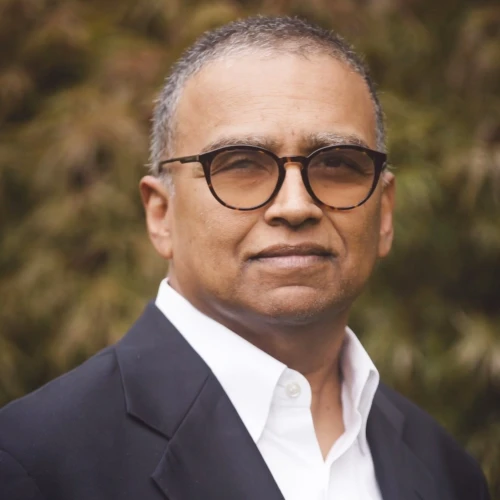
“Oct. 7 changed everything for me,” said Dr. Adam Berkovits, an emergency room physician from Las Vegas who had not spoken a word of Hebrew for 30 years. “On Oct. 8, I became a ‘born-again’ Jew. While the attacks in Israel didn’t surprise me, the reaction on Oct. 8 by people in the United States marked a turning point for me and for everyone around me.”
More than 2,500 miles away in Smithtown, N.Y., Dr. Richard Feldstein was equally shaken as he watched the death toll from the Hamas massacre climb.
“I was speechless,” he recalled. “I couldn’t understand what was going on—how did this happen, right under everyone’s noses? Fifty dead, 100 dead, and before you knew it there were 1,200 dead Israeli souls. They killed the very people who wanted a peaceful existence and coexistence.”
The two physicians had never met. But their parallel journeys would eventually bring them together in Las Vegas in April, where they stood alongside Feldstein’s son, Jacob, who was celebrating his bar mitzvah, to dedicate a Magen David Adom ambulance funded through their combined fundraising efforts.
That Shabbat, at a friend’s son’s bar mitzvah, Feldstein remained glued to his phone.
“Pro-Palestinian protests began in Manhattan against Jews,” he recalled. “I asked myself: How did they manage to organize themselves the very next day?”
The two Jewish physicians, both descendants of Holocaust survivors and complete strangers to one another, would ultimately follow remarkably similar paths.
Feldstein, whose mother was from Rehovot before moving to Montreal, quickly concluded that he had something meaningful to contribute.
“I asked myself, who am I? What am I?” he said. “I realized I have a skillset. I’m a Jew, I speak Hebrew. I grew up in a post-Holocaust household, and I felt a pull to help in any way I could.”
Born and raised in Montreal, he realized he was not only bilingual but trilingual.
“I can help,” he told himself.
Berkovits reached much the same conclusion.
“I knew I had something to offer as an ER doctor,” he said. “Israelis were suffering from trauma. There were people who needed medical care.”
Answering Israel’s call
Within an hour, Berkovits had found people online coordinating doctors to travel to Israel. Three weeks later, he was on a Zoom call with Magen David Adom.
“They asked if I could come for at least two weeks on particular days,” he said. “I emailed my colleagues at the hospital asking them to cover my shifts. Four weeks after Oct. 7, I had a flight, residence and a temporary medical license.”
He also had relatives warning him, “Don’t! You’re crazy! You’re going to die!”
He promised his wife and family that he would not go to areas still smoldering in the south—and boarded the plane.
For Feldstein, the logistics took longer. As a private-practice gastroenterologist, he had procedures and patients to reschedule.
“I was in my office after hours and my cell rang,” he recalled. “It was not a familiar number, but I picked up anyway. A physician on the other side who works for MDA introduced himself. He asked, ‘Do you still want to volunteer?’ I said, ‘Absolutely yes, 100%.’ And he said, ‘Great—you fly on Sunday.’ It was Wednesday.”
He negotiated a two-week delay before leaving.
“I hung up and said to myself, ‘What just happened?’ But I knew it was one of the most important things for me to do—not just for me but for my children and for world Jewry.”
Expecting pushback from his family, he instead found complete support.
“My wife, also a doctor, knew that for months I was beside myself,” he said. “I was going to Israel.”
According to Magen David Adom, approximately 200 international doctors, along with nurses, paramedics and EMTs, volunteered on MDA ambulances from Oct. 7, 2023, through 2025. More than 90% of MDA’s workforce consists of volunteers, totaling roughly 36,000 people.
In a typical prewar year, American Friends of Magen David Adom provided about 100 ambulances. Following Oct. 7, that number tripled to 313 in 2023 and remained well above the norm at 239 in 2024.
On the front lines with MDA
Upon arriving in Israel, Berkovits immediately underwent one day of MDA training in Jerusalem.
“They briefed us on the differences of practicing here and in the States, gave us a uniform and our shifts,” he said. “I was assigned to work on a yellow ambulance as a physician on the rig.”

On his first shift, he was handed a helmet and a ceramic vest and dispatched to emergencies in Petah Tikva and Bat Yam.
“There were heart attacks, seizures, traumatic injuries, one person fell off a roof, panic attacks—anything you might call an ambulance for,” he recalled.
After several days, he broke the promise he had made to his wife.
“I told MDA to put me in the south,” he said. “That was a much different experience. I was in a bulletproof ambulance. There, it was less about the medicine and more about bearing witness. There were bloodstains, shattered windshields, gunfire and booms coming from Gaza.”
He began documenting what he saw on social media.
“It’s important when these things happen to document and share them … so people can’t discount or downplay it and say it never happened.”
‘Being in Israel was therapy’
Ironically, Berkovits found himself calmer in Israel than he had been at home.
“From Oct. 7 on, I was very affected emotionally. I couldn’t sleep,” he said. “But as soon as I got to Israel, the angst went away. Being in Israel was therapy rather than having to watch from a distance.”

Feldstein described a similar sense of purpose.
“I can only describe the exhilaration and joy I felt in my MDA uniform, knowing that I’m helpful and was there to serve,” he said. “I felt more useful doing everything I did in Israel than what I do here in New York.”
His first red alert came within 45 minutes of landing.
“Suddenly the radio blares,” he recalled. “I watched as people pulled their cars over, jumped out, lay down and put their hands on their heads.”
Calling home each night underscored the contrast between daily life in Israel and life back in New York.
“There were red alerts every single day,” he said. “Still, I felt at home in Israel.”

One ambulance, one people
The two doctors eventually connected through WhatsApp after Feldstein helped his youngest son, Jacob, create a website for his bar mitzvah project through MDA.
A volunteer from the West Coast introduced him to Berkovits, who had also begun raising money for an ambulance. Together, their combined efforts funded the vehicle, which was dedicated in Las Vegas on Yom Ha’atzmaut, Israel’s Independence Day.
Berkovits described the experience as a profound awakening.
“With great-grandparents who were in the Shoah, I always wondered, what would I have done?” he said. “In my mind, I knew right away I needed to do something—anything—so I can say to my grandchildren that I at least tried.”
“After Oct. 7, we’ve seen an extraordinary outpouring of support,” said Elana Michael, director of major gifts at Magen David Adom. “More than 200 international doctors have volunteered on MDA ambulances, and donors have stepped up in a way we’ve never seen before, tripling our annual ambulance deliveries. Every ambulance tells a story, and this one is a reminder that the Jewish people, wherever they live, are one.”
Meanwhile, ever the volunteer, Feldstein will chair the Magen David Adom gala dinner scheduled for Oct. 27, 2026, in New York.