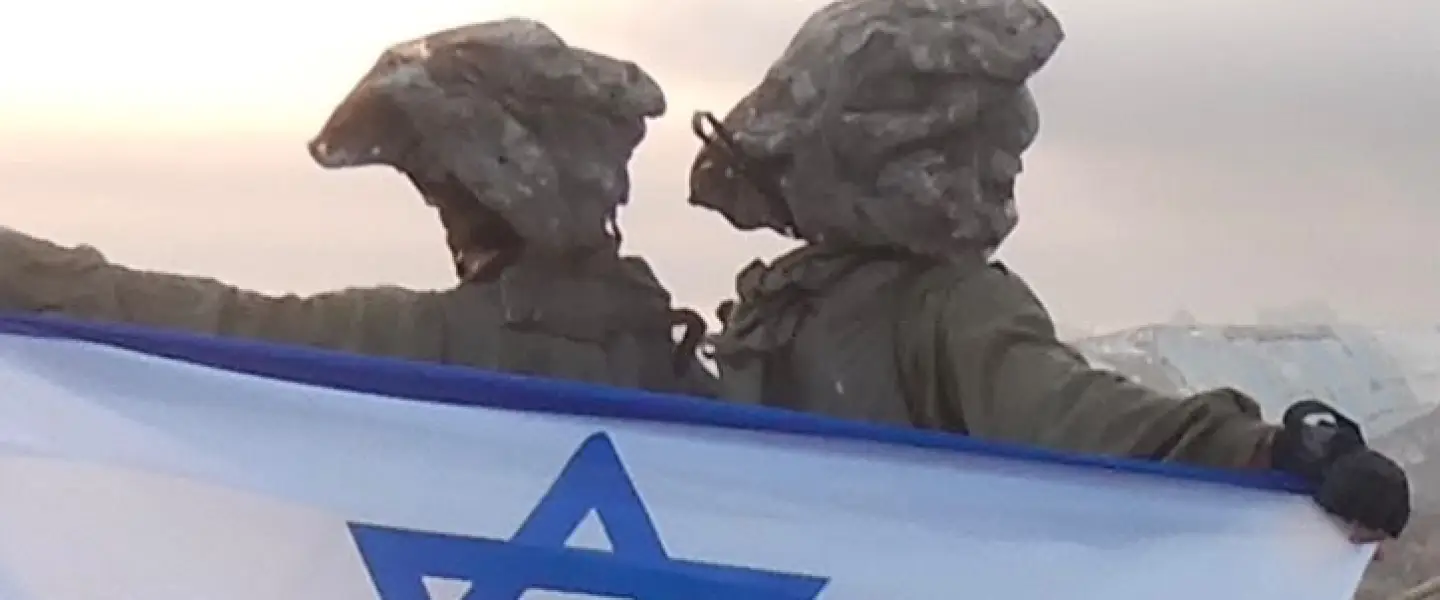
When Israeli reservists return from the battlefield, many come home to families who have kept life moving while they were away. Someone has paid the bills, spoken to the landlord, opened official letters and made sure there is food in the refrigerator.
A lone reservist may return to an empty apartment and face it all alone.
“For years, the system saw reservists as soldiers while they were in uniform, but it did not always account for what happened when they went home,” Levi Preger told JNS in a recent interview.

Preger is community manager of Growing Wings, a nonprofit supporting lone soldiers and lone reservists. Since Oct. 7, 2023, he has served more than 300 days in the IDF reserves while trying to maintain his university studies and civilian life.
His own journey to Israel began in an unexpected way.
When he was 17, his grandmother received a letter from the German government informing her that she was eligible for benefits as the descendant of someone persecuted by the Nazis.
That was how Preger, who grew up in a small town in the Netherlands in a family that celebrated Christmas and Easter, learned that his great-grandmother had survived the Holocaust and concealed her Jewish identity after the war.
He began researching Judaism, contacted a Chabad rabbi and celebrated his bar mitzvah at 18. After visiting Israel on a Birthright trip, he decided to make aliyah. He moved to Israel at 20, studied Hebrew and enlisted in the Nahal Reconnaissance Battalion.
“I did not just want to move to Israel,” he said. “I wanted to integrate, contribute and take responsibility for the country I had chosen to make my home.”
In the summer of 2023, after completing his mandatory military service, Preger returned briefly to the Netherlands before beginning studies in government and international relations at Reichman University in Herzliya.
On Oct. 7, he watched in horror as news of the Hamas attack unfolded.
He immediately began searching for a flight back to Israel. It took him four days to find a seat.
After landing, he rejoined his reserve unit, which was helping evacuate civilians and rescue wounded soldiers.
His parents remained in the Netherlands while Preger returned to war without close family in Israel.
A gap exposed by war
During their mandatory service, lone soldiers are formally recognized by the Israel Defense Forces. They receive assistance from welfare officers, social workers and dedicated military programs, as well as support for housing and finances.
After discharge, however, much of that framework disappears, even though many former lone soldiers continue serving in the reserves for years.
“The biggest difference is that a lone soldier serves within a clearly defined support framework, while a lone reservist often does not,” Preger said.
Before Oct. 7, Israel’s reserve system was generally built around relatively short call-ups. It was not designed for thousands of reservists serving for months at a time, returning briefly to work or university and then being mobilized again.
For those without family support, prolonged reserve duty can threaten their housing, education, income and, in some cases, even their ability to remain in Israel.
Preger experienced firsthand how quickly an informal support network can disappear. For a time, his girlfriend’s family provided the kind of practical help his own family could not offer from abroad. When the relationship ended, so did that support.
During a Knesset Immigration and Absorption Committee hearing, he described lone reservists sleeping on a different couch every night. Others returned from duty to find their businesses had collapsed or their studies had fallen apart.
“The war did not create every one of these challenges,” he said. “But it exposed their scale.”
Not only new immigrants
The term “lone reservist” may bring to mind a young immigrant whose parents live abroad. That describes many, but not all.
Growing Wings estimates that 55% of the lone reservists in its network are immigrants, while 45% were born in Israel. The latter include orphans, people who grew up in foster care or the welfare system, individuals estranged from their families and those who left closed religious communities.
Many are in their late 20s or early 30s. They are students, professionals, small-business owners, spouses and sometimes parents themselves. They may have built independent lives, but they lack the extended family network that many Israelis take for granted.
“What unites them is not where they were born,” Preger said. “It is that when they leave the battlefield and return to civilian life, there is often no parental or extended-family safety net waiting for them.”
The IDF now officially recognizes lone reservists as a distinct population. According to Preger, that gives commanders and welfare personnel a clearer way to identify those who may need assistance.
It has also opened access to additional welfare support, mental-health resources, administrative accommodations, assistance in urgent cases, special leave to handle personal matters and, in certain circumstances, reimbursements for reservists who returned from abroad to serve.
Preger sees the recognition as an important first step. The real test, he said, is whether lone reservists know what assistance is available and can access it when they need it.
Some are unaware of the benefits to which they are entitled. Others encounter complex bureaucracy or narrow eligibility requirements. A housing crisis cannot always wait for formal approval, and many of the problems reservists face fall outside the military system.
That is where Growing Wings steps in.
More than financial assistance
Growing Wings was founded in 2019 by Max Long, a former lone soldier and active IDF reservist. Today, more than 700 lone reservists participate in its active networks and community channels.
Since Oct. 7, 2023, the organization says it has assisted more than 2,000 lone soldiers and lone reservists with emergency aid, housing, furniture, moving services, mental-health referrals, bureaucratic guidance, and legal and professional support.
Its role is often to help reservists navigate a maze of assistance spread across the IDF, government agencies, universities, employers and nonprofit organizations. Someone returning from months in the field may not know which office is responsible, or have the energy to tell the same story over and over again.
Preger believes the support that matters most is often the kind families provide without thinking about it.
“When you do not have parents or close relatives in the country, you may not have someone to review a lease, help you understand a government letter, host you for dinner after weeks in the field, connect you to a job or recognize that you are struggling before you ask for help,” he said.
One incident in Gaza showed Long how the community built around lone soldiers can endure long after the original need has passed.
His reserve squad was positioned far from the rest of its unit and was running short of food, water and other supplies. He entered a building where other Israeli soldiers were stationed and asked whether they had anything to spare.
Someone inside called his name.
The soldier was a former lone soldier whom Long and Growing Wings had helped several years earlier. After learning what the team needed, he quickly gathered food, water and whatever other supplies he could find.
This time, the person who had once received support was providing it.
For Preger, the encounter captures the meaning behind Growing Wings’ guiding principle: “For lone soldiers, by lone soldiers.”
“The goal is not only to intervene when someone cannot pay rent or needs a place to sleep,” he said. “It is to build relationships that continue long after the immediate crisis has passed.”
From emergency response to permanent support
Preger said he experienced firsthand what effective institutional support can look like at Reichman University.
After repeated reserve call-ups disrupted his studies, the university appointed an adviser who communicated with his professors and helped him develop a plan to catch up.
But not every reservist has an employer, landlord or university willing to make similar accommodations.
At the beginning of the war, civil society mobilized with meals, equipment, grants and housing. As the war continued, however, that first wave of assistance began to recede. The consequences of repeated reserve service did not.
Nearly three years after Oct. 7, reserve duty remains part of daily life in Israel. Under the government’s framework for 2026, as many as 40,000 reservists may be serving on an average day, moving constantly between combat and civilian life.
“The systems were largely designed for short-term emergencies,” Preger said. “Lone reservists are now living through a marathon.”
He is calling for a permanently funded national framework that would accompany lone soldiers into reserve service and coordinate military, government, academic, employment, housing and mental-health support.
Civil-society organizations would remain an important part of that framework because they can respond to personal circumstances that do not fit neatly into official categories. But basic protections, Preger said, should not depend on a reservist finding the right nonprofit or knowing whom to call.
“If someone gives hundreds of days to defend the country, they should not have to prove their isolation over and over again or risk losing the civilian life they are serving to protect,” he said.
For most reservists, family is an unspoken part of Israel’s military system. It is the support structure that keeps civilian life functioning while they serve and helps them regain their footing when they return.
Growing Wings is trying to build that home front for those who do not have one.
“The central challenge is no longer simply helping someone survive one call-up,” Preger said. “It is making sure repeated service does not destroy the civilian future they are trying to build.”