


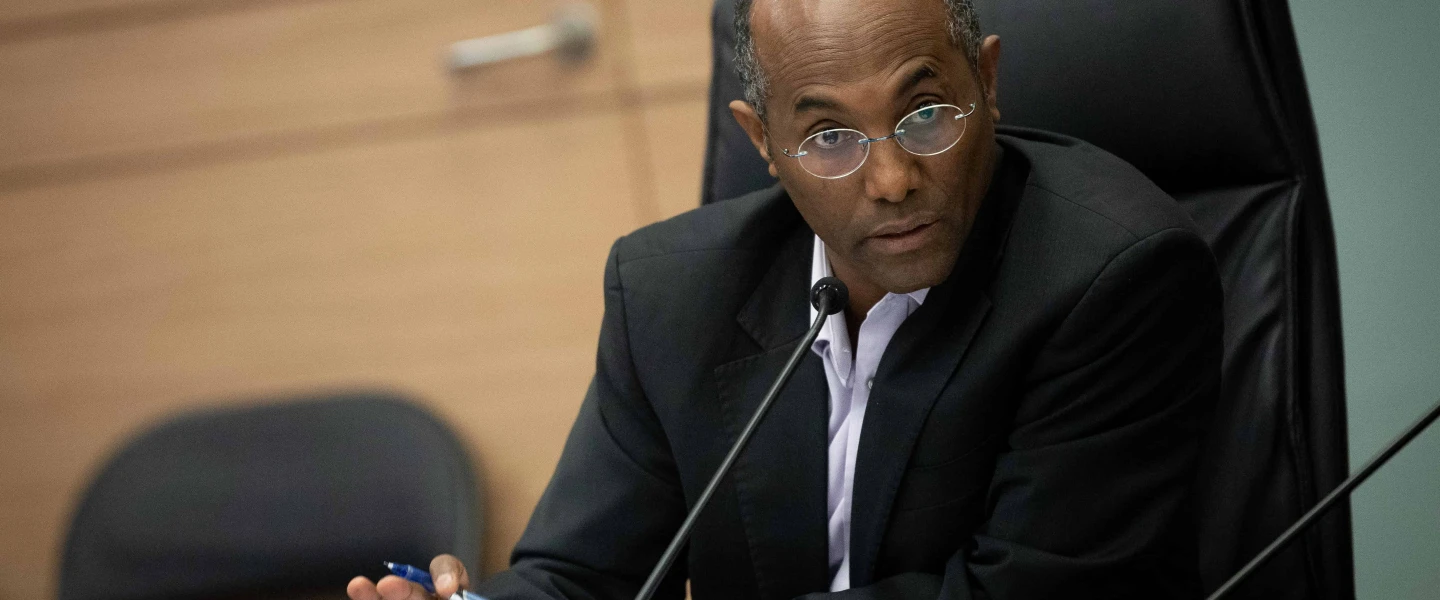
Religious Zionism lawmaker Moshe Solomon, who had a grueling aliyah to Israel from Ethiopia as a child, outlined in a wide-ranging interview with JNS last week his efforts to enhance the development and integration of his community into Israeli society.
Solomon was born in the city of Shire, in the Tigray region of Ethiopia, in 1975 as the eighth of 12 children. At age six, in 1981, his family began a journey on foot to Sudan with the aim of reaching Israel. The journey lasted about a month and a half and spanned approximately 620 miles. Upon reaching Sudan, the family was forced to wait in harsh conditions before finally immigrating to Israel in 1983.
Solomon noted that there are still people in Ethiopia who are eligible to immigrate to Israel, though determining eligibility remains difficult because there is no registry or organized Jewish community.
“I am asking the Interior Ministry to establish a department that checks eligibility for immigration. We are not seeing any progress. In the last three years, very few eligible people have immigrated, and I hope this will change,” he said.
Regarding the Ethiopian community in Israel, Solomon said that over the past three years, he has worked intensively to advance their interests. This year, 220 million shekels (over $67 million) were allocated to the community for education, security, employment, Jewish identity, and military preparation programs to ensure full engagement and participation in Israeli society.
Solomon served in the Paratroopers Brigade of the Israel Defense Forces and holds the rank of lieutenant colonel in the reserves. Regarding the proposed draft law for the ultra-Orthodox, Solomon, who studied in yeshiva and is an ordained rabbi, noted that over the past two years, Israel has been fighting a war on seven fronts and urgently needs manpower.
“We need enlistment based on the IDF’s needs. I believe the haredi leadership will rise to the occasion. I believe they will understand that this is not a whim meant to harm the world of Torah. It is possible to hold the book in one hand and a weapon in the other,” he added.
Although he said he cannot predict which issue will dominate the upcoming elections, Solomon noted that Religious Zionism is an ideological, nationalistic party that focuses on matters important to the Israeli public. “Sometimes it’s the economy, sometimes security, Jewish identity or the settlements,” he said.
While Solomon described President Donald Trump as a “true friend of Israel” and characterized the relationship between the two countries as “allies working to create a better reality throughout the Western world,” he emphasized that the State of Israel is independent and fully capable of defending itself.
After Oct. 7, 2023, he said, Israel cannot forget what happened and must make decisions with the understanding that those on the other side have no desire for peace or a better reality.
“Any normalization effort that does not ensure the security of the State of Israel is something we will not accept, even if it comes from our allies. This applies to Gaza, to Lebanon and to all surrounding countries that would use normalization to improve their military preparedness,” he said.
Israel’s enemies, Solomon added, are not sitting idly by waiting for peace. “We see it in Gaza with Hamas and its attempts to rebuild its forces. We see it in Lebanon with Hezbollah, where the government has failed to keep them in check. We see it in Iran.”
Regarding opposition leader Yair Lapid’s plan to bring to a vote a motion stating, “The Knesset has decided to accept and adopt President Trump’s 20-point plan,” Solomon said Religious Zionism will vote against it.
“I’m not sure what he’s proposing exactly, but if it leans toward establishing a Palestinian state, that is unacceptable to us. The Knesset voted by an absolute majority—including the opposition—against a Palestinian state because they understand it would constitute a security peril,” he said.
Discussing the countries that could join the International Stabilization Force for the Gaza Strip—an element to be overseen by Trump’s proposed peace council—Solomon said that states holding openly hostile positions toward Israel cannot take part, with Turkey being one of them.
“We can’t bring in a country that wants to destroy Israel. The president of Turkey makes calumnious statements about Israel that are completely disconnected from reality, such as claiming that we have apartheid here. We need countries that have never been hostile to Israel regarding the conflict,” said Solomon.
Although Hamas was not fully eliminated before Israel agreed to the ceasefire, said Solomon, he believes the organization is “crushed.”
Religious Zionism voted against the current ceasefire, Solomon noted, because freeing terrorists who have murdered Jews reopens the wounds of the families affected.
“We oppose any deal that leads to the release of terrorists with blood on their hands. Unfortunately, it happened. We are glad the hostages returned—saving one life in Judaism is like saving an entire world. Still, we are responsible for the security of all Israelis,” he said.
Despite the disagreement, Religious Zionism chose to remain in the government, as Solomon said no government is perfect.
“This is a right-wing, nationalist government. It has done a lot to counter the previous security doctrine of maintaining quiet, and it has advanced the revival of the Jewish people in Judea and Samaria,” he said.
Regarding the conflict with Iran, Solomon said the next round of fighting is inevitable unless a civilian uprising topples the regime.
“We damaged their air defenses, their uranium-enrichment capabilities, and neutralized their military and scientific leadership. The conflict is inevitable because we are talking about two opposing ideologies. The only way to deal with terrorist nations is to be proud, strong and reject concessions such as releasing terrorists or surrendering land,” he said.
During his term, Solomon said he advanced two main categories of legislation: social legislation and national legislation.
Social legislation, he explained, aims to address grievances affecting citizens in the periphery. These include a bill to abolish fines for those using public transportation and have paid the fare or are exempt from paying, but did not validate their pass or ticket. On the nationalistic front, Solomon said he is advancing legislation that strengthens the security of the Israeli people, including a bill that prevents the State from returning the bodies of deceased terrorists unless the cabinet decides otherwise.
Solomon has also worked to overturn a Jordanian-era law that prohibits the sale of land in Judea and Samaria to Israeli Jews. The bill is advancing to its first reading.


