In a quiet art gallery on George Washington Street, a short walk from Jerusalem’s bustling city center, color fills the walls with scenes of Jewish weddings and musicians, Jerusalem landscapes and Biblical figures bathed in radiant light.
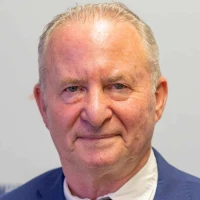
For the London-born Robert Elisha, the owner and curator of Huvy’s, these are not simply paintings. They represent memories, faith and history—preserved on canvas in his art gallery and reflecting his family’s own warmth and hospitality.
In an interview at the JNS Media Hub in Jerusalem on Feb. 17, Elisha described his lifelong mission of safeguarding the work of his late mother, the famous Israeli artist Huvy (Ahuva) Elisha, whose luminous paintings fused traditional Jewish life with the vibrancy of European impressionism.
“She was an amazing personality,” he recalled. “Anyone who met her loved her. She was simple, happy—nothing fancy. All her finesse was on the canvas.”
Huvy’s story
Born in Jerusalem in 1927, Huvy—as she later became known because that’s how she signed her works—spent her childhood between the holy city and Europe after her parents left Mandatory Palestine. The family ultimately escaped to London just before World War II. There, her extraordinary talent emerged early: at only 13, she was accepted to Saint Martin’s School of Art—an unprecedented achievement at the time—and studied at the Royal Academy.
“She was gifted as a child,” Elisha said. “She could imagine something and convey it onto canvas in the most fantastic way.”
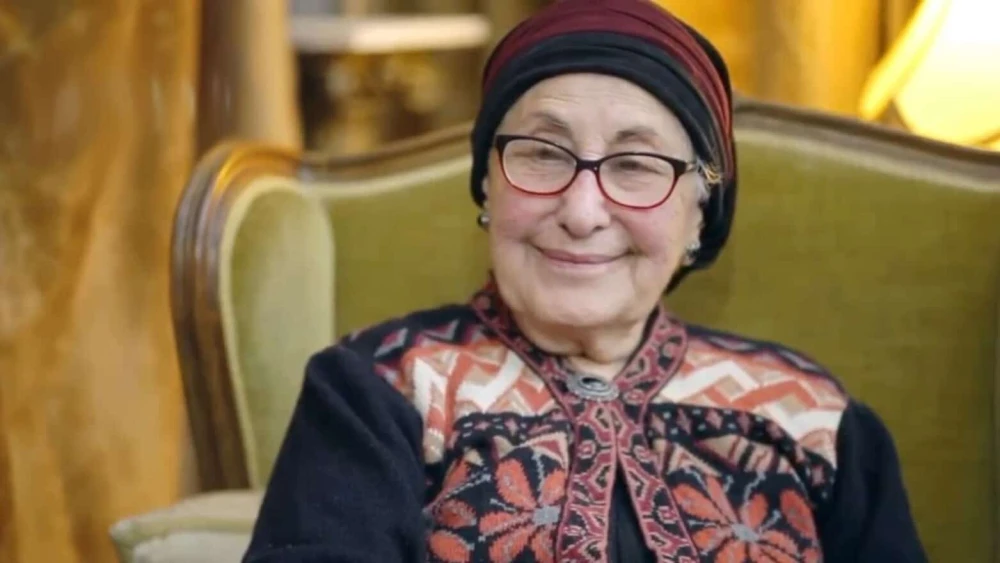
Despite her classical training, her subject matter remained deeply Jewish. She painted weddings, rabbis, markets and Jerusalem streets in vibrant color—works that conveyed optimism rather than nostalgia.
“It was the first time people saw the Jewish world presented with such joy,” he said. “That was her message—to make people happy.”
Return to Israel
After years in England, the family returned to Israel in the late 1960s, settling first in Herzliya before eventually moving back to Jerusalem, where Elisha’s parents chose to live near the Haredi (ultra-Orthodox) neighborhood of Mea She’arim. His father, Eli Elisha, an international textile, carpet and antique dealer, embraced religious study later in life, living to 96. Huvy died in 2022 at 94.
Elisha himself served in the IDF before drifting toward the art world he had grown up in. Exposure to antiques through his father and painting through his mother created what he calls a natural path.
“I realized my mother was never really put in the limelight,” he said. “Whenever she exhibited, everything was sold—but she remained modest. So I took it under my arm seriously.”
That effort became Huvy’s, which now features not only her work but also pieces by major Israeli and Jewish artists such as Yaacov Agam, Reuven Rubin and Marc Chagall.
Still, her paintings remain its backbone. Art historians and collectors frequently classify her as a post-impressionist. Elisha points to her drawings as proof of her mastery.
“Connoisseurs who own works by Rembrandt told me her pencil works are very, very good,” he said. “That’s how you know an artist.”
Among her most recognized subjects were large Jerusalem landscapes and wedding scenes, now collected internationally. Some smaller portraits have sold for tens of thousands of dollars, while larger canvases hang in prominent hotels and institutions in Jerusalem.

The Spies
One major work, titled “The Spies,” which depicts the 12 Biblical scouts dispatched by Moses to explore Canaan before the Israelites entered, hung for years in the office of former U.S. Ambassador David Friedman. It was later returned to the embassy during Ambassador Mike Huckabee’s tenure. Both envoys are close to President Donald Trump.
“It talks to him,” Elisha said, referring to Huckabee, a religious Christian. “Not only Jews—people worldwide connect to it.”
The painting portrays the returning spies: ten fearful, two faithful, light descending toward the Tabernacle. For Elisha, it captures the Jewish story itself—skepticism and hope confronting each other.
Huvy’s art deliberately avoided despair. Though she created several Holocaust works, she rarely displayed them publicly.
“She said those works are sad. She didn’t want sadness to define her art,” her son explained. “But once a year, on Holocaust Remembrance Day, I place one in the window—and I still cry.”

Bridge between worlds
Beyond preserving his mother’s legacy, Elisha sees his art gallery as a bridge between worlds. A pious Jew with a pronounced British accent and eclectic background, he welcomes visitors who sometimes hesitate to enter.
“They think, ‘This is not for us,’” he said, smiling. “Half an hour later, we’re best friends.”
He recounted a memorable encounter with a Christian priest from Amsterdam who recognized a tiny painting of the Baal Shem Tov’s grave and regularly taught Hasidic teachings to his congregation.
“That’s what I’m trying to do,” he said. “Connect people—not only Jews, everyone.”
Despite the recent war and regional tensions, visitors continue to come, albeit fewer than before. Yet Elisha believes art remains essential—especially during periods of uncertainty.
“Time is short and there’s a lot of work to be done—to unite people,” he said. “People want to come close to each other, but sometimes things block the connection.”
Good art, like that of his mother, he added, removes those barriers. “Every time you look at her painting, you discover something new—and it’s happy,” he said.
Almost a century after her birth, Huvy’s canvases continue to glow with light, offering not just images of Jewish and Israeli life but an emotional language that crosses faiths and cultures.
For her son, keeping that legacy alive is both a profession and a calling.
“That’s what my mother did,” he concluded. “She connected Heaven and Earth.”