Newsletter
Newsletter Support JNS

Israeli Finance Ministry tempers jump in country’s dairy prices

Meanwhile, an expected hike in the cost of gasoline was canceled.

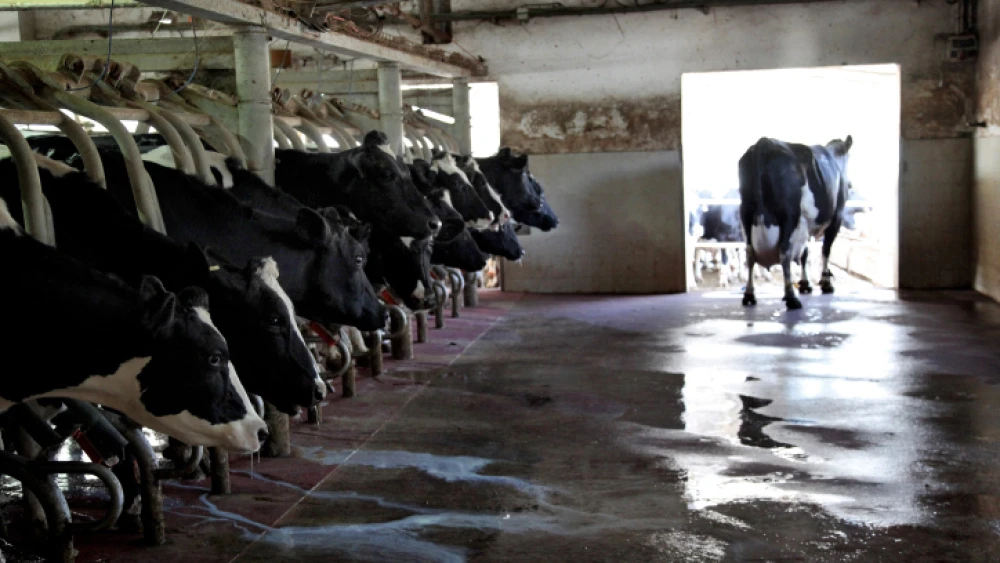
Dairy cows at Kibbutz Sarid in the Jezreel Valley, Jan. 24, 2017. Photo by Anat Hermoni/Flash90.

The price of government-regulated dairy products in Israel will rise by 9.28% this week after the Finance Ministry stepped in to spread a planned 16% hike over three years.

Separately, Israeli Finance Minister Bezalel Smotrich intervened to cancel a gasoline price hike that was to have taken effect on Monday.

The moves come as the rising cost of living tops the Israeli public’s list of concerns, according to surveys.

The last-minute agreement reached by Smotrich will see the cost of basic milk and cheese products go up 9.28% with an additional 3.1% increase coming each May through 2026.

Dairy companies will receive compensation for the postponed price rises.

Smotrich hailed the agreement and blamed the price rise on the “irresponsible conduct” of the previous government.

“We are beginning a process of a thorough reform of the dairy industry. I have asked the professionals at the Finance Ministry to examine the entire production chain,” the minister said in a statement Monday.

“All of this is with the goal of freeing up the economy from excessive centralization and anachronistic planning, and moving towards an open and competitive market,” he said.

The report concluded that leading chatbots frequently failed to recognize antisemitic tropes in Persian and called on developers to improve the accuracy and quality of multilingual responses.
The Radwan Force is Hezbollah’s commando unit that specializes in cross-border infiltration operations.
A state report finding Jews were targets of three-quarters of hate crimes in California in 2025 “should be a gut-check for our entire society,” Nathan Hochman told JNS.
The Israeli military would have “no contact” with civilians and “no role” in separating the zones from the rest of Gaza, a source tells JNS.
“They just couldn’t figure out how to represent 11% of the city,” stated the writer Avital Chizik-Goldschmidt.
Day Two of the “Contemporary Antisemitism 2026” conference in Haifa explored how Jewish belonging is increasingly contested across digital platforms, popular culture and minority movements.