


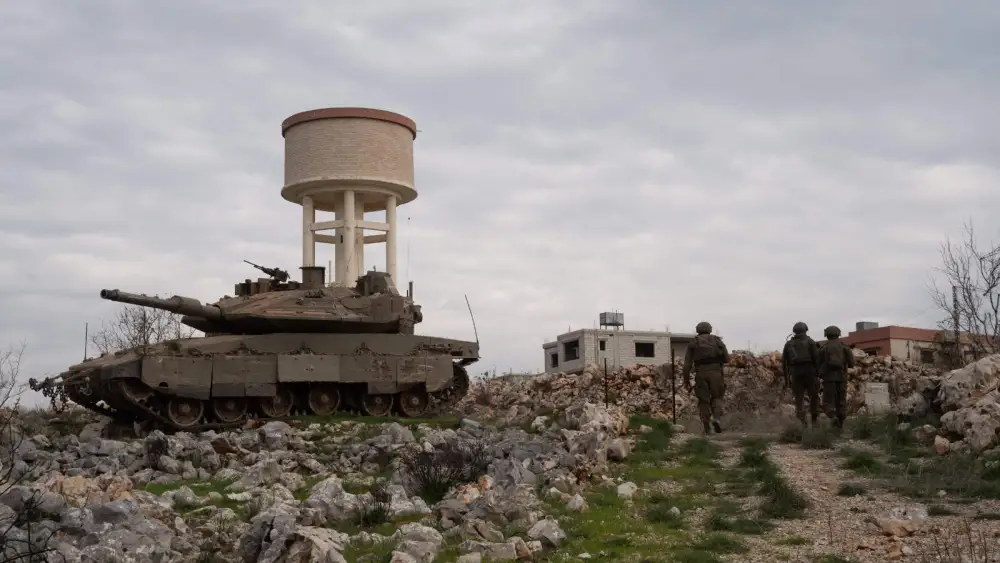
Israel Defense Forces soldiers will remain deployed at five outposts in Southern Lebanon beyond the Feb. 18 deadline set out in the truce deal with Beirut, the army’s Northern Command confirmed on Monday.
Israel’s decision to keep boots on the ground in Lebanon was made in conjunction with the Trump administration. The company-size posts, located within several hundred meters of the border, will be manned by hundreds of IDF soldiers until the political echelon decides otherwise.
The five outposts are located at a hill near Labbouneh, opposite the Israeli border town of Shlomi; on the Jabal Blat peak, opposite Moshav Zar’it; on a hill opposite Moshav Avivim and Kibbutz Malkia; on a hill opposite Moshav Margaliot; and on a hill opposite the town of Metula.
The IDF is taking into account that Hezbollah terrorists may attempt to damage the outposts—which are all located outside of built-up areas—and is preparing for expected provocations against troops.
Hezbollah leader Naim Qassem warned Israel on Sunday that if it does not withdraw its forces by Tuesday, “we will know how to deal with it.
“Israel must fully withdraw on February 18, it has no excuse,” the top terrorist leader said in a televised speech cited by the France 24 outlet.
תום תקופת המבחן בלבנון מחר:
— איתי בלומנטל 🇮🇱 Itay Blumental (@ItayBlumental) February 17, 2025
בפיקוד הצפון נערכים לסוף תקופת היישום להפסקת האש בלבנון, כולל נסיגה של כוחות צה"ל, מלבד חמישה מוצבים שנבנו בשטח לבנון כפי שפרסמנו בשבוע שעבר
במשך חודשיים וחצי, כך אומרים בפיקוד הצפון, לוחמי צה"ל פעלו בדרום לבנון למקסם את ההישג שהגיעו אליהם במהלך… pic.twitter.com/3B6aqR74rv
In addition to its continued presence in Lebanon, the IDF is working to build forward operating outposts near every border town. Construction of the outposts has already started and many have already been built.
If the relative calm on the border with Lebanon is preserved, residents of evacuated communities in northern Israel will be able to return to their homes on the planned date of March 1, the IDF statement said.
The truce with Lebanon, which took effect on Nov. 27, mandated an IDF redeployment within 60 days. However, the U.S.-monitored agreement is expected to continue until Feb. 18, the White House said on Jan. 26.
Under the ceasefire agreement between Israel and Lebanon, the IDF is to gradually withdraw from Southern Lebanon as the Lebanese Armed Forces and U.N. Interim Force in Lebanon assume responsibility for ensuring Hezbollah remains disarmed in the country’s south.
However, there have been growing doubts in Jerusalem that the LAF can fulfill its obligation to clamp down on Hezbollah’s presence. The Israeli army remains engaged in frequent operations in the area.
On Sunday, IDF troops destroyed an underground tunnel system near the border that was used by the terrorist group’s elite Radwan Unit and contained “living quarters and combat equipment,” the military said.
In recent weeks, soldiers from the 810th “Mountain” Brigade, under the command of the 210th “Bashan” Division, completed dozens of targeted raids in Southern Lebanon’s Mount Dov area to “remove threats facing the State of Israel and its citizens,” according to the IDF statement.



