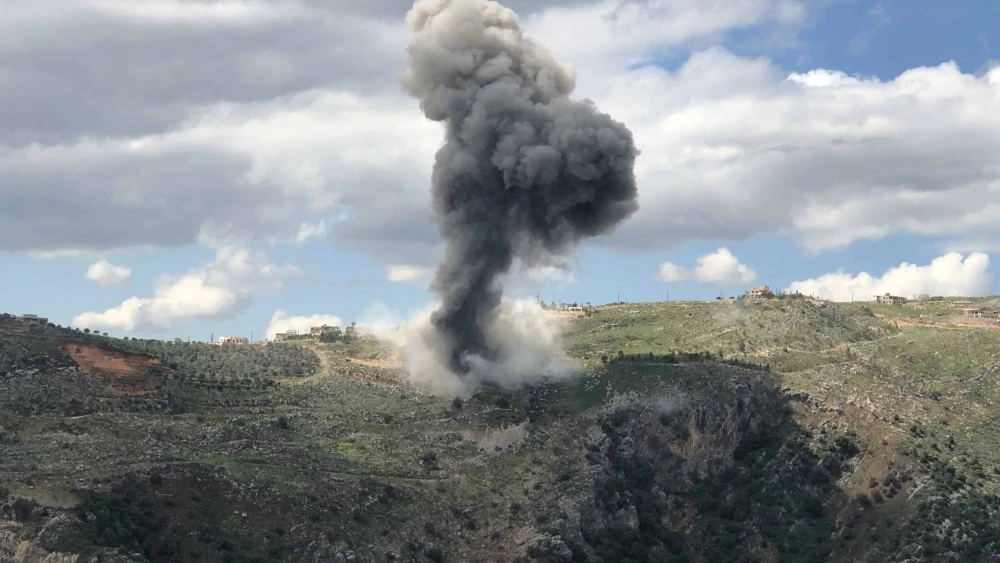
The Israel Defense Forces overnight Wednesday struck a Hezbollah command center used by terrorists in the area of Yohmor in southeastern Lebanon’s Nabatieh Governorate.
According to the IDF, the site was operating under the cover of a civilian structure, underscoring Hezbollah’s systematic attempts to conceal its activities and advance terrorist attacks against the State of Israel.
Before the strike, numerous precautions were taken to minimize the risk of civilian harm, the military said.
“The existence and use of this command center constitute a blatant violation of the understandings between Israel and Lebanon. The IDF will continue to operate to remove any threat,” added the statement.
Earlier on Wednesday, the IDF released footage of soldiers conducting “special, targeted operations” after intelligence led to the discovery of Hezbollah arms depots and other terrorist infrastructure across Southern Lebanon.
The raids were carried out “to prevent Hezbollah from reestablishing itself in the area,” said the IDF.
Troops of the IDF’s 91st “Galilee Formation” Division remain deployed along the Lebanese border “with the goal of protecting the security of Israeli citizens and eliminating any threat from within the state’s territory,” according to the statement.
On Nov. 26, 2024, Israel and Lebanon signed a truce that sought to end more than a year of cross-border clashes. Since the deal, the IDF has carried out frequent operations aimed at preventing Hezbollah from reestablishing its presence in Southern Lebanon in violation of the agreement.
On Monday, during an airstrike in the Deir Kifa area in Southern Lebanon’s Tyre District, the IDF killed Ali Abd al-Hassan Haidar, who was identified as a senior commander in Hezbollah’s Radwan Force.
Meanwhile, Hezbollah chief Naim Qassem declared on Tuesday that his terrorist group had been “rebuilding, recovering” and was “ready now” to take on the Jewish state in a future confrontation.
“If Israel were to attack, we would not stand by and watch—we would fight,” he vowed, adding that while the Israeli army destroyed many of Hezbollah’s weapon depots in Southern Lebanon, “the country is vast.”
U.S. envoy Thomas Barrack told reporters on Monday that Hezbollah “needs to see that there’s a future for them” to accept his roadmap to disarmament, which Beirut had agreed to as part of the ceasefire.
Speaking to reporters after meeting with Lebanese President Joseph Aoun in Beirut, Barrack said the Iranian-backed terrorist group “needs to see … that the road is not harnessed solely against them, and that there’s an intersection of peace and prosperity for them also.”
Hezbollah has been designated as a Foreign Terrorist Organization (FTO) by the U.S. State Department since 1997.
A State Department official subsequently told JNS that “our position has not changed—[Hezbollah] is a designated terrorist organization, and we do not distinguish between its political or armed wings.”
Under the terms of the November deal, Hezbollah must retreat north of the Litani River, about 20 miles from the border, while the Lebanese Armed Forces deploy along the 75-mile frontier, in coordination with monitors from the U.N. Interim Force in Lebanon.