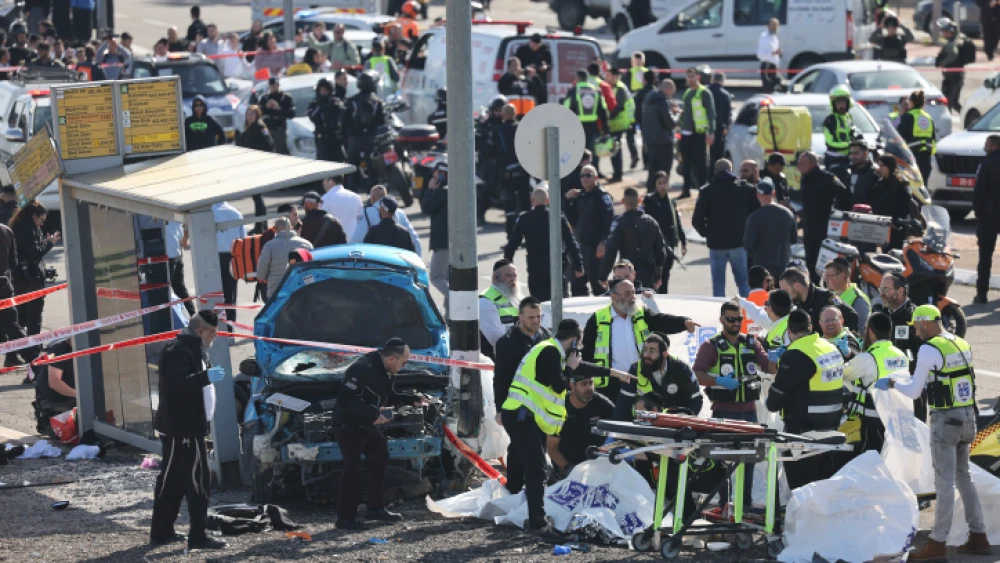
The injured father of two sons killed in a terrorist car-ramming in Jerusalem last month left the hospital on Monday for the first time since the attack, and immediately visited the graves of his children.
Avraham Paley visited the resting place of his sons Yaakov Yisrael, 5, and Asher Menachem, 7, who were killed when a terrorist rammed his car into a crowd at a bus stop in the Ramot neighborhood of the Israeli capital on Feb. 10.
Paley, 42, was seriously injured in the attack and only learned of the death of his sons when he regained consciousness nearly three weeks later.
He went straight to the Har Hamenuhot cemetery in Jerusalem on Monday after leaving Hadassah Medical Center in Ein Kerem, arriving via ambulance and using a wheelchair. Video taken at the gravesites shows Paley weeping while seemingly attempting to recite the traditional Jewish mourner’s prayer.
תיעוד מצמרר: הרב אברהם נוח פלאי בא להיפרד מילדיו שנרצחו בפיגוע ברמות. עין לא נותרה יבשה pic.twitter.com/INswbGoWEx
— מנחם קולדצקי (@nbjovsr88) March 13, 2023
Before being discharged, Paley thanked the staff who took care of him “with devotion from the moment I arrived at Hadassah, both in the intensive care unit and the surgical department.
“I thank everyone for accompanying me during these difficult moments,” he said.
Twenty-year-old Alter Shlomo Lederman was also killed in the Feb. 10 attack committed by Hussein Karaka, 31, an Arab Israeli resident of the Issawiya neighborhood in eastern Jerusalem.