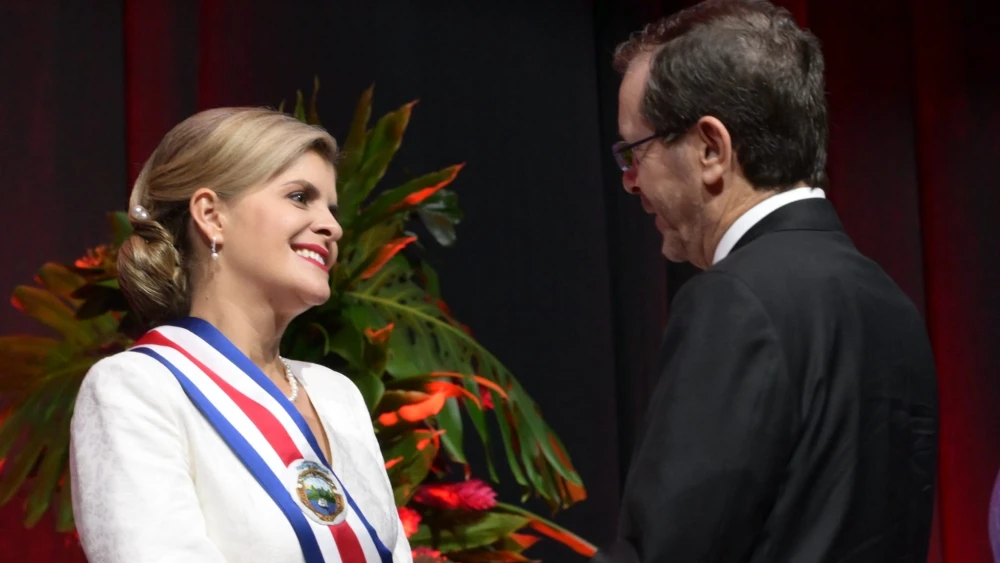
Laura Fernández Delgado, the new president of Costa Rica, has told Israeli President Isaac Herzog that she wants to upgrade her country’s mission in Jerusalem to an embassy, Herzog’s office said on Sunday.
The move, which comes at a time of burgeoning relations between the two nations and increasing Israeli diplomatic inroads in Latin America, would reverse a Costa Rican decision taken two decades ago to relocate its embassy back to Tel Aviv.
The two leaders met in the country’s capital of San José, shortly after Fernández’s inauguration on May 8, for her first official meeting as president.
Herzog met with six heads of state on the sidelines of the inauguration ceremony, including King Felipe VI of Spain, President Jose Antonio Kast of Chile, President Nasry Asfura of Honduras, President Bernardo Arévalo of Guatemala and President Rodolfo Abinadar Corona of the Dominican Republic.
“I was moved to see the depth of appreciation for Israel, the great interest in its capabilities, and the recognition of its unique contribution to humanity,” Herzog said at the conclusion of his official visit to Central America. “In contrast to many voices on the international stage, a positive trend of change, tightening of ties and deepening of cooperation with Israel is evident in Latin America.”
Costa Rica formerly maintained its embassy in Jerusalem, though relocated it to Tel Aviv in 2006 as a result of international pressure and efforts to further its relations with the Arab world.
Seven countries currently have embassies in Israel’s capital: the United States, Guatemala, Honduras, Kosovo, Paraguay, Papua New Guinea and Fiji.
All other nations that maintain ties with Israel have their embassies in Tel Aviv or its suburbs due to the political sensitivities of Jerusalem.
U.S. President Donald Trump’s decision to move the U.S. embassy to Jerusalem during his first term set the stage for other countries to follow suit, but the two-year war against Hamas in Gaza, triggered by the terrorist invasion and ensuing massacre on Oct. 7, 2023, delayed such action.