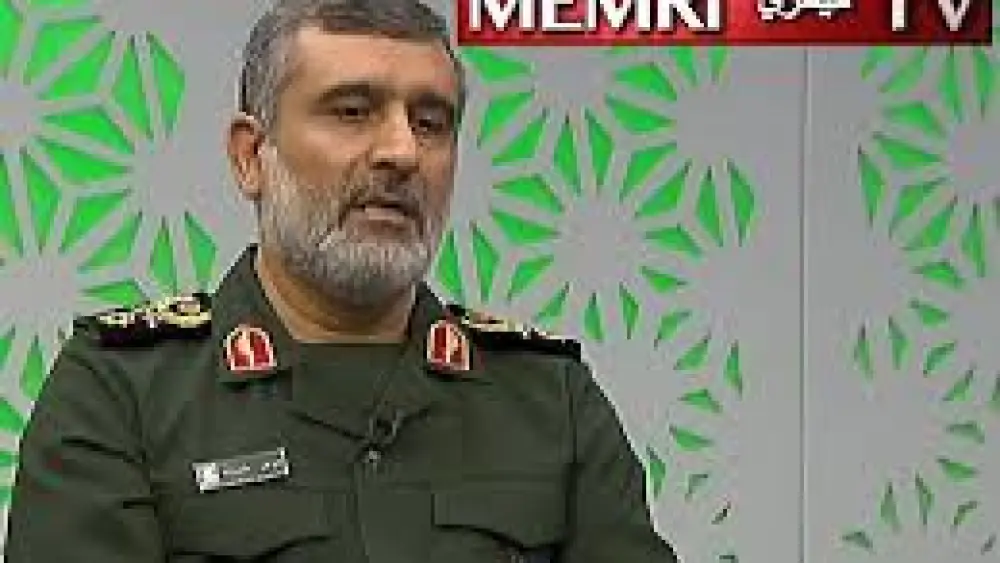
During a show on Channel 1 TV (Iran), the co’s Aerospace Force commander General Amir Ali Hajizadeh reviewed maps of different U.S. airbases in the region, including Al-Udeid in Qatar, Al-Dhafra in the United Arab Emirates, and Kandahar in Afghanistan, saying that they are all within Iranian missile range. He also said that American aircraft carriers in the Persian Gulf or the Gulf of Oman are within range, and that the U.S. military presence that used to be a threat to Iran is now an opportunity.
He described Iran’s arsenal of captured UAVs, saying that it consists of Sentinel, Predator, Reaper, Shadow, ScanEagle and Hermes drones, and he added that Iran would support any group or country that wants to confront Israel. The show aired on Nov. 21.
Following are excerpts:
Gen. Amir Ali Hajizadeh: Take a look here. This is the Al-Udeid Air Base in Qatar. This is a large base. Look , all these are airplanes. This is all American equipment. I don’t know if it’s clear, but this is a large base. It’s about 4 km by 6 km. These are the buildings. Where is all of this located? Less than 300 kilometers away from us. This is the Al-Dhafra Air Base, located in the UAE. This is an American base, and I don’t know what is there—fighters, cargo planes, tankers. … This is the base, and this is the equipment kept by the Americans. If you go to other bases, such as Kandahar Airfield, which is 400 kilometers from our borders …
Look, this is Kandahar Airfield. You see here an empty space. I remind you of our precision missiles that can strike anywhere. We even know the route of the RQ-170, which took off from Kandahar. We know its route and where it was parked. This is the situation of the Americans. They are like pieces of meat before our teeth. If they do so much as move, we can hit them on the head. That’s the situation in the region. It wasn’t like this before. Before, it was a threat, but now it is an opportunity. Why doesn’t the U.S. talk about attacking or fighting a war against Iran? Because we can hurt them. This is their situation in the region.
You should take into consideration that the situation is the same in the sea. Their aircraft carriers get to here, in the Persian Gulf. This is very close to us. We have missiles that can hit a ship from 300 km away. Our new missiles, which we developed, have a range of 700 kilometers. We can’t do anything with them in the Persian Gulf. They only become effective around the Gulf of Oman. We assume that their aircraft carriers carry at least 40-50 planes and a crew of 6,000. This used to be a serious threat to us, but what good is it [for them] now? Now it’s a central target.
[…]
We have the largest collection of captured UAVs. We have the RQ-170 [Sentinel]. We have the MQ-1 [Predator], which is a large drone, as you saw in Afghanistan. It is a combat drone that can also be used for reconnaissance. We have the MQ-9 [Reaper], the [RQ-7] Shadow and the ScanEagle. Those are all American drones. We also have a Hermes, which is a drone of the Zionist regime. No other country has so many captured [drones].
[…]
We will certainly support any group or country that wants to confront the Zionist regime. We will not hold anything back when it comes to helping them.