


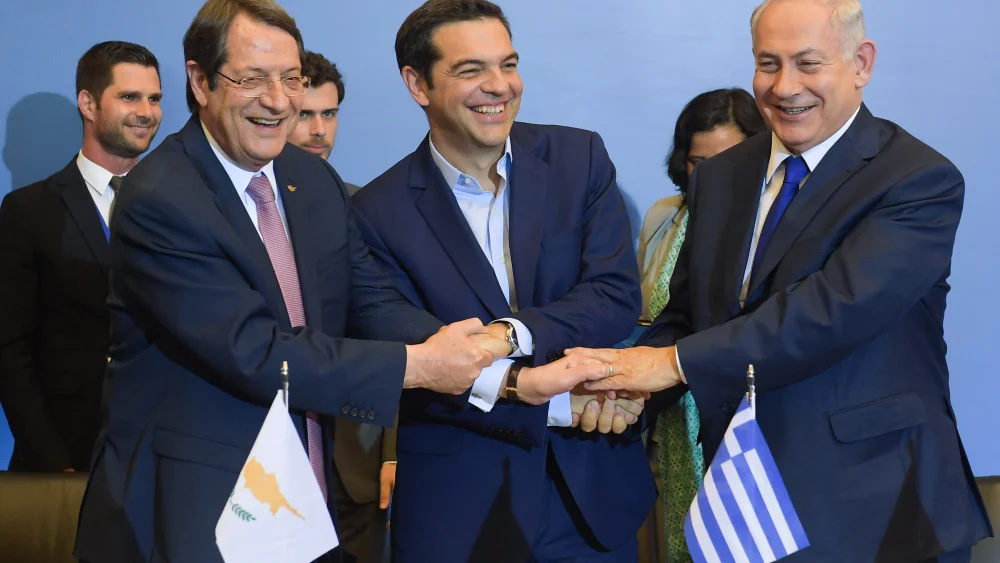
Israeli Prime Minister Benjamin Netanyahu will hold a trilateral meeting in Jerusalem on Monday with Greek Prime Minister Kyriakos Mitsotakis and Cypriot President Nikos Christodoulides.
The three eastern Mediterranean allies share a strategic partnership focused on energy, defense and economic ties. They are reportedly examining the creation of a joint rapid-response military force in the region amid growing concern in Athens over Turkey’s expanding challenges.
Netanyahu will hold a bilateral meeting with each leader and then will host a trilateral summit, the Prime Minister’s Office in Jerusalem said.
The Athens-based Ta Nea daily reported last week that the rapid-response force under discussion would incorporate about 2,500 troops and operate from bases in Israel, Cyprus and the Greek islands of Rhodes and Karpathos.
Israel, Greece and Cyprus have been working on an energy deal that would link their electrical grids.
The grid accord, which was stalled the by two-year war with Hamas in Gaza, will not include Turkey, which has reemerged as one of Israel’s bitterest critics.
The much-discussed deal to link the three countries’ electrical grids, referred to as an “energy highway,” is to be carried out via the world’s longest and deepest underwater electricity cable, crossing the Mediterranean seabed and bridging Asia and Europe.
The countries have also been mulling cooperation on an offshore natural gas deal that could establish an energy corridor to Europe and beyond, including Arab countries in the region.
“As we experience deteriorating relations with Turkey, it should be expected that Israel will strengthen its already existing overt and covert cooperation with Greece and Cyprus on various Mediterranean issues,” Tel Aviv University Professor Uzi Rabi told JNS on Monday.
Turkey has long been a regional rival to Greece, while relations between Jerusalem and Ankara have again hit rock bottom in the face of the heightened hostility of President Recep Tayyip Erdoğan following the Oct. 7, 2023, Hamas-led attack on Israel.
“We can expect that this summit will not only further the establishment of joint energy infrastructure between the three countries, including underwater electric cables, but also come with the understanding that this infrastructure will need both physical and digital protection against sabotage, both from Turkey in Cyprus’ case and from the Palestinians and Iranians on Israel’s side,” said Elai Rettig, an assistant professor at Bar-Ilan University in Ramat Gan.
The leaders of Israel, Cyprus and Greece have called the ties between their nations an “unprecedented strategic partnership.”


