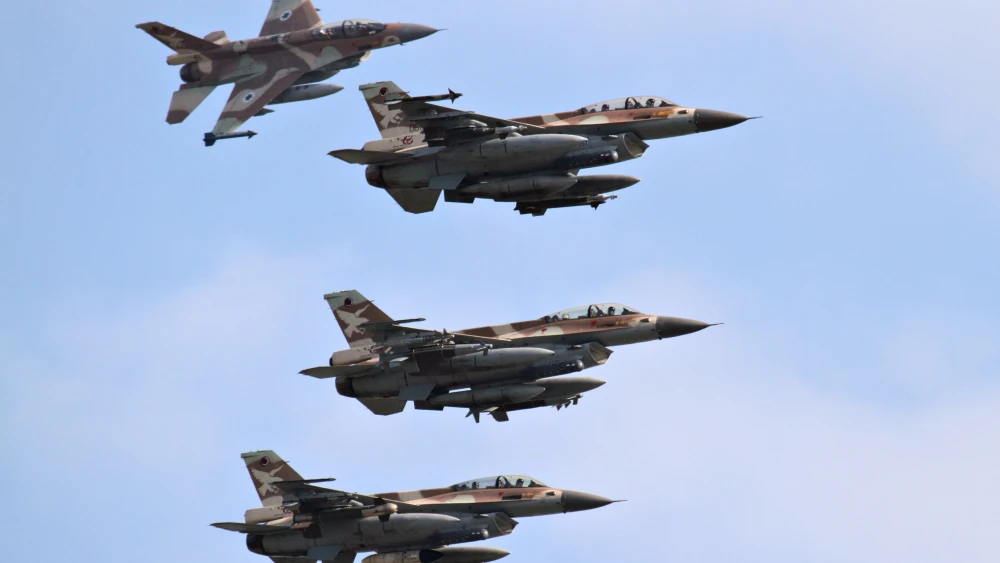
Despite the excitement and expectations generated by the arrival of the fifth-generation F-35 stealth fighter jets into the Israeli Air Force fleet, much older workhorses—the F-16 and F-15 aircraft—continue to do most of the heavy lifting.
Israel’s F-16 and F-15 jets may get less headline space these days, but they still form the crux of the air power, a senior military official has affirmed in recent weeks.
Out of the approximately 700 flying platforms in the possession of the IAF, nine are F-35 fifth-generation fighter jets, and many hundreds are F-16s and F-15s, outnumbering the F-35s by a very large margin.
The F-35 jets will eventually grow to 50 aircraft, and their game-changing capabilities have already begun impacting the entire air force. But they will remain the minority for a long time to come; the IAF has no intention of placing its trusted F-16s (or, for that matter, its F-15s) into storage hangers.
“The F-16, not the F-35, is the backbone of the air force,” the official said. The legacy F-15 jet, and its newer version, the F-15i, although fewer in number than the F-16, are also part of the air force’s core fleet.
“Every type of plane in the order of battle in the air force has its unique place,” Maj.-Gen. Eitan Ben Eliyahu, former IAF commander, told JNS in an interview.
The F-35, dubbed “Adir” (“Mighty”), “is part of a gradual renewal process for an aging order of battle, which in any case must be replaced,” he said.
“This process has always gone on in the service,” said Ben Eliyahu. “It stretches out over many years—tens, and sometimes many tens of years—and this way, a suitable order of battle of aircraft is maintained.”
The purchase of two F-35 squadrons is a powerful, new component that creates deterrence for Israel in the Middle East, added Ben Eliyahu. It does this by keeping the IAF at the forefront of technology, by maintaining a strategic Israeli-U.S. bond and by creating essential stealth capabilities that Israel would need in any future war, he said.
The F-35 jet’s ability to create networks of intelligence data—to gather, receive and distribute this data—is critical to the 21st-century Israeli air force, added the former air-force chief. Nevertheless, the older planes still have a major role to play in the IAF’s power.
The networking abilities of the older jets are not as developed, but are still good enough to remain in service for many years to come, he said.

‘Composed of the right mix’
“At all times, the IAF must maintain a number of planes that does not fall under the required minimum for carrying out the service’s duties during combat,” said Ben Eliyahu. “Not one of the planes has passed the age that obligates its removal” from the fleet, he said, adding that all of the planes are equipped with modern electronic-warfare abilities, meaning that they can survive even in an arena that is filled with threats.
“All of the planes can activate smart, precise weapons in a way that does not fall short of the F-35,” he said.
In recent years, the IAF has also been upgrading and modifying its F-16 jets, according to Col. A. (who cannot be named), head of the Planning and Organization Department. The colonel said on the IAF’s official website last week that both the older F-16c/D jets, dubbed “Barak” (“Lightening”), and the newer F-16I planes—known as the “Sufa” (“Storm”), are undergoing upgrades—receiving new munitions and other vital systems.
According to Ben Eliyahu, all of the older aircraft have the ability to reach altitudes, ranges and carry payloads that do not fall short of the F-35 . . . and sometimes surpass it.
Ben Eliyahu drew attention to the way in which new and older aircraft will cooperate with each other during missions, saying “after the ‘Adir’ breaks through and clears a path through its stealth, the [other] planes can freely arrive after it. In addition, after achieving air supremacy, all of the planes can freely penetrate [the enemy’s airspace].”
As a result, he said, although the F-35 remains vital in its importance, the air force still needs to have hundreds of combat aircraft at its disposal, “meaning that its order of battle is composed of the right mix.”
While the IAF is kept busy defending the national security of the Jewish state on multiple fronts—conducting missions over Gaza, Syria and other regions, and policing Israel’s red lines against Iran’s attempt to take over the Middle East—its older jets will remain an inseparable part of that effort.