Newsletter
Newsletter Support JNS

Ayelet Shaked to UAE media: No current plans to discuss Palestinian conflict

“We do believe in economic peace to improve Palestinian lives and to do mutual industrial zones,” said Israel’s interior minister. “But not a state with an army, definitely.”

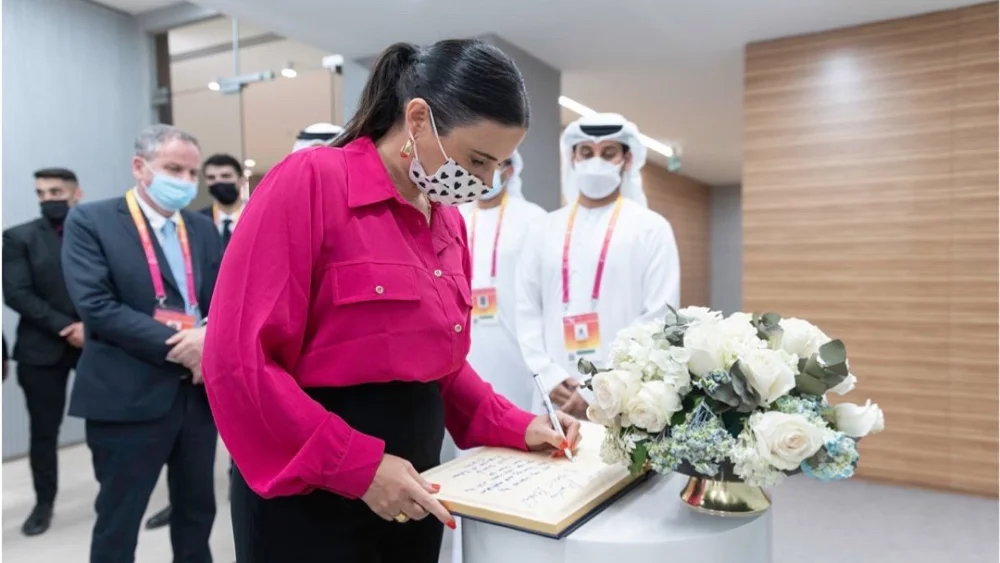
Israel’s Interior Minister Ayelet Shaked visits the Expo 2020 in Dubai, United Arab Emirate. Credit: UAE Ministry of the Interior.

Israeli Interior Minister Ayelet Shaked said the government does not plan on discussing the establishment of a Palestinian state during the tenure of Israeli Prime Minister Naftali Bennett or of Yair Lapid if he takes over according to the rotation agreement.

Shaked, who is on a visit to the United Arab Emirates in her first diplomatic visit there, told the local publication The National that agreement exists among various factions in the government not to push issues at present that would cause division.

“We do believe in economic peace to improve Palestinian lives and to do mutual industrial zones,” she said. “But not a state with an army, definitely.”

She also spoke against the BDS movement and in favor of the Abraham Accords, which has fostered normalization with Israel and the UAE, Bahrain, Sudan and Morocco.

“We have known firsthand that from every territory we withdraw, a terror organization will spring up. It happened in South Lebanon where Hezbollah is ruling and funded by Iran, and having thousands of missiles pinpointed at Israel,” she continued.

The Knesset member added that “when we withdrew from Gaza, people were saying it would be another Monaco, but we know what happened there—Hamas took over [and] turned it into a terror state. We will not repeat this experiment again.”


A small business owner in the Big Apple told JNS that she is being hurt by tariffs more than by the credit rating.
Jay Greene, author of a new report on the subject, told JNS that the unions communicate in an “overwrought and extreme” way about Israel.
“Why are we to trust the U.N.’s own vetting procedures?” Adam Kaplan, of USAID, asked a congressional committee.
The pro-Israel group “has become increasingly problematic for many American Jews and for many candidates running for office,” Lauren Strauss, of American University, told JNS.
Sharon Liberman Mintz, of Jewish Theological Seminary, told JNS that the 1526 Haggadah “is one of the most exciting books that I have ever had the pleasure to turn the pages of.”
Tehran combines a narrative of victory with one of victimhood to shape public opinion. Israel is trying to catch up in the battle for public perception.