


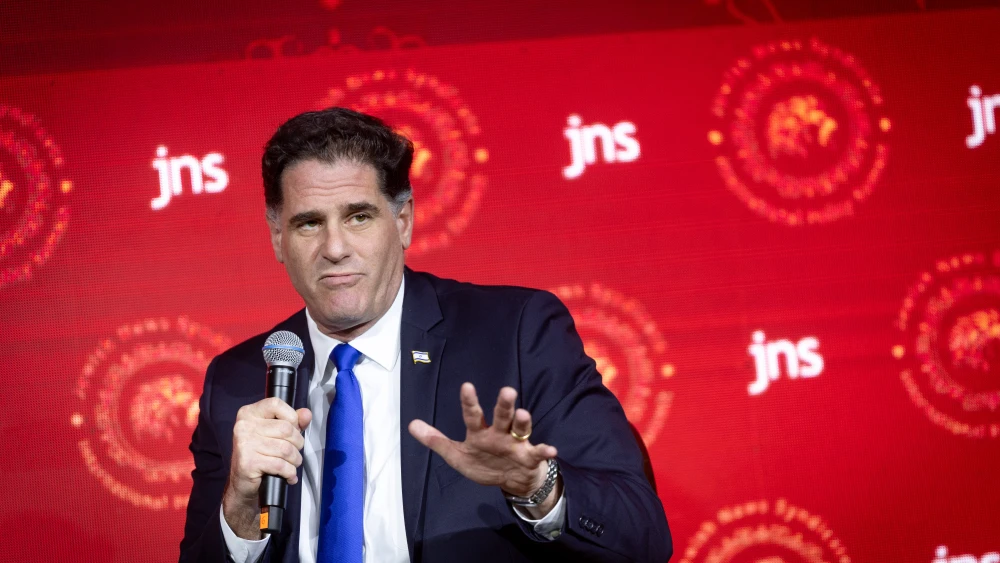
Israeli Strategic Affairs Minister Ron Dermer was set to meet with Syrian Foreign Minister Asaad al-Shaibani in London on Wednesday to discuss security arrangements for a third round of U.S.-mediated negotiations, according to Axios.
Sources familiar with the talks told the outlet they have seen progress but no deal between Jerusalem and Damascus appeared imminent.
Israel was said to have conveyed to Syria a detailed proposal for a new buffer zone, including a map from southwest Damascus up to the border with Israel, according to sources familiar with the details.
Israel proposed to divide southern Syria into three zones and limit the types of regime forces and weapons permitted in each, the report said.
Under Jerusalem’s proposal, the security zone along the Israeli-Syrian border would be extended by some 1.24 miles on the Syrian side. In the strip adjacent to the border, Syrian military and heavy weapons would be barred, though police and other internal security forces would remain.
Meanwhile, the entire area from Damascus to the Israeli border would also be declared a no-fly zone for Syrian aircraft, to maintain an aerial corridor for the Jewish state’s military to attack Iran, according to the report.
In exchange for these restrictions, Israel would gradually withdraw from Syrian territory it has seized in recent months, with the exception of an outpost at the summit of Mount Hermon. An Israeli official told Axios that Jerusalem insists on maintaining a permanent presence there.
Syria has reportedly not responded yet to Israel’s proposition, which was made several weeks ago, and has been working on a response in recent weeks, which is expected to be discussed with Dermer on Wednesday.
Syria’s Foreign Ministry confirmed Tuesday that Damascus was working to “reach security understandings with Israel concerning southern Syria that address the legitimate security concerns of both Syria and Israel.”
Al-Shaibani, in remarks quoted by AFP, said the plan was backed by the United States and Jordan and would also seek to restore calm in southern Syria following repeated atrocities there, reportedly by regime-backed militias, against minority groups, including against local Druze.
According to reports from rights groups and local Druze activists, armed clashes in July between regime-allied forces, Druze militias and Sunni Bedouin tribes escalated into widespread violence targeting civilians.
The alleged abuses include summary executions, abductions, looting, destruction of property and sexual violence against women and girls.
While a ceasefire ended the sectarian bloodshed two months ago, the situation in southern Syria has remained unstable, with Sweida city controlled by Druze forces and the rest of the area by regime troops.
“The Syrian government has laid out a clear roadmap for action,” stated al-Shaibani at the press conference on Tuesday, saying the plan would hold accountable those who attacked civilians and compensate their victims, in addition to launching a process of internal reconciliation.
Jordanian Foreign Minister Ayman Safadi said a “joint Syrian-Jordanian-American mechanism” would assure the implementation of the plan, which U.S. envoy Tom Barrack, also present, described as “historic.”
The announcement came as a Reuters report claimed that Jerusalem has been working to unify the fragmented Druze factions in the Sweida area, providing them with weapons and paying salaries of militia fighters.
Two senior Druze figures, who spoke anonymously with Reuters due to the sensitivity of the matter, said that the fighting in July, Jerusalem had delivered military aid, including guns and ammunition, to the militias.
The two Druze and a Western intelligence source said that the Jewish state was also paying the salaries of many of the 3,000 militia fighters.
Reuters was not able to independently confirm the military shipments or payments, and the offices of Prime Minister Benjamin Netanyahu and Dermer did not respond to the wire agency’s questions on the issue.
Syrian President Ahmed al-Sharaa said on Aug. 24 that there had been progress in the talks for understandings with Israel based on the 1974 Disengagement of Forces Agreement that ended the Yom Kippur War.
While the president said that he does not view current circumstances as favorable for concluding a peace, he said he would “not hesitate” to do so if he becomes convinced that it would benefit Syria and the region.
Syria in July claimed a willingness to reimplement the 1974 deal with Israel. After a phone call with U.S. Secretary of State Marco Rubio, Al-Shaibani declared he intended “to cooperate with the United States.”
During a visit to the Syrian side of Mount Hermon on Jan. 28, Israeli Defense Minister Israel Katz said Israel Defense Forces troops would remain in the border region with the Arab Republic for as long as necessary.
“The IDF will remain at the summit of the Hermon and the security zone indefinitely to ensure the security of the communities of the Golan Heights and the north, and all the residents of Israel,” Katz said.



