By Ben Cohen/JNS.org
I’ve long argued that any proper understanding of the Palestinian conflict with Israel’s legitimacy is compromised by not taking wider regional factors into account. The school of thought that describes the Israeli-Palestinian conflict as “the Middle East conflict” is dangerously misguided, because it ignores other factors that are far more important, such as the historically violent schism between Sunni and Shi’a Islam, Iran’s renewed assertiveness in Syria and Lebanon, the shared strategic interests binding Israel and the conservative regimes in the Arab Gulf in confronting Iran’s nuclear ambitions, and the fragmentation of the various jihadi groups in Sinai, Syria, Iraq, and other territories.
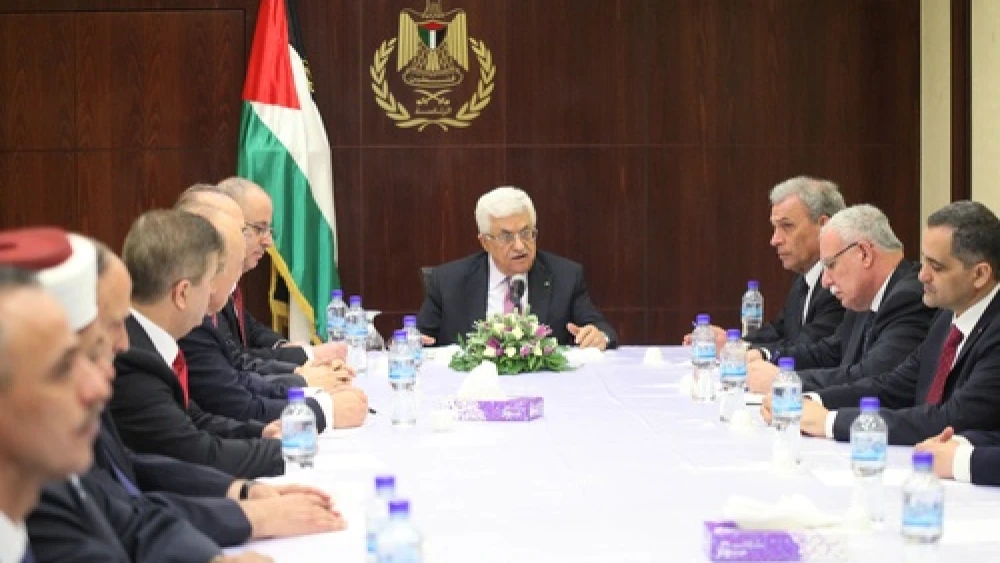
That’s why I want to preface my comments about the new Palestinian unity government, which brings together Palestinian Authority (PA) President Mahmoud Abbas’s Fatah movement with the Islamists of Hamas, by pointing to a political rally several hundred miles to the east of Jerusalem, in Tehran.
At that rally, Iranian Supreme Leader Ayatollah Ali Khamenei stood in front of a banner that declared, “America cannot do a damned thing.” A “military attack is not a priority for Americans now,” Khamenei boasted. “They have renounced the idea of any military actions,” he said.
In other words, in the Middle East as a whole, America is weak, or is at least perceived to be weak. And weakness has a natural partner in the form of naïveté—the exact word used by Israeli government minister Gilad Erdan to describe the Obama administration’s acceptance of the new Fatah-Hamas coalition, but which could equally apply to the American approach to conflicts from Libya in the west to Afghanistan in the east.
After all, would Abbas have cut a deal with Hamas if he were dealing with an American administration with a tough and cogent Middle Eastern policy? Would Obama’s predecessor, George W. Bush, have been hoodwinked into believing that because the new PA government’s ministries are largely run by technocrats, the American pledge to shun Hamas while it remains a terrorist organization has not been violated? I think not.
Still, Israel’s supporters are compelled to deal with this situation as it is, and not as we would like it to be. Hence, we have a choice. We can lambast Secretary of State John Kerry for placing the lion’s share of the blame for the recent collapse of peace talks on Israel, while ignoring Abbas’s pursuit of unilateral recognition for a Palestinian state and his reconciliation with the genocidal anti-Semites of Hamas. We can laugh, bitterly, at Obama’s statement to Bloomberg columnist Jeffrey Goldberg that Abbas is “sincere” about resolving “these issues in a diplomatic fashion that meets the concerns of the people of Israel”—a line worthy of a Monty Python scriptwriter.
But as therapeutic as doing all that might be, it is not a replacement for a political strategy. With more than two years to go before President Obama departs the White House, the best strategy we can work for now is damage limitation.
The first element of such a strategy is to point out that the Fatah-Hamas deal, which on the surface looks more secure when compared to previous agreements between these bitter rivals in the recent past, still contains some serious holes. Critically, as the Tel Aviv University security analyst Dr. Benedetta Berti argued in an interview with Fathom, a British magazine focused on the Middle East, “where the parties have not seen eye to eye so far is on their mutual desire to keep control of Gaza, in the case of Hamas, and the West Bank, in the case of Fatah.” Berti further pointed out that the “core elements of Hamas’s ideology have not shifted, but there is an internal conflict in the organization about how to accommodate ideology with political interests and pragmatism.”
It is nigh on impossible to believe that Hamas will become so pragmatic as to surrender its formidable arsenal of weapons and materiel to the PA. Far more likely, as the Israeli journalist Ehud Yaari has observed, is that Hamas will increasingly mimic the “bullets and ballots” model followed by Hezbollah in Lebanon. Under this arrangement, 20,000 fighters and security personnel will remain under the Hamas banner. At the same time, these terrorists will be able to continue with the production of missiles capable of reaching Tel Aviv and Jerusalem.
The possibility that the unity government will enable a fresh terrorist assault on Israel that provokes a sustained response on the part of the IDF is, therefore, a very real one. How, then, are we to avoid a repeat of the clashes over the last decade that resulted in Israel’s being smeared with false accusations of war crimes, from Jenin in 2002 to Gaza in 2009?
One avenue is to mobilize the U.S. Congress to frustrate the Obama administration’s determination to deal with the unity government. At present, American taxpayers are supporting Abbas and the PA to the tune of $400 million a year. Now that Hamas, a designated terrorist organization, is part of the PA’s governing machine, we should be demanding that our congressional representatives work for an immediate suspension of this aid.
Also, just as the Palestinians have used “lawfare”—the invocation of international legal conventions against Israel—so can we. Abbas and his colleagues should be held accountable for breaching the 1998 Wye Memorandum, which obliges the PA to control the arsenals of Hamas and smaller terror groups like Palestinian Islamic Jihad.
The fundamental problem remains: There is no credible Palestinian political force committed to an enduring peace deal with Israel. Therefore, expect more violence, both among the Palestinians and against Israel, and expect, as a consequence, further international vilification of Israel for taking the necessary measures to protect its population.
Like I said, from now on, it’s all about damage limitation.
Ben Cohen is the Shillman Analyst for JNS.org and a contributor to the Wall Street Journal, Commentary, Haaretz, and other publications. His book, “Some Of My Best Friends: A Journey Through Twenty-First Century Antisemitism” (Edition Critic, 2014), is now available through Amazon.