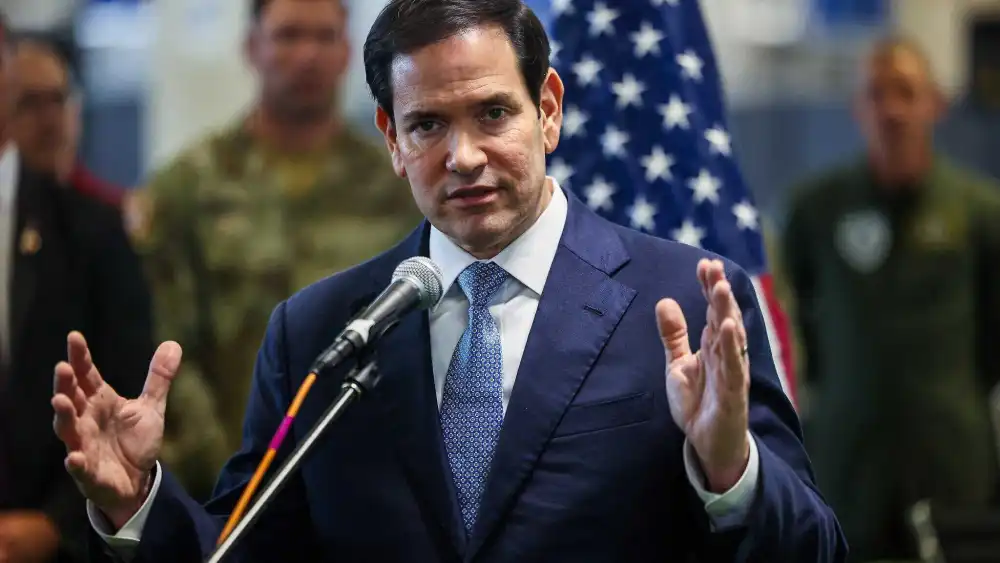
There is no viable alternative to President Donald Trump’s Middle East peace plan, U.S. Secretary of State Marco Rubio told reporters in Israel on Friday, expressing “healthy optimism” that it will be fully implemented.
“There is no Plan B,” Rubio said during what was termed “a press gaggle” at the new Civil-Military Coordination Center (CMCC) in Kiryat Gat. “This is the best plan. It’s the only plan. It’s one that we think can succeed. It’s one that we believe is the way to success, as impossible and unimaginable as it may have been.”
He elaborated, “Remember a month ago, six weeks ago? No one would have thought it possible that you were going to get all the hostages out. And I know that we still have the remains of hostages [set to be returned]. That has to happen. That’s part of this. And we’re very committed to making sure that happens.”
Rubio said the United States is not going to stop pushing until “all the commitments that were made here are kept,” stressing that these include the demilitarization of Hamas in Gaza.
“I think we have a lot to be proud of in the first 10 days, 11 days, 12 days of implementation, where we have faced real challenges along the way, including over the weekend, but also an exciting opportunity,” he said. “There’s going to be ups and downs and twists and turns. But I think we have a lot of reasons for healthy optimism about the progress that’s being made.”
Noting that dozens of countries had endorsed the plan, Rubio said its implementation was being carried out in close coordination with Israel. “A deal requires conditions to be met,” he said. “Israel has met their commitments. They’re standing at the Yellow Line,” referring to the demarcation line in Gaza established on Oct. 10 as part of the U.S.-brokered ceasefire deal.
He said the world needs to understand that “on the other side of that Yellow Line, there is still a terrorist group that remains armed. And we’ve seen them take actions against their own population. I think it’s important, by the way, that there be more media coverage given to the fact that Hamas has brutalized Palestinians, has brutalized Gazans over the last few days.”
U.S. Central Command announced on Tuesday that it had opened the CMCC, the “main coordination hub for Gaza assistance,” in Israel on Oct. 17. CENTCOM said that the center “is designed to support stabilization efforts” and that the hundreds of American troops stationed there won’t deploy in Gaza. Instead, they will “help facilitate the flow of humanitarian, logistical and security assistance from international counterparts into Gaza.”
Rubio said he wanted to visit the CMCC “to get a sense of the workflow, get a sense of the organization and get a sense of the needs.”
He pointed out that humanitarian assistance was now flowing into Gaza and that this involved “coordinating with all of these different organizations from around the world, including international organizations and charity groups. That’s a massive undertaking to coordinate all of that.”
Rubio insisted that the United Nations Relief and Works Agency for Palestine Refugees in the Near East (UNRWA) could no longer participate in delivering humanitarian aid to Gaza.
“UNRWA’s not going to play any role in it,” he said in response to a question. “The United Nations is here. They’re on the ground. We’re willing to work with them if they can make it work, but not UNRWA. UNRWA became a subsidiary of Hamas.”
Declaring that “it’ll be historic if it can be pulled off,” he said the 20-point Trump plan would “change Israel’s security in the long term. It will change the character and the nature of the region in a positive way.”
Rubio, who was in Israel from Oct. 22-25, concluded, “We are committed to making that work and we’re committed to ensuring that every one of these points is lived up to. But it’s not going to be an easy ride. There are going to be bumps along the road, but we have to make it work. There is no other alternative and we feel good about the progress that’s being made. Every day that goes by, it gets better.”