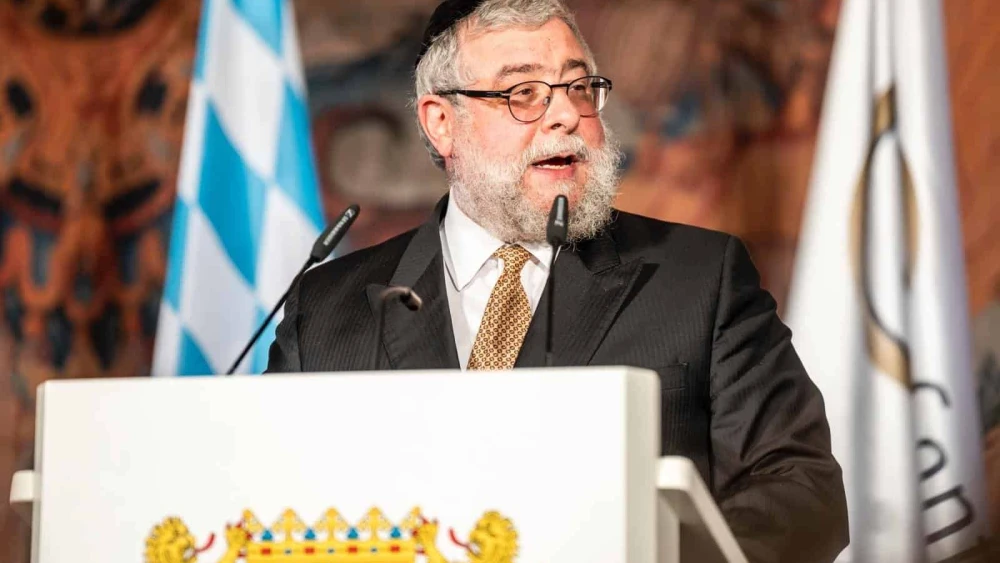
Hundreds of European rabbis from across the continent will be gathering in Azerbaijan this fall to discuss the expansion of the Abraham Accords in the first such convention in a Muslim nation.
The extraordinary assembly in the secular Shi’ite country comes amid burgeoning relations between Israel and Azerbaijan that developed from a centuries-long affinity between the two nations into an unprecedented strategic partnership in the face of ongoing regional turmoil.
The biennial convention of the Conference of European Rabbis is scheduled to take place in the capital, Baku, between Nov. 4-6 at the invitation of the Azerbaijani government, which will serve as the honorary host, with more than 500 rabbis expected to attend the event.
The organization’s 70th anniversary convention will address key contemporary challenges and opportunities, including the expansion of the landmark Abraham Accords—which saw Israel reach peace agreements with four Arab countries under the first Trump administration five years ago—to include Azerbaijan as well as the promotion of freedom of religion and the fight against rising antisemitism in Europe.
Azerbaijan’s President Ilham Aliyev is expected to address the three-day gathering.
The group’s previous conference, which had been scheduled to take place in the Azerbaijani capital two years ago, was cancelled because of the Oct. 7, 2023, Hamas attack on southern Israel.
The primary Orthodox rabbinical alliance in Europe, the organization unites more than 700 religious leaders from communities across Europe. Founded in 1956, it works to defend the rights of Jews in Europe, with freedom of religion and matters related to the Jewish communities expected to be front and center at the conference.
“Jewish life in Azerbaijan is historic, visible, and vibrant and dates back to the Babylonian exile and the Persian Empire,” Rabbi Pinchas Goldschmidt, president of the Conference of European Rabbis, told JNS on Tuesday. “Our visit will be a unique opportunity to meet with the Azeri community and hold talks with the government there, which is widely recognized for its secular, tolerant and inclusive nature.”
The Zurich-born Goldschmidt, who served as chief rabbi of Moscow for nearly three decades, left Russia following the invasion of Ukraine three years ago and then resigned from his position. His subsequent public criticism of the war led him to be branded by Russia as a “foreign agent.”
Ties that bind
The selection of secular Shi’ite Muslim Azerbaijan as the venue for the conference is highly symbolic, since it is believed that indigenous Jews arrived on the territory of Azerbaijan following the Babylonian destruction of the First Temple in Jerusalem in 586 BCE.
Indeed, at a time of heightened antisemitism across the globe, Azerbaijan is considered free of such animus with the country’s 25,000 to 30,000 Jews living in harmony with their predominantly Muslim neighbors.
“Azerbaijan is a secular Muslim country where there has never been antisemitism,” said Baku-born Roman Gurevich, who serves as the honorary envoy of the quasi-governmental Jewish Agency for Israel in Azerbaijan. “It stands as a shining example to the world of how peoples can live together in harmony, good neighborliness and mutual respect.”
He noted that centuries of nurtured traditions of brotherhood, friendship and respect toward their Jewish community and then the State of Israel make it “the most fitting and honorable place” to host the international conference of rabbis.
For Israel, ties with Azerbaijan—which shares a 428-mile border with Iran, a country that is home to tens of millions of Azerbaijanis—are of strategic importance, both as a conduit for reconnaissance and because Azerbaijan supplies nearly half of the Jewish state’s oil.
At the same time, Azerbaijan is a leading purchaser of Israeli military hardware, which helped Baku in its 2020 war with archrival Armenia. The victory greatly strengthened Baku regionally in a time of geopolitical change.
Historically, Azerbaijan is home to three distinct Jewish communities: European Jews, who settled in the area during the late 19th to early 20th centuries, and during World War II; Jews from the former Soviet Republic of Georgia, who settled mainly in Baku during the early part of the 20th century; and Mountain Jews, the most sizable and ancient group.
The conference will include a visit to the historic ancient Jewish community of Quba in Azerbaijan, which was home to Mountain Jews for centuries.