


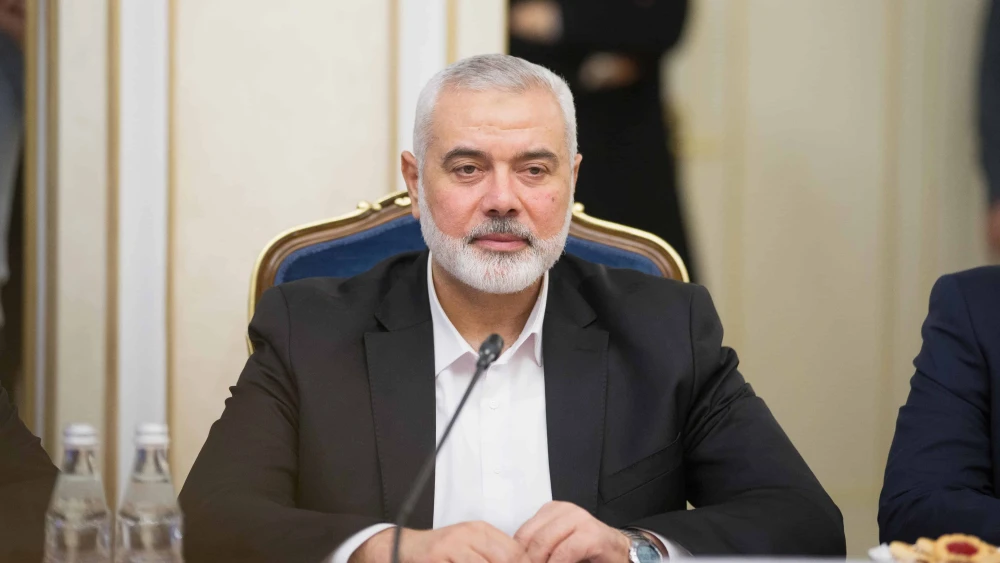
Hamas “political” leader Ismail Haniyeh, who was slain by Israel in Tehran on July 31, was struck by a missile that zeroed in on him using his own mobile device, an Islamic Revolutionary Guards Corps spokesman said on Sunday.
“The assassination was based on digital operations and radio signals that made it possible to easily discover the point where he was standing and target him,” and “was not a sophisticated operation,” the IRGC official said.
The IRGC claim contradicts earlier reports that Haniyeh was killed by a remote-controlled bomb planted months earlier by the Mossad.
The IRGC spokesman strongly rejected that version of events and said that the targeted killing was carried out using signals from Haniyeh’s cell phone. The spokesman added that Haniyeh had been explicitly cautioned about the risk by the IRGC but chose to ignore the warnings.
A shoulder-fired, or stationary, missile hit Haniyeh through a window. The missile hit at the exact moment when Haniyeh answered the phone, the IRGC claimed.
Defense Minister Israel Katz confirmed in December of last year that Israel was behind the killing of Haniyeh. Until then, Jerusalem had not taken responsibility for the attack.
Early reports, including that of the Al Mayadeen media network affiliated with Hezbollah, claimed that the killing was “carried out by means of a missile launched from country to country, not from within Iran.”
However, then-Israel Defense Forces spokesman Rear Adm. Daniel Hagari said during a press briefing on Aug. 1: “There was no additional aerial attack—not a missile and not an Israeli drone—in the Middle East that night, and I won’t say anything beyond that.”
Haniyeh was in Iran for the inauguration of President Masoud Pezeshkian. He was staying at a special residence for war veterans in the north of the capital. A bodyguard was killed with him.
Based in the Qatari capital of Doha, Haniyeh was one of the most senior members of Hamas, along with the terrorist group’s leader in Gaza Yahya Sinwar. Sinwar was assassinated on Oct. 16, 2024.
Qatar, a major financial backer and political ally of Hamas, condemned Haniyeh’s assassination, saying that the killing “and Israel’s behavior, which harms civilians, will lead to the region slipping into a cycle of chaos that will undermine the opportunities for peace.”


