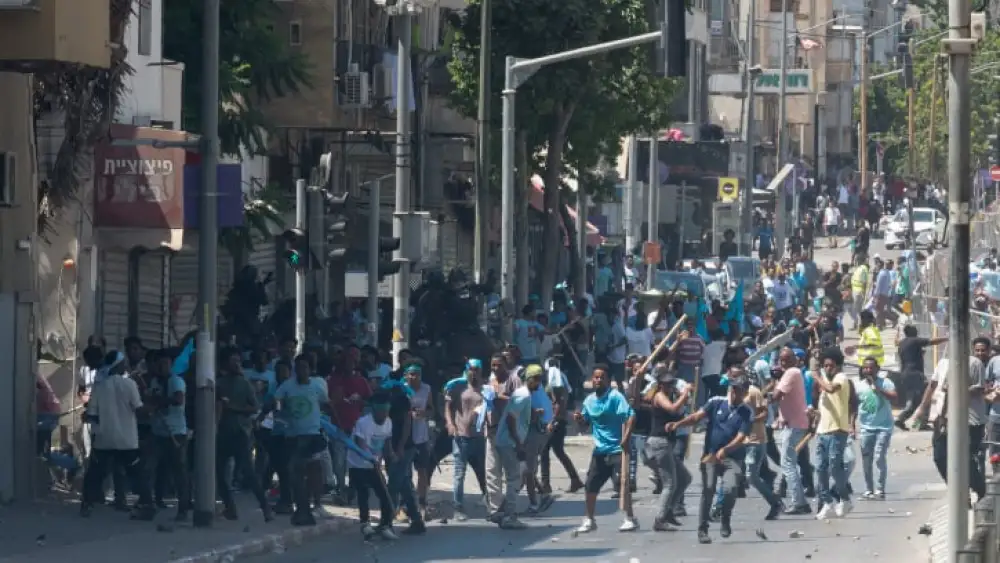
Fifty-three suspects from Saturday’s violent clashes between rival Eritrean factions in Tel Aviv have been placed in administrative detention.
The suspects were transferred to Givon Prison in the central Israeli city of Ramla on Monday and Tuesday after being questioned by the Population, Immigration and Border Control Authority. They will be held there for at least four days during which they will be brought to court.
Fourteen of the detainees are supporters of the Eritrean regime, 20 are opponents and the rest are unaffiliated, Haaretz reported.
“I am glad that the State’s Attorney’s Office and the Immigration Authority accepted my directive in the committee of ministers meeting to administratively arrest the infiltrators who rioted and injured police officers over the weekend,” National Security Minister Itamar Ben-Gvir said.
“I congratulate the police and law-enforcement officials for implementing the policy on the ground. We will not give up and we will act with full force against rioters in the State of Israel.”
Earlier on Tuesday, police arrested a foreign national after he was recorded on video with a gun at Saturday’s riots in South Tel Aviv. The 41-year-old resident of the city was transferred for questioning and will be brought to court to extend his detention. Seven more suspects were arrested on Monday for involvement in violence during the riots.
More than 170 people were injured, including 49 police officers, when a demonstration by Eritrean asylum seekers against an event at the Eritrean embassy in the southern part of the city turned violent.
Rocks, clubs and other weapons were used against police and other rioters, and businesses and parked vehicles were vandalized.
Israeli ministers met on Sunday morning to discuss the government’s response to the riots, with Israeli Prime Minister Benjamin Netanyahu saying that Saturday’s violence “crossed a red line.”
“We are seeking strong steps against the rioters, including the immediate expulsion of those who took part,” the premier said. “It is hard for me to understand why we would have a problem with those who declare that they support the regime; they certainly cannot claim refugee status.”
Netanyahu added: “I would also like this forum to prepare a complete and updated plan to repatriate all of the remaining illegal infiltrators from the State of Israel; this is the purpose of our meeting today.”
Meanwhile, the United Nations cautioned Israel against mass deportations of Eritreans following the riots, saying it would “contravene international law.”
“UNHCR calls for calm and restraint, and on all parties to refrain from taking any steps that could aggravate the situation further,” William Spindler, spokesman for the U.N. high commissioner for refugees, told reporters in Geneva on Tuesday.
Spindler said that it was “important to establish accountability” for the event but warned that “any decision impacting all Eritrean asylum-seekers … would contravene international law.”