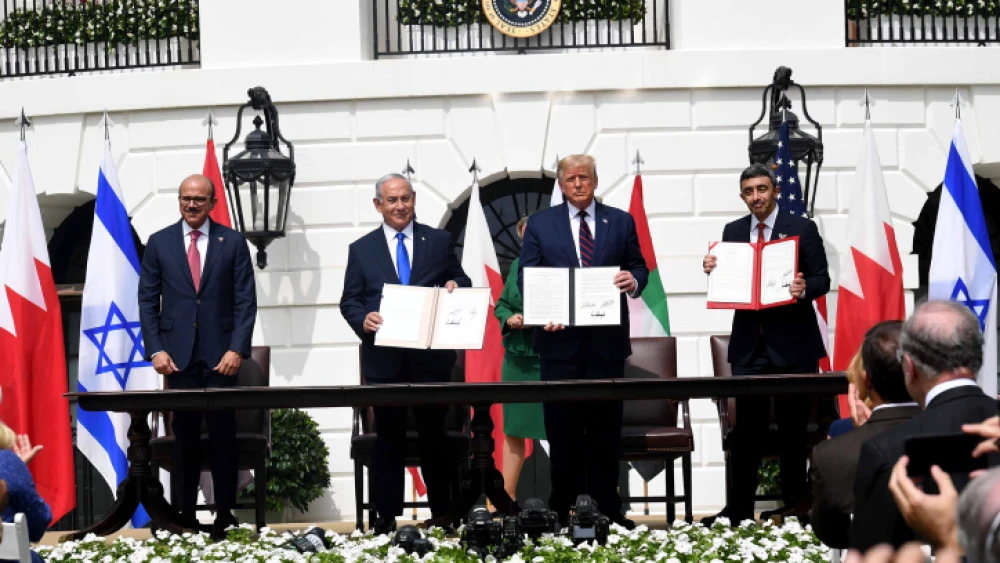
The Israeli Cabinet on Sunday ratified the peace agreement with the United Arab Emirates and also approved the submission of the peace agreement with Bahrain for Knesset approval, according to a statement from the Prime Minister’s Office.
The Knesset approved the U.S.-brokered treaty with the UAE on Oct. 15—exactly one month after the Sept. 15 signing of the Abraham Accords at the White House—by an overwhelming majority, following a unanimous Cabinet vote on Oct. 12 to submit the deal to the Israeli parliament for ratification.
The tally of the Oct. 15 Knesset vote was 80-13, with 27 of the 120 plenum members absent. All 13 MKs who voted against the deal were from the Joint Arab List, which believes that no Arab country should make peace with Israel until the Palestinians have a state.
Until Friday, when U.S. President Donald Trump announced that Sudan was joining the peace effort, the treaties with the UAE and Bahrain were the only ones to have been reached between the Jewish state and a Muslim-majority country since 1994, when Israel signed a deal with Jordan. Before that, the last such state in the region to make peace with Israel was Egypt, in 1979.
The first-ever official delegation to Israel from the UAE arrived on Oct. 20 for a series of meetings between visiting and local officials—including U.S. Treasury Secretary Steven Mnuchin and U.S. special envoy Avi Berkowitz (who accompanied the UAE delegation on the flight), as well as UAE Minister of State for Financial Affairs Obaid Humaid Al Tayer and UAE Economy Minister Abdulla Bin Touq Al Marri—to formalize cooperation agreements, among them a mutual visa-exemption deal.
Two days earlier, on Oct. 18, Israeli National Security Council head Meir Ben-Shabbat and Bahraini Foreign Minister Abdullatif bin Rashid Al Zayani signed a joint communique on the establishment of “diplomatic, peaceful and friendly” relations between Jerusalem and Manama.
At the ceremony in the Bahraini capital, the directors general of the two countries’ relevant ministries simultaneously signed eight Memoranda of Understanding (MoUs) relating to economics, trade, finance, commerce, civil aviation, telecommunications, IT, postal services, agriculture and the easing of visa requirements for diplomats and holders of service passports.