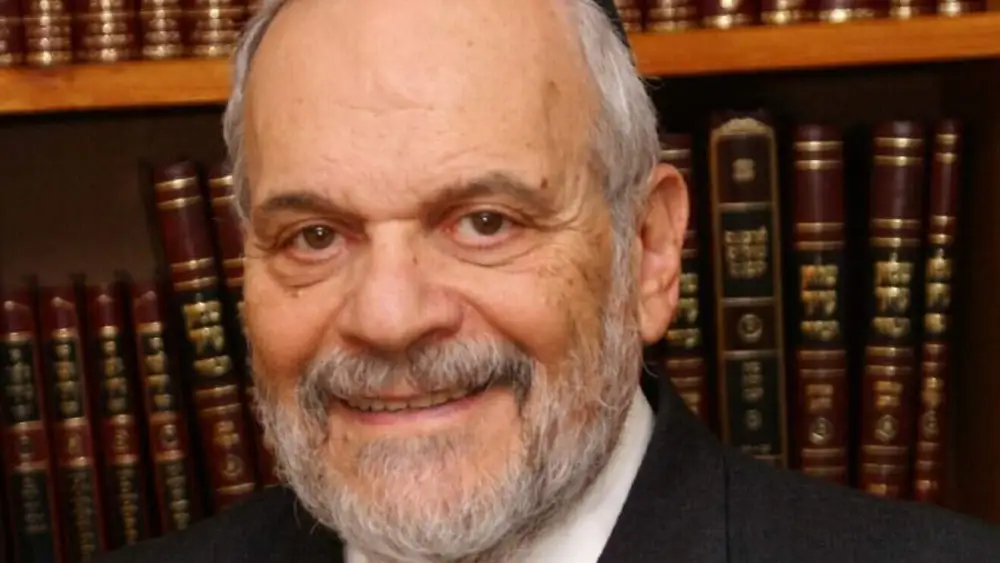
Rabbi Berel Wein, a charismatic and eloquent Illinois-born spiritual leader and scholar, educator and historian, writer and orator who made aliyah in 1997, died in Jerusalem on Aug. 16. H was 91 years old.
“We mourn the passing of this unique rav, educator and communal leader and will remain forever indebted to him both for his enduring impact on Klal Yisrael [the Jewish people] and for his lifelong support and involvement in the work of the Orthodox Union,” the OU said in a statement. “Rabbi Wein was a uniquely impactful Rav whose work, perspective and voice profoundly influenced generations of Orthodox Jewry.”
Wein authored dozens of books in both Hebrew and English, focusing on Judaism and Jewish history, recorded more than 1,000 audio tapes and wrote regular newspaper columns in the Jewish and Israeli press. He also authored and edited a monthly newsletter, The Wein Press, and appeared regularly on public television in Israel as part of a program titled “Ask the Rabbi.”
Born in Chicago to a family descended from distinguished Lithuanian rabbis, Wein received his semicha (“rabbinic ordination”) from the Hebrew Theological College, which was founded by his maternal grandfather, Rabbi Chaim Tzvi Rubinstein.
In 1964, when he was 30, Wein became the rabbi of the Beth Israel Congregation in Miami Beach and at 38, he was appointed executive vice president of the OU. Shortly thereafter, following the sudden death of Rabbi Alexander Rosenberg, one of his mentors, Wein replaced him at the helm of OU Kosher, a position he held for five years. He is credited with transforming kosher supervision in North America through his leadership of the OU’s Kashrut Division.
In Monsey, N.Y., he led Congregation Bais Torah for 24 years and in 1977 founded Yeshiva Shaarei Torah, serving as its dean until 1997, when he moved to Israel with his wife to serve as rabbi of Beit Knesset Hanassi in Jerusalem’s Rehavia neighborhood.
In addition to being a beloved congregational rabbi, he was a popular faculty member of the Ohr Somayach yeshiva in Jerusalem and lectured extensively in Israel and abroad.
In 1986, Wein embarked on “a mission to resurrect the dying narrative of Jewish history” by establishing The Destiny Foundation. “From a series of audio lectures, Rabbi Wein’s mission ballooned into a worldwide multimedia operation of books, videos and courses that continue to transform the lives of thousands of Jews across the globe,” it said.
In recent years, the Rabbi Berel Wein Podcast became extremely popular in Israel and around the world, particularly after the Hamas attacks on Oct. 7, 2023. In an episode recorded during an appearance before a young audience in the U.S. at the end of that month, Wein spoke about the situation in Israel through the lens of the Tanach.
“You are all privileged to live in a biblical moment,” he stated. “It’s a choice moment, something that should affect you for the rest of your lives, so we should be able to see it in perspective, because the Torah is perspective.”
He added, “Hamas is not new. Part of the thing to realize now is that this is a rewind; this is a replay. It’s not new. It may be new for you because it never happened before and it may disturb your plans to go to Harvard. But it’s not new. We’re an old people. We’ve seen everybody. We’ve seen everything. And everybody is gone and we’re still here.”
The OU said in its statement following news of Wein’s death, “He literally revived the popular study of Jewish history through a pioneering series of hundreds of lectures on the topic, one of the first sets of widely distributed Torah recordings.”
It added, “Until the end, he continued to be a prolific writer and teacher of Torah whose books and columns were read by thousands and whose insight and wisdom were sought out and treasured.”
Among his bestselling books, penned with Wein’s classic mix of wisdom and wit seeped in Jewish history and faith, are his Jewish History Trilogy, which includes Echoes of Glory, Herald of Destiny and Triumph of Survival; Endless Hatred: Antisemitism from the Biblical Era to Modern Times; Teach Them Diligently: The Personal Story of a Community Rabbi; and Second Thoughts: A collection of musings and observations.
He also coauthored The Legacy: Teachings for Life from the Great Lithuanian Rabbis with South Africa’s Chief Rabbi Warren Goldstein.
On his website, Wein wrote about being a Jewish historian: “History is our rearview mirror. Pull out without looking and you’re blindsided—especially by the car you didn’t see. The Jewish story is over 3,700 years old and each of us is part of it. We aren’t facing a single problem today that we haven’t faced before. And if we study the past and learn its lessons, we’ll be in a much better position to pull out toward our shared future.”
Wein married his first wife, Yocheved, in 1955 and had four children, 29 grandchildren and 70 great-grandchildren. After her death in 2006, he married Mira Cohen, who died in 2018.
His funeral ceremony was held on Aug. 17 at Beit Knesset Hanassi, after which he was laid to rest on the Mount of Olives in Jerusalem.
Wein received the Educator of the Year Award from the Covenant Foundation and the Torah Prize Award from the Rabbi Frank Institute in Jerusalem. He was also a member of the selection committee of the Nefesh B’Nefesh Sylvan Adams Bonei Zion Prize, awarded annually to English-speaking immigrants who have significantly contributed to the State of Israel. He was undoubtedly one of them.