


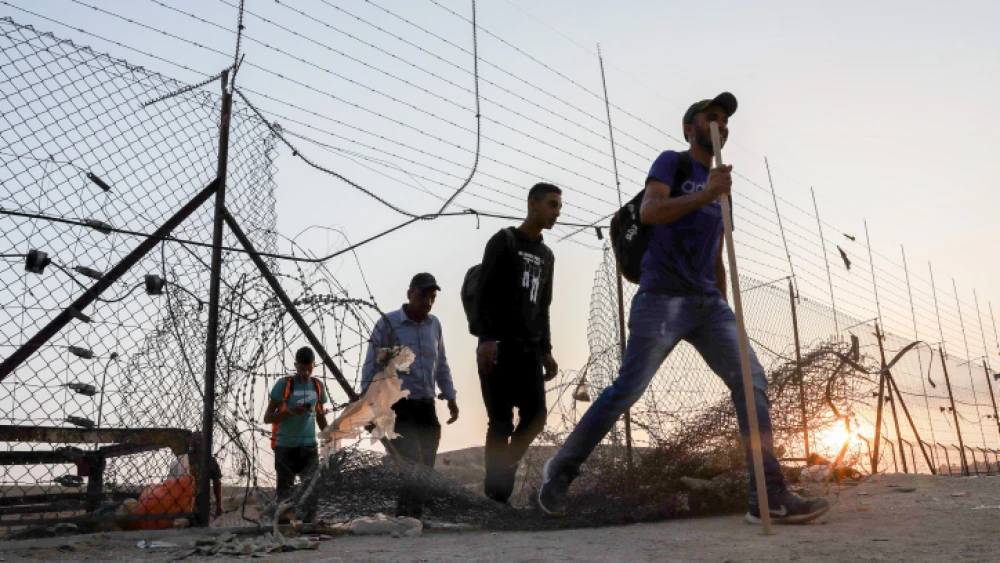
Thousands of Palestinian workers are illegally crossing the Judea and Samaria security barrier every day to seek employment within Israel’s pre-1967 lines, in defiance of a blanket entry ban imposed in the wake of Hamas’s Oct. 7 massacre.
Citing officials in the construction industry, the Globes business daily reported Tuesday that large numbers of Palestinian laborers continue to “enter Israel in different ways, of course not through the official border crossings, and are hired by contractors, even though employing them is effectively illegal.”
A spokesperson for the Israel Defense Forces confirmed that more than 2,900 illegal infiltrators have been arrested since January, many of them at construction sites along the seamline of the security barrier and in the Jerusalem area. Some were caught deep into pre-1967 Israeli territory.
An inquiry by JNS to the IDF about measures being taken to secure the Judea and Samaria barrier went unanswered as of press time.
After Oct. 7, Israel canceled entry permits for thousands of Palestinians. In addition, most foreign workers have fled the Jewish state, while many Israeli citizens have been called up for IDF service, leading to a situation where some 50% of building sites are at risk of being closed down.
In January, dozens of coalition lawmakers, including Economy Minister Nir Barkat, signed a letter calling on the government to “sy explicitly that no more Palestinian workers will be allowed to enter.”
“Besides our security obligation, we also have a moral duty—we are not responsible for the livelihood of those who support the murder of Jews in the Land of Israel” added the missive, noting that some three in four Arab residents of Judea and Samaria hold favorable views of Hamas in the wake of its Oct. 7 massacre of around 1,200 people in Israel.
Prime Minister Benjamin Netanyahu, however, last week announced that he intends to present to his Cabinet a “limited pilot” for the re-introduction of Palestinian workers from Judea and Samaria.
The announcement prompted fresh condemnations from within Netanyahu’s Likud Party. “Do not repeat the mistake that preceded Oct. 7 by bringing in Palestinians who receive a million dollars for murdering a Jew. You can’t buy calm in security with money,” tweeted Barkat.
“Prime Minister, it is a grave mistake to approve the return of Palestinian workers to Israel after Oct. 7,” he added. “170 thousand workers from peaceful countries are only waiting for a government decision to come [to Israel], and they do not pose any risk to Israeli citizens.”
Last month, Jerusalem announced it would attempt to bring in 65,000 foreign workers from India, Sri Lanka and Uzbekistan to replace Palestinian construction workers and avoid a dramatic rise in real estate prices. At the time, an official in the Prime Minister’s Office declined to say whether the decision reflected a policy change going forward.


