Newsletter
Newsletter Support JNS

UTJ, Shas sign vote-sharing agreement as elections loom

Israel’s ultra-Orthodox parties join forces to maximize their results; party leaders promise “full cooperation” in the new government.

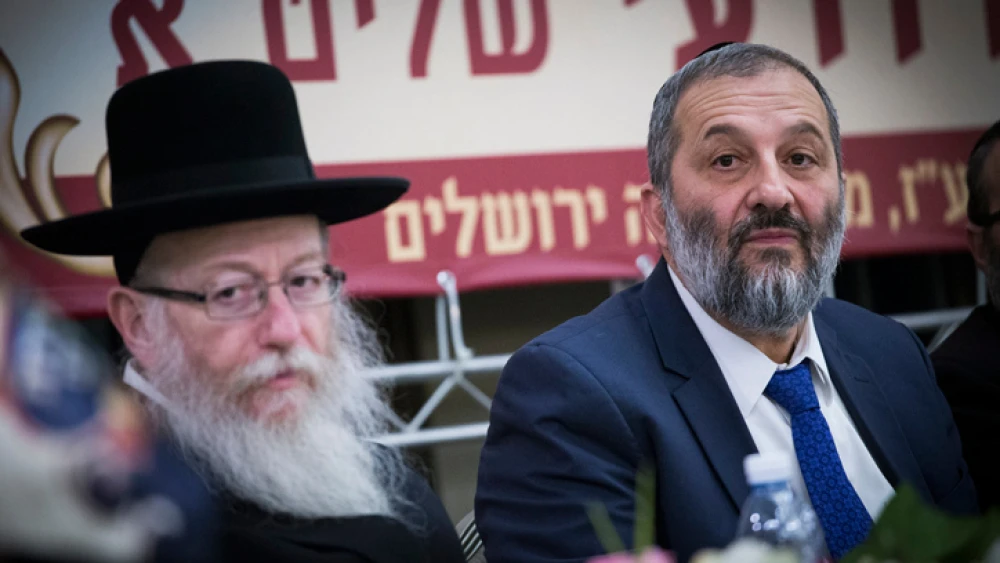
UTJ Party head Yaakov Litzman (left) and Shas Party leader Aryeh Deri attend a conference at the Ramada Jerusalem Hotel on Feb. 16, 2017. Photo by Yonatan Sindel/Flash90.

Israel’s ultra-Orthodox United Torah Judaism and Shas parties concluded a vote-sharing agreement on Tuesday and pledged to continue working together in the next Knesset “with full cooperation.”

The deal was signed by Shas leader Interior Minister Aryeh Deri and UTJ head Deputy Health Minister Yaakov Litzman.

Vote-sharing agreements are common in Israeli politics and a way that parties can pool surplus votes (i.e., votes that don’t add up to a full Knesset seat) to squeeze one more Knesset seat out of the “leftover” ballots.

For the Sept. 17 elections, the Likud has a vote-sharing agreement with Yamina; Blue and White has one with Yisrael Beiteinu; and the Labor-Gesher alliance will share votes with the Democratic Union.

Shas and UTJ are each predicted to win seven to eight seats in the election, according to recent polls.

Israel’s top diplomat said that it is “outrageous” to draw a moral equivalence between Hamas leaders and Israeli citizens.
The U.S. administration expects “conversation to continue” on Chinese revenue and dual-use exports benefiting Tehran, a senior U.S. official said before meetings in China.
“It’s a glaring double standard,” the New Jersey Democratic congressman, who is Jewish, wrote in the “New York Times.”
“The targeting of U.S. service members and partners will not go unanswered,” the U.S. State Department said.
One of six detectives to be awarded by the ADL told JNS of New York City’s recent changes to hate crime reports that “you can’t have, ‘Ok, this is a robbery and this is a ‘reported’ robbery.”
The Rafael chair says the system intercepted about 99% of 40,000 rockets, as he defends Israel’s war stance and says the Iran conflict set back Tehran’s nuclear program.